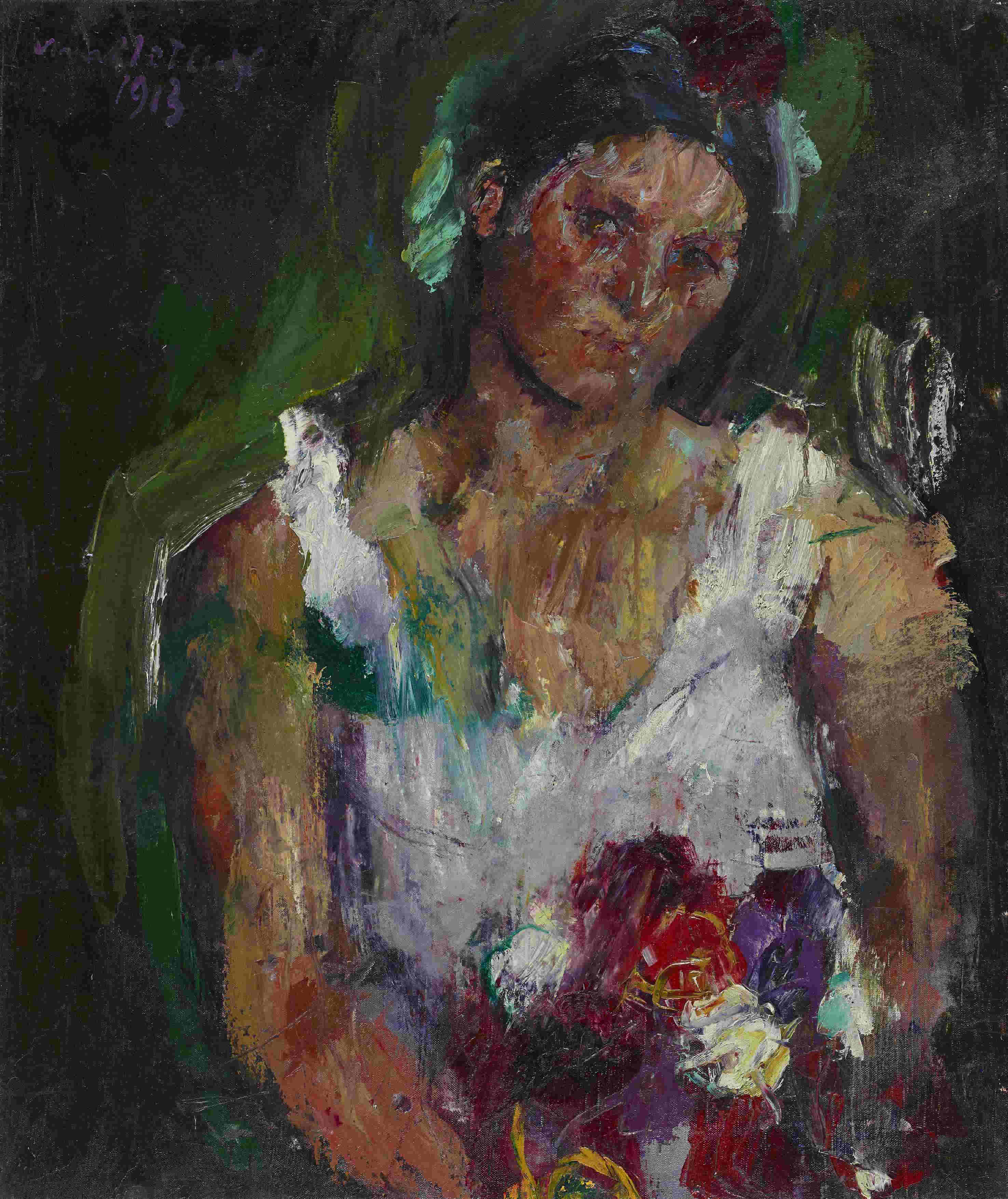
Die Neukunstgruppe and Friends of Schiele: Anton Kolig
The Artist’s Wife with Flowers (Die Gattin des Künstlers mit Blumen), 1913
Oil on canvas
71.5 × 61 cm
©Belvedere, Vienna
Anton Kolig painted The Artist’s Wife with Flowers in 1913 during a stay in Ambleteuse. The sitter is his wife Katharina Kolig (1889–1970), née Wiegele, whose presence marks the family connection between Kolig and Franz Wiegele. The painting belongs to Kolig’s early mature period, in which he consolidated a structural, compact handling of form and colour after leaving the Vienna Academy. Ambleteuse is a small coastal town in northern France, located in Pas-de-Calais on the English Channel, just north of Boulogne-sur-Mer, which explains the inscription “Ambleteuse / 1913” on the painting and indicates that Kolig was working there during that year.
Kolig (1886–1950) entered the Vienna Academy in 1904, where he studied alongside Franz Wiegele and Egon Schiele. Schiele’s dissatisfaction with academic instruction led to the formation of the Neukunstgruppe on 17 June 1909. The group opposed traditional teaching methods and rejected conventional aesthetic expectations. Wiegele was one of its founding members. Kolig did not join the association, but he remained closely connected to its members through shared training, shared criticism of academic norms and his continued friendship with Wiegele. Notably, it was Gustav Klimt and Carl Moll who were so impressed by Kolig’s work at a 1911 Hagenbund exhibition that Klimt personally secured the travel scholarship that enabled Kolig’s pivotal journey to France. Kolig’s early influences include Michelangelo, Hans von Marées and Lovis Corinth, whose monumental approach to the human figure and colour structure informed his development.
While this French period was highly productive, it ended abruptly. With the outbreak of the First World War in 1914, Kolig was forced to flee France hastily, leaving almost all his newly created Parisian and Ambleteuse canvases behind—the vast majority of which were subsequently lost. After the war, Kolig settled in Carinthia, where he became a central figure in the Nötscher Kreis. This informal circle included Franz Wiegele, Sebastian Isepp and later Anton Mahringer. Their connection was defined by regional proximity, shared modernist interests and the exchange of ideas rather than a formal program. Kolig’s marriage to Katharina Wiegele reinforced the link between the families and contributed to the cohesion of the group. Their work from the 1920s shows parallel developments in figuration, colour structure and the treatment of the human figure within a restrained modernist vocabulary.
Kolig produced male nudes, still lifes and portraits throughout his career, often on a monumental scale. Some of his works reflect his personal religious sense. During a bombardment in 1944, two-thirds of his remaining oeuvre was tragically destroyed, leaving only a fraction of his lifelong production intact. Today, Kolig is represented in major collections, including the Austrian Gallery Belvedere, the Military History Museum, the Leopold Collection, the Essl Collection and the Art Gallery of Carinthia.
The 1913 portrait stands at the beginning of his artistic trajectory. Painted before the Nötscher Kreis fully emerged, it reflects Kolig’s departure from academic conventions and his alignment with the modernist tendencies visible in Wiegele’s work from the same period. The painting serves as a vital document of Kolig’s early independent development and of the familial and artistic connections that later shaped the Nötsch circle.
Leave a Reply