
Same room. Same model. Same hour.
Vienna, 1907.
Take a very close look at these two drawings. Do you see it?
It is exactly the same man, in exactly the same pose. On the left is Schiele’s interpretation; on the right is Peschka’s. Now you understand why, because you see the exact same model. This is not strange when you consider that Egon Schiele and Anton Peschka followed the same art education in Vienna in 1907 at the Akademie der bildenden Künste. But what is so incredibly nice and special to see, is the realization that you are literally looking at the result of one specific lesson.

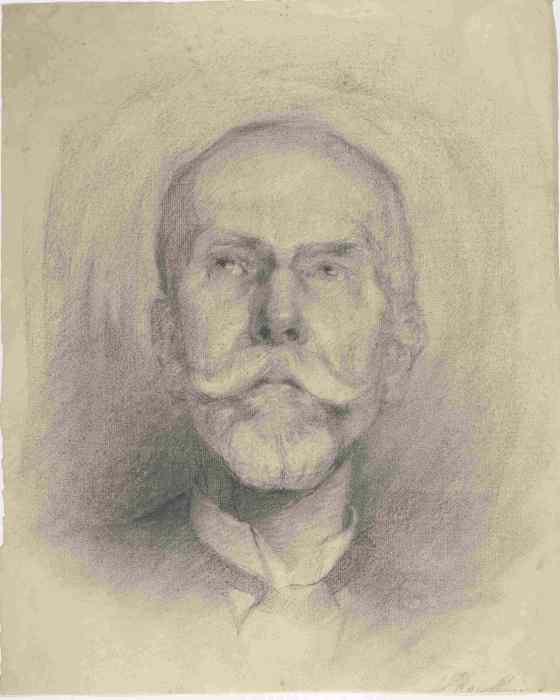
Imagine the classroom: 29 April 1907. Schiele and Peschka sit shoulder to shoulder on their wooden stools. The elderly model takes his place and holds his gaze. No one speaks; only the scratching of pencil and charcoal on paper can be heard. Both follow the same instruction, both work through the same shadows, but they each produce a completely distinct result. At that moment, they couldn’t have imagined that nearly 120 years later, we would be placing their drawings side by side.
Look closely at the physical evidence left on these sheets. You can almost trace where their stools were placed. Egon Schiele, on the left, sitting slightly to the right, captures the man with heavy, dramatic charcoal, demanding space on a grander sheet (53.5 × 38.1 cm) and carving out deep, dark shadows. Anton Peschka, on the rigt, sitting just feet away, views the model from a more frontal, slightly lower angle. He reaches for a pencil, mapping the man’s features with a softer, almost silver-toned academic precision on a tighter page (42 × 34.2 cm). You can clearly see they looked at the model from just a slightly different angle!
This connection did not end with their training. The two hung out and studied together during their student days, and of course, they remained close friends throughout their lives. Furthermore, their bond officially became family when Anton Peschka later married Egon’s sister, Gerti, and together they had four children.
Seeing them together shifts our understanding of their early years. These studies were never meant to be compared. Yet, more than a century later, when you see these two portraits side by side, you are not just looking at two academic studies. You are looking at the tangible, physical evidence of the very beginning of their shared lives—two young hands moving across paper at the exact same moment, still holding the breath of a single April day in 1907.
Leave a Reply