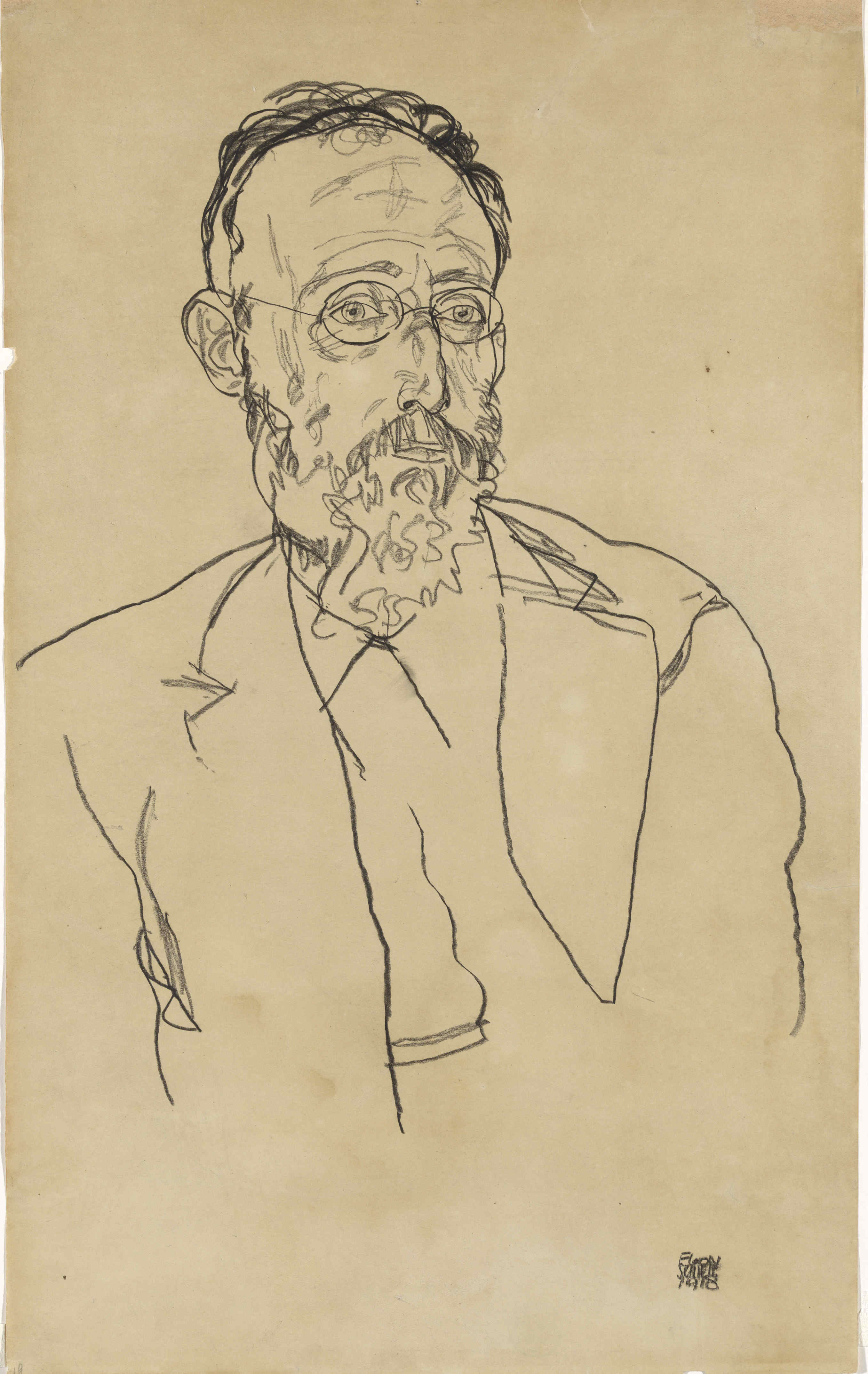
Egon Schiele:
The philosopher Heinrich Gomperz, 1918
Chalk drawing
46.7 × 28.8 cm
©Wien Museum
(Kallir d2463)
Heinrich Gomperz (1873–1942) was one of Vienna’s most distinctive philosophers in the early twentieth century. Shaped by an unusually broad academic background—spanning law, church history, classical philology, and philosophy—he completed his doctorate under Ernst Mach in 1896. This placed him close to the empirio‑critical tradition. From 1905 onward, he taught at the University of Vienna, becoming a full professor in 1924. His unique theoretical position, Pathempirismus, rested on the idea that all knowledge arises from the immediate experience of consciousness, blending rigorous historical scholarship with a modern psychological approach.
While Gomperz maintained contact with thinkers around the famous Vienna Circle, he always remained an independent voice with a strong historical focus. However, his prominent career was abruptly disrupted in 1934, when he was forced into retirement by the Austrofascist regime for political and racial reasons. He emigrated to the United States the following year, teaching at the University of Southern California until his death in Los Angeles in 1942.
Created in 1918, Schiele’s drawing belongs to his very last, mature period—a time when his draftsmanship shifted from the raw, jagged distortion of his early expressionism toward a new, disciplined clarity. The portrait presents Gomperz with a quiet, concentrated seriousness that perfectly reflects the introspective nature of his philosophical work. Schiele’s economy of line emphasizes the tension between intellectual focus and emotional sensitivity, brilliantly capturing a thinker who bridged classical scholarship and modern theories of consciousness. The result is a direct, unembellished portrait that remains deeply attentive to the inner life of a man rooted in Vienna’s Golden Age.
Leave a Reply