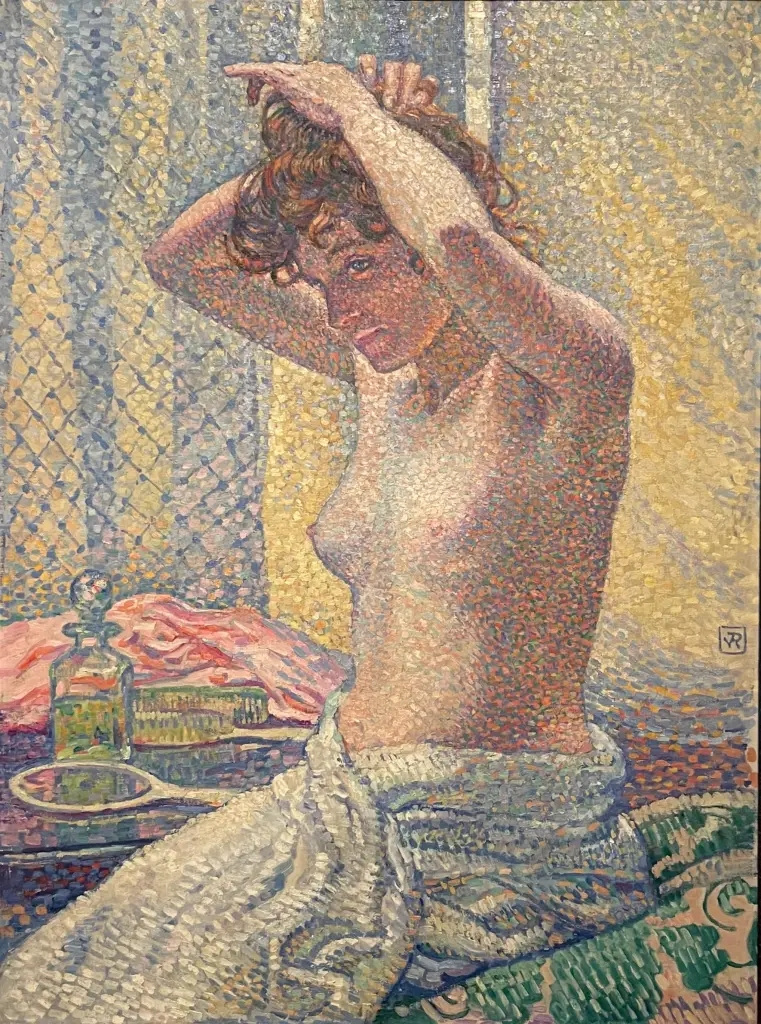
The Belgian connection: Théo van Rysselberghe
Torso of a Nude at Her Toilette (Torse de nu à sa Toilette), 1905 Oil on canvas
41 × 18 cm
Private collection
Van Rysselberghe paints a woman at her toilette without turning the moment into a performance. She sits half‑draped, arms raised as she gathers her hair, surrounded by the small objects that make up a morning routine: a comb, a bottle, a cloth, a mirror catching a thin pulse of light. Nothing is staged. Nothing is dramatized. It’s simply a private act, seen without fuss, rendered in the tight, vibrating pointillist touch that still defines his work in these years.
The painting is also known under the alternative title Woman at Her Dressing Table (Femme à sa toilette), used in several exhibition catalogues and private‑collection listings. Both titles refer to the same work.
By 1905, Van Rysselberghe is easing away from strict pointillism. The dots remain, but they’re no longer a rigid system. They soften, shift, and open up the surface. Light filters through patterned curtains, breaking into small fragments of color. The body is built with measured touches, never mechanical, never cold. He keeps the palette restrained, the background quiet. Everything is focused on the simple fact of a woman in the middle of her routine.
Before 1905, Van Rysselberghe painted very few nudes. That year marks a clear shift. He begins exploring the genre with a calm, observational curiosity: women bathing, drying themselves, lying in the shade, combing their hair, adjusting a towel, standing before a mirror. Not erotic, not symbolic — just bodies in real situations, doing real things. Torso of a Nude at Her Toilette fits squarely into that turn. It’s a nude that doesn’t pose. It doesn’t perform. It simply exists, and Van Rysselberghe pays attention.
This quiet directness links back to his years with Les XX, the Brussels avant‑garde group that opened Belgian art to Seurat, Signac, Whistler and Redon. Van Rysselberghe was the bridge between Paris and Brussels — the one who brought Seurat’s divisionism north and defended it fiercely. He arranged for Seurat’s work to be shown in Belgium, pushing the group toward a new, scientific approach to light and color. By 1905, that discipline has relaxed, but the underlying structure remains. You feel it in the way the skin is built, in the way the room breathes, in the way the light breaks into small, deliberate fragments.
Leave a Reply