The Vienna University Scandal: Klimt’s Lost Faculty Paintings
The commission known as the Faculty Paintings is traditionally discussed as a trilogy of works by Gustav Klimt: Philosophy, Medicine, and Jurisprudence. These canvases corresponded to three of the core academic faculties of the University of Vienna in the 1890s.
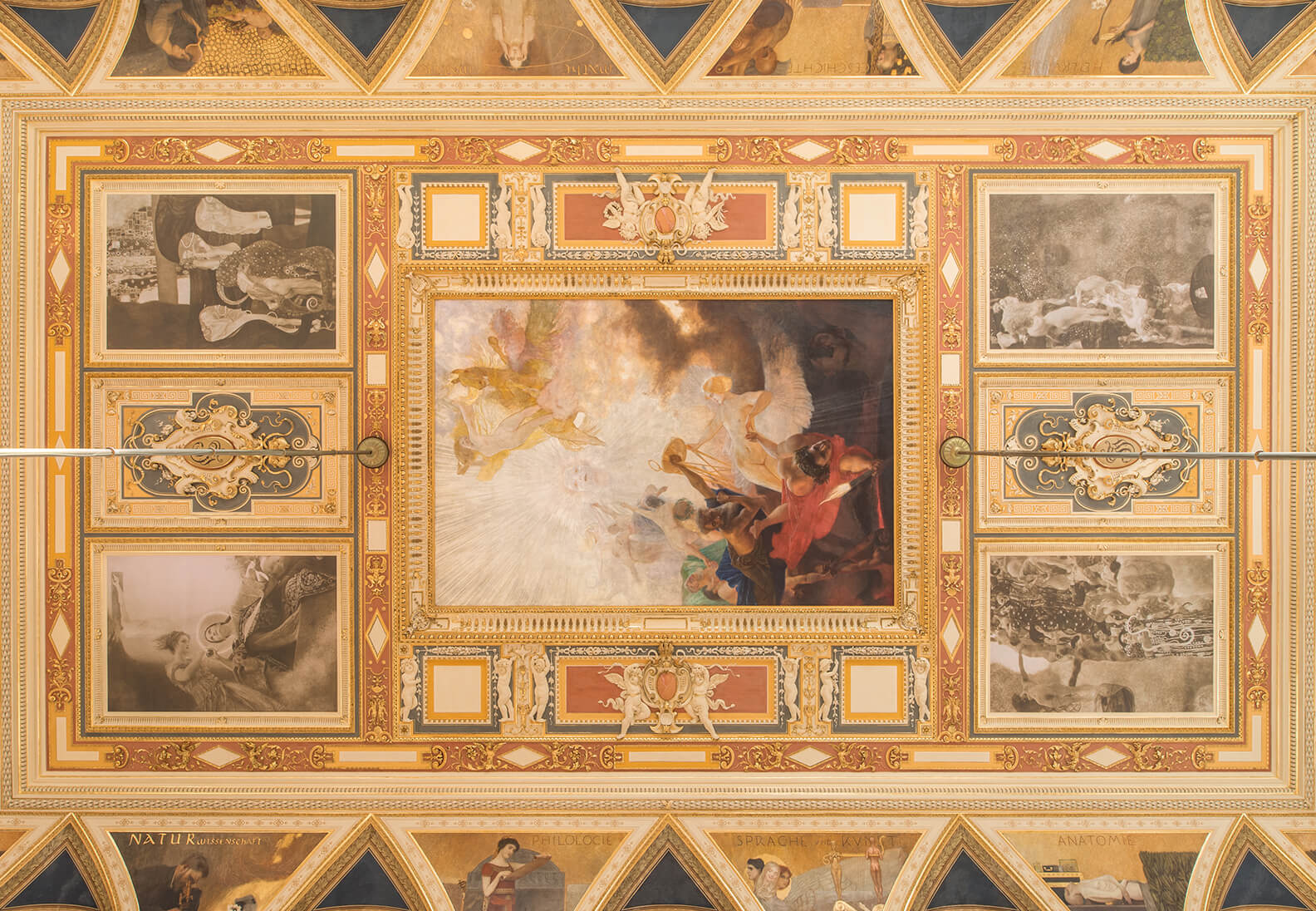
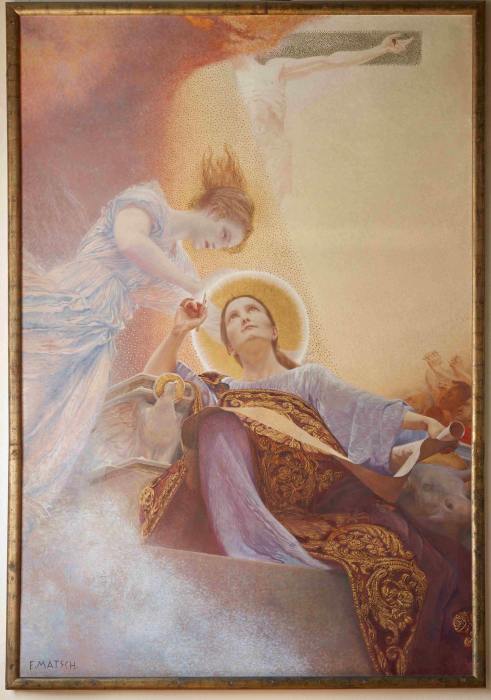
Looking at the historical record, however, the full decorative program for the university’s Great Hall consisted of five monumental panels. The project was shared between Gustav Klimt and Franz Matsch. While Klimt developed his three panels, Matsch produced the corner panel Theology (1904) and the 8-meter-long central panel, The Triumph of Light over Darkness (1905). Within the planned program, Matsch’s The Triumph of Light over Darkness was simply meant to supply the cycle’s central allegory of knowledge overcoming ignorance. This central canvas formed the physical and thematic core of the entire ceiling, designed to dominate the ceiling. Matsch’s two paintings were intended to be permanently installed alongside Klimt’s to form a single, integrated program.
Shift in Style and University’s Response
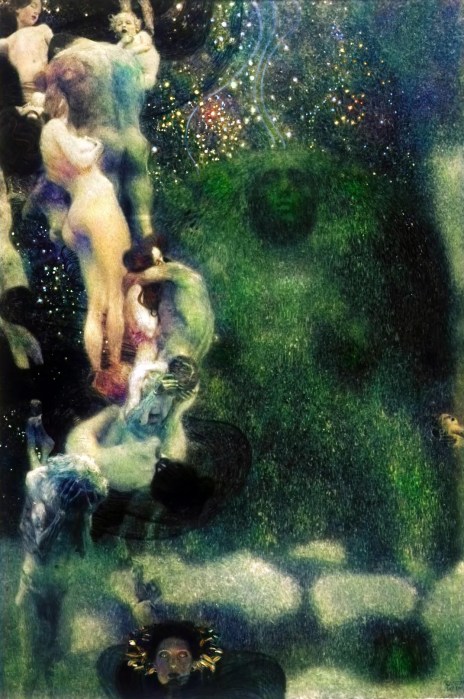
When the Ministry of Education granted the commission in 1894, Klimt was celebrated for his historicist, academic style, such as the architectural decorations he had completed for the Kunsthistorisches Museum and the Burgtheater. The university board expected traditional, clear allegories affirming human progress, rational thought, and the triumphs of science and law. The earliest sketches and documented trial compositions from mid 1890s, preserved in a small group of photographs, show that Klimt initially remained within the expected academic allegorical structure before the later break became unmistakable. However, the Faculty Paintings completed between 1899 and 1907 departed sharply from these early expectations.
Philosophy:
Rather than depicting intellectual triumph, Klimt painted figures drifting in a dark space, representing the cycle of birth, life, and decay. The university expected a depiction of knowledge; Klimt presented human doubt.

Medicine:
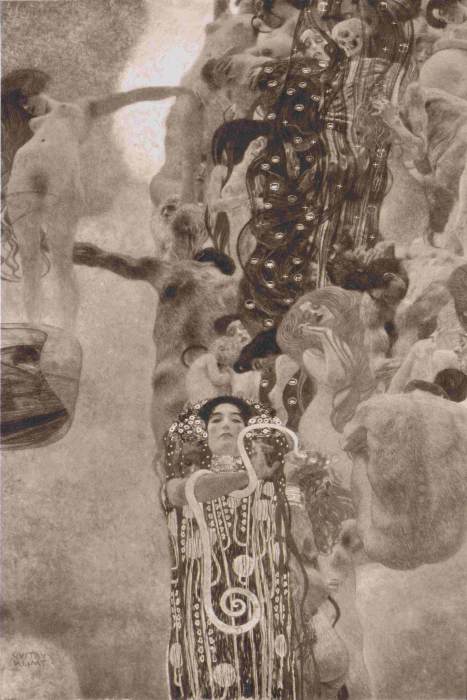
The debate intensified with the second panel. Instead of showing the victory of doctors over illness, Klimt focused on the the vulnerability of the human body to illness and death. A column of naked bodies, including a pregnant woman and a skeleton, filled the central field. At the bottom, Hygieia, the goddess of health, turned her back on humanity. Critics attacked the painting for its raw nudity, labeling it offensive and pornographic.
Jurisprudence:
The final panel was the furthest departure from academic expectations. Justice was not shown as a balanced ideal. Klimt turned the canvas into a depiction of guilt and punishment, showing an old man trapped in the grasp of a large creature, surrounded by the Furies.

During the years spent working on the canvases, the physical scale of the project presented an immense challenge. Klimt’s three panels were monumental, each measuring 4.30 meters in height and 3.00 meters in width —requiring him to rent a separate high-ceilinged studio just to paint them. Yet, even these were visually anchored by Matsch’s central panel, which had to be large enough to span the middle of the Great Hall, which measured an impressive 8.00 meters in length and 4.50 meters in width.

During this period, Klimt’s artistic direction changed radically. In 1897, he co-founded the Vienna Secession, breaking away from the conservative academy. Influenced by Symbolism and contemporary psychological ideas, he moved away from academic imagery toward Symbolist themes. When the panels were progressively unveiled, the university committees and the public rejected them.
This initial backlash soon developed into formal opposition. A formal petition signed by 87 university professors demanded that the works be rejected, stating that the paintings were entirely unsuitable for the institution.
The Decision to Withdraw (1900–1907)
Klimt worked on his three assigned panels between 1900 and 1907. As each canvas was shown at the Vienna Secession exhibitions, the institutional backlash grew.
Exhausted by the ongoing bureaucratic and public conflict, Klimt made the decision to withdraw from the state commission. Backed by his wealthy patron August Lederer, he repaid the government advance of 30,000 crowns out of his own pocket.
Klimt’s frustration with the establishment is well documented. Following his withdrawal, he stated openly:
“To Hell with the State… I refuse all state support, I want nothing to do with it.”
His resistance was not just verbal; when the ministry sent removal staff to retrieve Jurisprudence, historical accounts note that Klimt refused to hand it over until all the financial transactions regarding his repayment were fully completed. This definitive move ended his involvement with public state commissions for the rest of his career, and he focused entirely on private portraits and landscapes.
Plunder, “Aryanization”, and the Unresolved Fate of Schloss Immendorf
Following Klimt’s withdrawal, Philosophy and Jurisprudence were purchased by August and Serena Lederer. The Lederers were a Jewish industrialist family who became Klimt’s most significant private patrons. Medicine was initially acquired by Klimt’s colleague Koloman Moser before eventually entering the collection of the Austrian Gallery.
The fate of the paintings changed following the Nazi annexation of Austria (Anschluss) in 1938. Because the Lederer family was Jewish, their art collection was targeted by the regime. The family was forced into exile, and their property was seized through the process of “Aryanization” (Arisierung).
The Gestapo took control of the Lederer collection in 1940. Under the authority of the Institut für Denkmalpflege (the Monuments Authority), the confiscated artworks were processed under the official term “Safeguarding” (Sicherstellung), a bureaucratic term used to cover art plunder as protective custody.
The paintings were briefly brought back to Vienna in 1943 for a retrospective exhibition organized under National Socialist authority. After the exhibition, as Allied bombing raids intensified over the capital, the three Faculty Paintings, alongside other Klimt works from the Lederer collection, were moved to Schloss Immendorf in Lower Austria for storage.
What happened to the collection in the final days of the war remains unresolved. Official reports state that on May 8–9, 1945, retreating German SS forces deliberately set fire to Schloss Immendorf to prevent the repository from falling into the hands of the advancing Soviet Army.
However, uncertainty and historical debate persist regarding whether all the paintings stored inside were actually destroyed in the fire. Reports suggest that looting took place before the fire was set, or that specific artworks may have been evacuated by fleeing officers. To this day, no physical evidence has proven the destruction of every single canvas, yet neither the Faculty Paintings nor the missing pieces from the Lederer collection have ever been found. Today, they survive officially only through the archival black-and-white photographs.
The Missing Colors and the Digital Reconstruction
The true color appearance of Klimt’s three panels remains undocumented. The single historical exception is a specific fragment of Medicine featuring the figure of Hygieia, which exists in color due to a high-quality collotype plate published by Max Eisler in 1931, alongside a surviving oil sketch.

To address this loss, a collaboration between the Belvedere Museum and Google Arts & Culture in 2025 used artificial intelligence to analyze historical descriptions and existing paint fragments, digitally recoloring all three missing works.


This digital project raised significant questions within the art historical community. Jane Kallir, a prominent expert on Austrian art, openly challenged the validity of the AI results. Kallir argued that the algorithm’s output resembled “cartoons” of Klimt paintings, noting that they lacked the nuanced tonal transitions and texture that defined Klimt’s actual brushwork. The project makes clear that a statistical model cannot reconstruct an artist’s decisions, and the certainty of Klimt’s color relationships remains lost.
Klimt’s Artistic Response: “Goldfish”
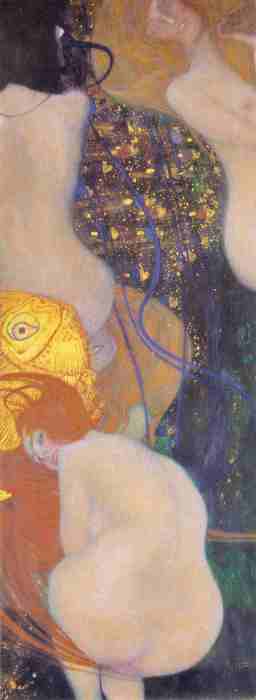
As a direct, visual response to the political uproar surrounding the commission, Klimt painted Goldfish (1901–1902). Originally titled Against My Critics, the canvas featured a prominent female figure turning her backside directly toward the viewer—a deliberate gesture directed at the university professors and art critics who had condemned his work.
Leave a Reply