Egon Schiele:
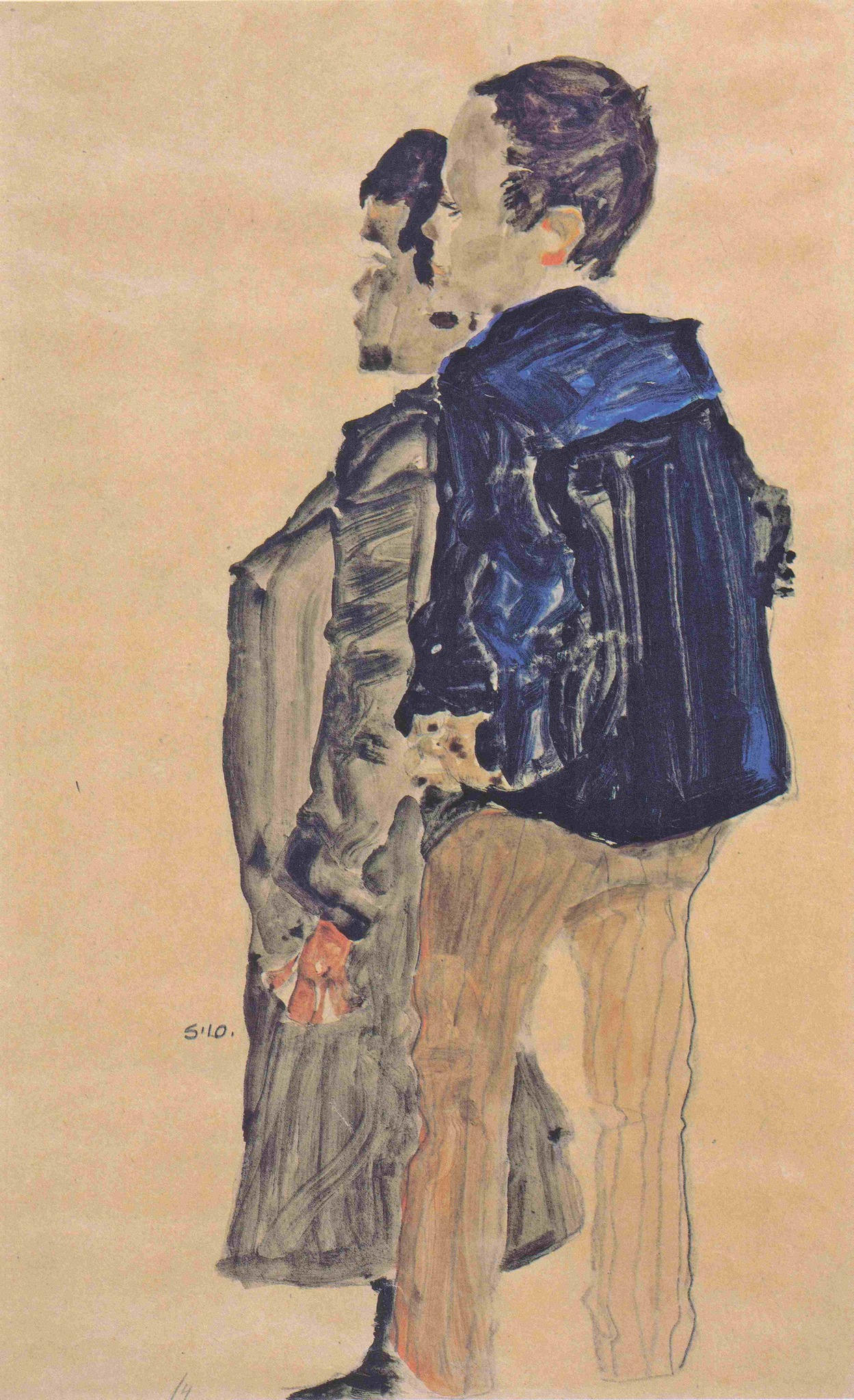
Two Children in Profile Facing Left (Zwei Kinder im Profil nach links), 1910
Gouache, watercolor and pencil on paper
44.2 × 31.2 cm
Graphische Sammlung Albertina
(Kallir d464)
Schiele draws these two children in 1910, at the moment his work begins to shed academic politeness and move toward something more exposed. The bodies stand close to the surface, almost pressed forward, as if he refuses to give them the comfort of pictorial distance. The contours are quick and tense, cut with that early Schiele edge that makes even a simple profile feel unsettled.
Schiele drew children often, especially in 1910, 1911 and 1912. Not because he was looking for innocence, but because they were simply there. These were street children — kids who spent their days outside, unsupervised, hardened by a city where poverty, casual violence and abuse, and rough labor shaped daily life. For them, stepping into Schiele’s studio wasn’t unusual. It was a warm room, a curious young artist, a coin, a piece of bread. They came and went freely. Studios in 1910 weren’t sealed professional spaces; they were porous, half‑public rooms where neighbors, workers and children drifted in and out without ceremony.
And these kids had little sense of shame. They lived in cramped apartments, washed in shared courtyards, relieved themselves wherever they needed to, changed clothes when it suited them, and barely noticed who was watching. Privacy wasn’t part of their world. So when Schiele asked them to sit, or even to undress, it wasn’t a rupture. It barely registered. For them, posing was easier than running errands, and being drawn by “Herr Schiele” was just another moment in a life already marked by exposure. They didn’t adjust their posture or hide their bodies; they acted as they always did — directly, bluntly, without self‑consciousness — and Schiele used that rawness without smoothing it over.
You see that bluntness here. The child in front stands with a slight forward lean, shoulders narrow, the profile sharp and unguarded. The second child, just behind, mirrors the direction but not the stance, creating a small tension between closeness and distance. Nothing is softened. Childhood isn’t idealized. Schiele isn’t trying to make them symbolic or charming. He’s recording the physical uncertainty of being young — bodies that haven’t yet learned how to present themselves, postures that shift between compliance and discomfort. The mixed media reinforces that tension: muted washes of gouache and watercolor cut by pencil lines that refuse to settle.
This isn’t provocation. It’s observation. A young artist looking directly at the world around him and not flinching, even when the subject is socially uneasy. Schiele wasn’t chasing drama; he was chasing truth. And here, that truth is small, tense, and unmistakably alive.
Leave a Reply