
Tracing and uncovering Karl Zakovsek, the artist painted by Schiele
For decades, standard art historical literature offered little more than brief acknowledgement that very little was known about Karl Zakovsek (1888–1965) after 1912. Because his name disappeared from public exhibition records following the early years of Egon Schiele’s Neukunstgruppe, authors generally noted his absence without investigating further, allowing unverified speculation about a tragic end or his total disappearance to fill the gap. However, through recent contact with Zakovsek’s grandson, I was able to examine his true biography and a significant body of surviving work. It allows us to actively follow the trail of an artist who simply chose a different environment.
Zakovsek was born in Vienna to Helene Zakovsek, who had moved to the capital from Slovenian Styria. Following his mother’s early passing from illness in 1889, the infant was taken into the care of Johann Schlechter, a master engraver who assumed full legal guardianship and raised him. His formal artistic training began at the Graphic Arts Training and Research Institute before he entered the Academy of Fine Arts Vienna in 1906.
Academic Origins and the Neukunstgruppe
There, he studied in the same painting class as Egon Schiele under Professor Christian Griepenkerl. Newly discovered studio drawings shared with me from the family archive strongly indicate that Zakovsek, Schiele, and Anton Peschka worked side-by-side during this academic period, sharing the exact same models, subjects, and early stylistic developments.
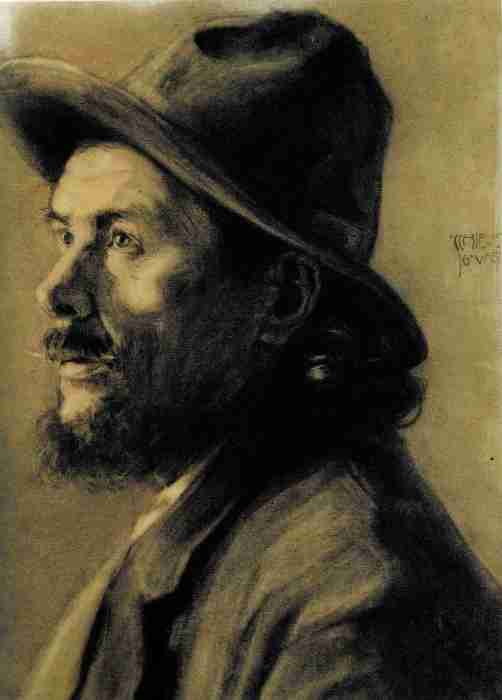

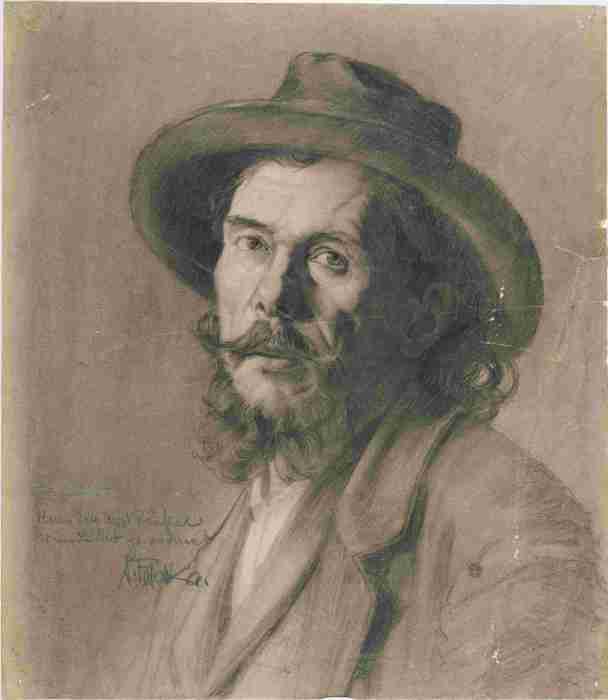
While Schiele would go on to develop a highly expressive, volatile technique in his later years, Zakovsek’s academic career was marked by steady recognition, winning the Academy’s prestigious Perspective Prize in 1907. This intense dialogue is visible not only in their structured charcoal studies, but also in their shared material experiments on colored papers.
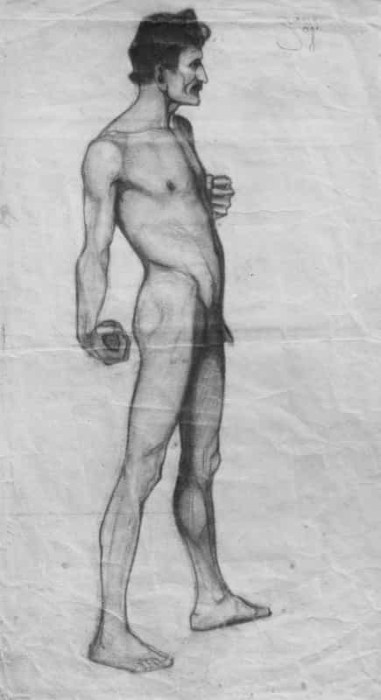
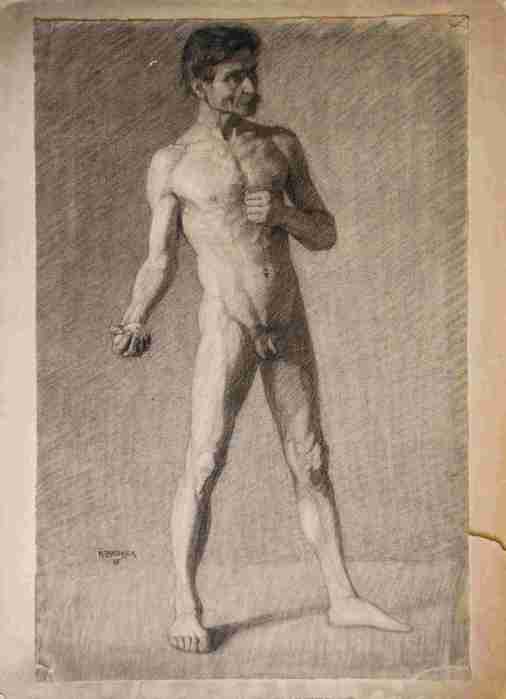
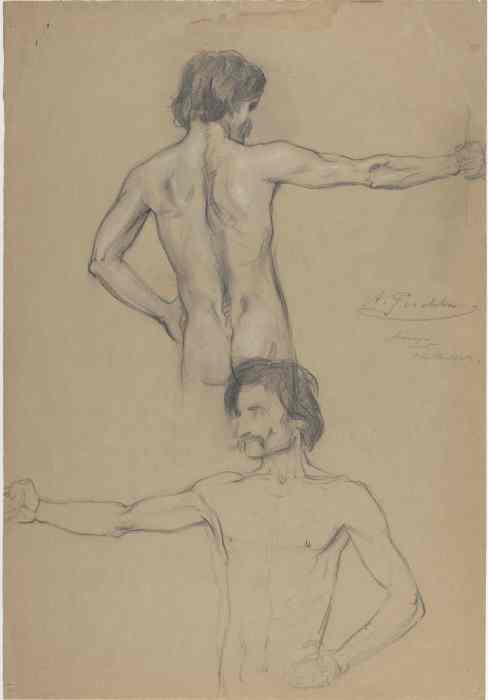
Their shared studio practice is further demonstrated by full-length nude studies where they recorded identical, complex poses from their respective vantage points in the classroom.
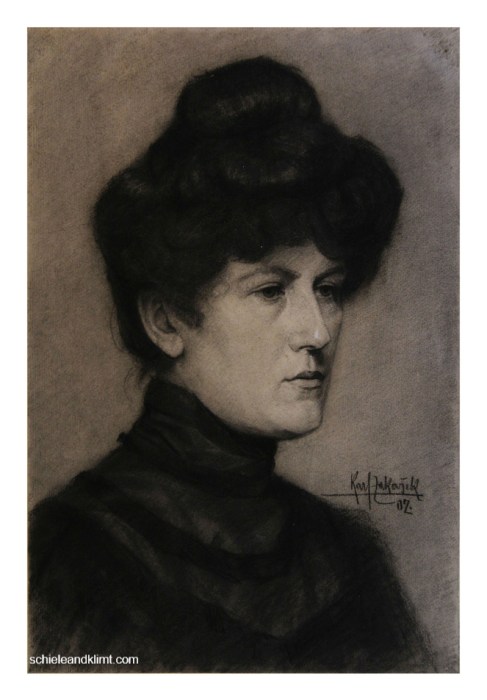
This creative synchronicity extended far beyond their mandatory classroom exercises. As late as the summer of 1907, both artists produced deeply psychological charcoal portraits that appear to depict the exact same female model, filtering her introspective features through their developing individual styles.

When Schiele broke away from the Academy to form the Neukunstgruppe in 1909 with other artists experiencing the same stifling, conservative climate that suppressed experimentation and personal vision. Schiele and the other young artists felt that the institution clung to outdated academic conventions, leaving little room for the new artistic impulses emerging in Vienna. Their departure marked a deliberate rejection of the Academy’s rigid hierarchy and teaching methods, and the founding of the Neukunstgruppe became their way of creating a space where modern art, individuality, and expressive freedom could flourish. Karl Zakovsek co-signed the founding document and participated in their public debut at Salon Pisko.
![Black ink, pencil on paper drawing/painting, [English title] Agreement (warrant) issued by the artists belonging to the Neukunstgruppe for the exhibition at Salon Pisko,](https://schieleandklimt.com/wp-content/uploads/2026/07/Verpflichtungserklarung-fur-eine-Ausstellung-der-Neukunstgruppe-im-Kunstsalon-Pisko-vom-17.-Juni-1909-Works-ALBERTINA-Sammlungen-Online.png)
Salon Pisko, 17 June 1909, signed by all members, including
Egon Schiele and Karl Zakovsek (bottom right) © Albertina
Their close creative dialogue during this era is preserved in a 1910 portrait of Zakovsek painted by Schiele (Kallir P160) and a rare coordinating invitation postcard that has been preserved as an original artifact within the Zakovsek family archive.
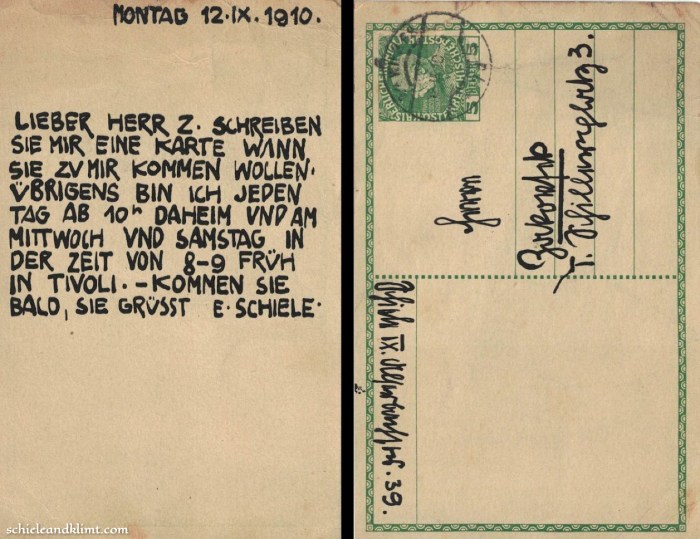
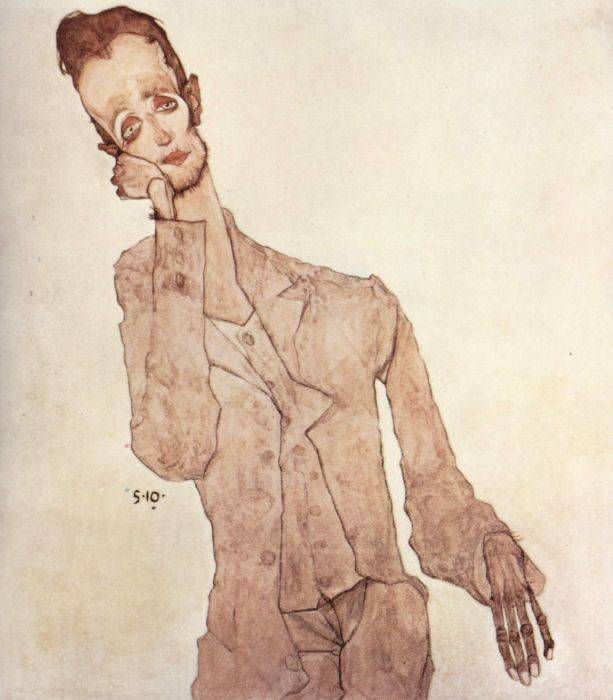
However, by 1911 their paths diverged due to different professional goals. Seeking financial stability and a career in art education, Zakovsek completed his degree and qualified as a permanent state drawing professor in 1912.

To protect the unblemished reputation required for civil service, he quietly withdrew from Schiele’s increasingly scrutinized public circle, focusing his draftsmanship on highly delicate, individual works that aligned closely with contemporary Secessionist aesthetics.

The Landscape of Bohemia
Zakovsek’s subsequent artistic output was determined by the academic calendar, restricting his painting campaigns to school holidays. Driven by a profound and lifelong affection for the region, he returned to Bohemia repeatedly throughout his career to paint, with documented campaigns starting as early as 1907, and continuing in 1909, 1912, 1937, and as late as 1946. During the summer of 1912, he traveled to Český Krumlov (Krumau) to document the town, driven by a broader fascination with the Bohemian landscape that he shared with many contemporary Viennese artists rather than a synchronized trip with Schiele. Bohemia remained a recurring and central theme within his landscape oeuvre, with his surviving painting of Krumau from this period synthesizing expressionist structural innovations into a softer, harmonious rendering of space.

The Autumn of 1918: A Fateful Intersection
After surviving service with the Red Cross on the Italian front during the First World War, Zakovsek’s resilience was tested to its limits by the 1918 Spanish flu pandemic. Among the unpublished family papers made available to me, the letters sent from Lavis in South Tyrol reveal the grueling ordeal he faced. Writing on Saturday, October 26, 1918, he described the situation to his parents:
“… I’ve been in bed with a high fever continuously since Tuesday – only today am I fever-free again, but of course I still have to stay in bed and currently have a severe bronchial catarrh. I’ve become completely exhausted and, unfortunately, very thin again due to the fever. I heard from my parents that so many people are dying on Rennweg – I’m glad I wasn’t at home. I hope to recover here soon, when, as hoped, the mild autumn weather and sunshine return for an extended period. Imagine, since Tuesday I’ve been living on nothing but red wine, coffee, tea, and soup. …”
Showcasing the same tenacity that characterized his mountaineering, Zakovsek fought off the high fever and finally recovered on October 31, 1918—the exact day Egon Schiele succumbed to the very same pandemic in Vienna. Following this fateful intersection of survival and loss, and a grueling foot-exodus from the collapsing Italian front, Zakovsek returned to a fractured post-war Vienna to resume teaching.
Post-War Practice and the Künstlergruppe Rosenhügel
Driven by a persistent need for studio space, Zakovsek co-founded the Künstlergruppe Rosenhügel in the 1920s, contributing 3,000 hours of physical labor to cast the bricks for his own home and workshop. This extraordinary physical stamina was rooted in his youth; Zakovsek was a lean but remarkably tough hiker and mountaineer who routinely carried his watercolor supplies on grueling mountain tours. This endurance even defined his unconventional 1922 wedding and honeymoon—a multi-day alpine trek with his young wife, Olga Toth, during which he produced two paintings.
Within this private sanctuary, alongside Olga and their twins, Zakovsek established a prolific but entirely localized practice. Far removed from the commercial gallery system, his post-war oeuvre consisted of post-impressionist still lifes, dense, structured botanical studies of his Rosenhügel garden heavily influenced by Vincent van Gogh and Gustav Klimt, and intimate family portraits.
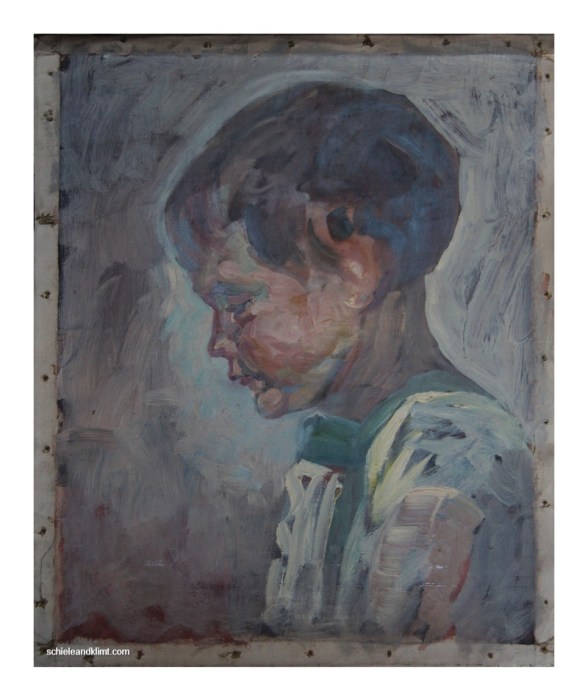
Although Zakovsek prioritized his role as an art educator, he continued to exhibit his work. In the autumn of 1928, his paintings were shown in Vienna in a group exhibition that included works by Ernst Ludwig Kirchner and other members of Die Brücke. His remaining exhibition record spans several decades, including regular entries with the Künstlerbund in the Burggarten glasshouse, the presentation of his seven-painting cycle The War in 1931, contributions to the local Rosenhügel exhibitions between 1936 and 1952, and an inclusion in the 1938 exhibition in Munich.
Late Landscapes and Restoring the Record
Zakovsek spent his late retirement traveling through Italy and painting Mediterranean coastal landscapes. He passed away following a heart attack in November 1965 at the age of seventy-seven, just as the early waves of the international Schiele revival began to touch his neighborhood in the Maygasse. Official registry data from the Friedhöfe Wien confirms his interment on November 19, 1965, at the Friedhof Mauer (Gruppe 54, Reihe 7, Nummer 9).
His artistic estate was never dispersed through the auction market; it remains intact across five families of his direct descendants. Pieced together from their private archives, his biography does more than just correct the record. It restores the actual life and career of an artist previously known primarily through a single portrait by Schiele.
This article was made possible thanks to the generous insights shared by the grandson of Karl Zakovsek, who kindly entrusted me with memories and details about his grandfather.


Leave a Reply