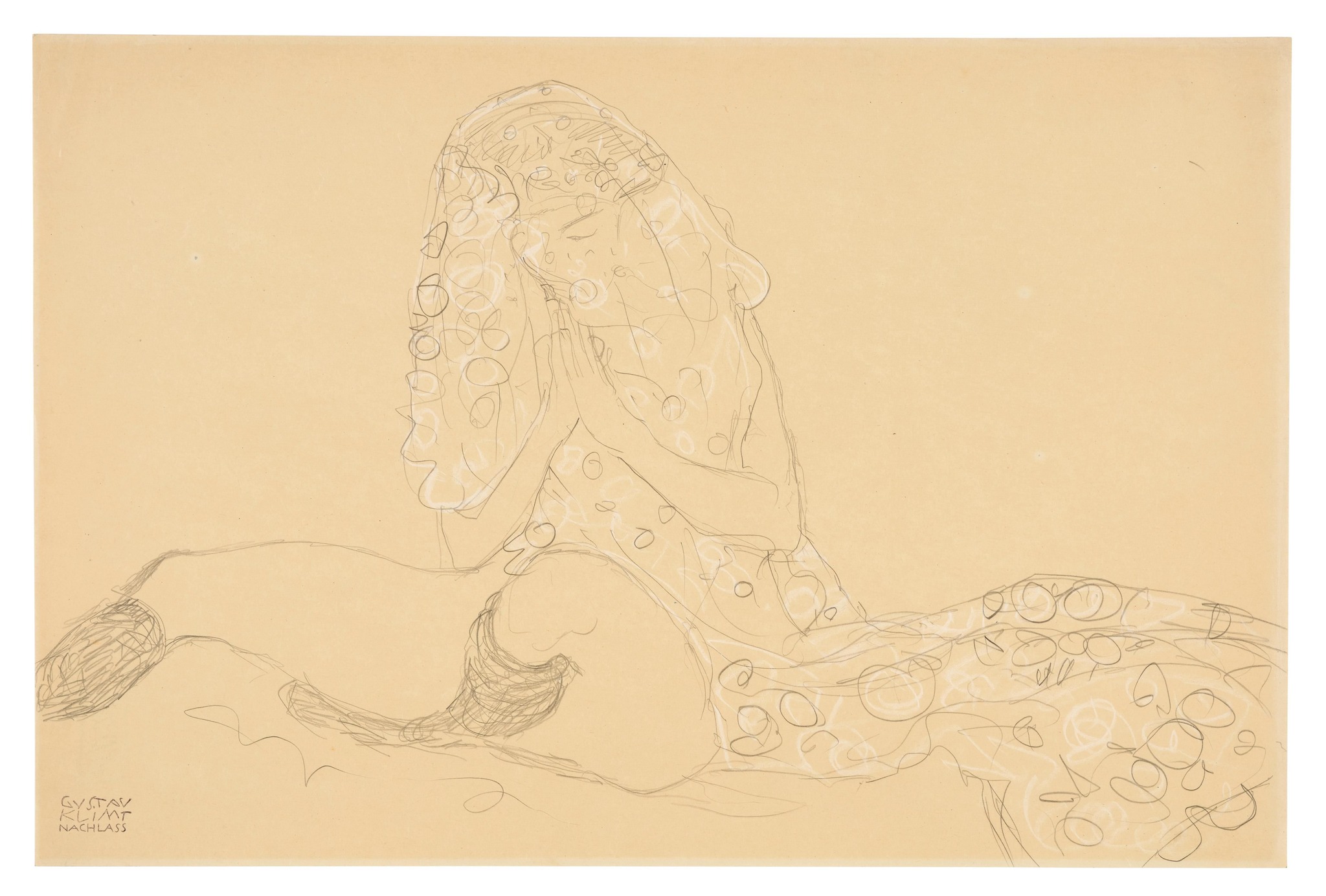
Gustav Klimt
Girl with a Veil (Mädchen mit Schleier. Studie für die „Jungfrau“), c. 1913
Pencil with white heightening
37 × 56 cm
Auctioned at Dorotheum in 2024 for EUR 117,000
(Strobl s2274)
The Architecture of the Veil
This large and quietly absorbing study belongs to the group of drawings Klimt produced around The Virgin (Die Jungfrau), a late allegory in which several women drift together in a circular movement of veils, flowers and intertwined bodies. Within that broader constellation, this seated figure occupies a more introspective sphere. She is placed low to the ground, her posture gently folded inward, her hands raised in a gesture that feels devotional yet suspended, as if she were listening to something just beyond the edge of the paper.
The veil that envelops her is not merely a covering but a luminous field: it softens the contours of her face, hides one eye, and lets the other emerge only faintly, creating a delicate interplay between presence and withdrawal.
Materiality and the Shimmer of Light
Klimt’s pencil work is unusually tender here. The lines are fine and searching, defining the body with a clarity that feels both intimate and unguarded. His execution of the white heightening is remarkably economical; with just a few minimalist chalk strokes, he catches the light, bringing out the shimmer of the veil and giving it a subtle, almost breathing transparency.
Beneath this airy surface, the lower part of the figure is rendered with a more grounded naturalism: the legs slightly apart, the dark stockings anchoring her to the earth. This contrast — the weight of the body below, the drifting translucence above — gives the drawing its emotional rhythm. It is a study, yet one that already contains the symbolic dualities Klimt explored in his late work: spirit and matter, purity and desire, distance and closeness.
From Toorop’s Symbolism to Klimt’s Dreamworld
The connection to The Virgin has long been noted, and Marian Bisanz‑Prakken’s observations on the broader group of preparatory drawings provide a helpful frame for understanding the emotional register of this sheet. But what distinguishes this particular study is the autonomy it achieves. Though conceived in relation to a larger composition, it stands on its own as a profound meditation on interiority. The figure seems to inhabit a threshold state, poised between awakening and retreat.
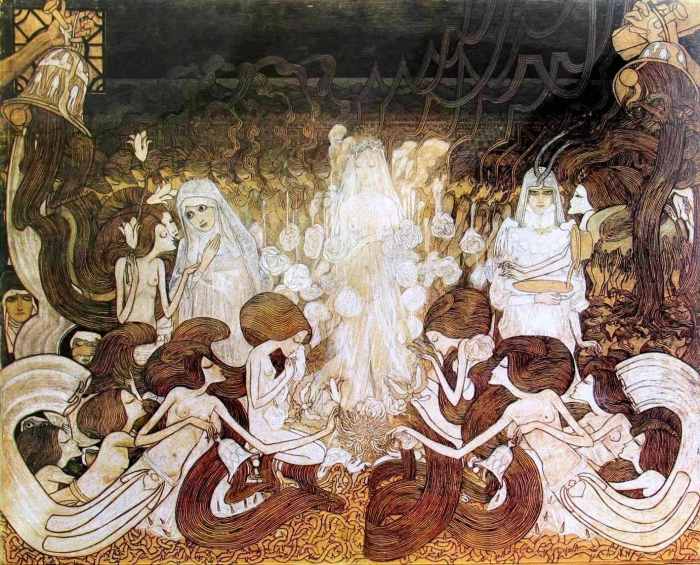
The closed eye directly echoes the linear, psychological atmosphere of Jan Toorop’s masterpiece The Three Brides (1893), an artwork that deeply captivated the Vienna Secession. Where Toorop used long, flowing veils to map telepathic and spiritual currents, Klimt transforms this visual language to depict the subconscious dream-state. It suggests a world turned inward, a moment of profound stillness within a swirling universe.
The Autonomy of a Masterpiece
What makes this drawing remarkable is the way Klimt allows the veil to become a landscape in itself. It drapes, pools, and glows, creating a soft architecture around the woman’s body. The hands, raised yet relaxed, introduce a quiet emotional tension: they are neither pleading nor resisting, but simply present, as if holding the space between the visible and the veiled.
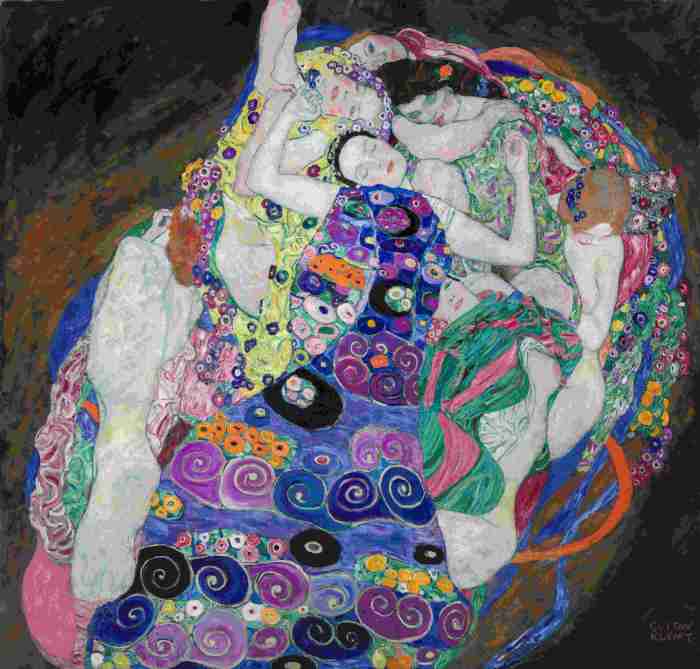
In the final, painted composition of Die Jungfrau (now in the National Gallery in Prague), this exact figure is integrated just to the right of the center within the floating human cloud. Wrapped in her stockings and pulling her knees toward her chest, her devotion shifts toward an awakening, sensual eroticism.
Yet, as an independent sheet, this drawing transcends its preparatory function. It is no surprise that this work was highly prized by August and Serena Lederer, Klimt’s most vital patrons, who held it in their legendary Viennese collection. Bearing the official Nachlass-Stempel on its reverse, the sheet has always been treated with the reverence of a finished masterpiece. The fact that this study commanded EUR 117,000 at Dorotheum in 2024 underscores its status not merely as a working sketch, but as a fully realized, autonomous masterpiece. In this balance of fragility and groundedness, the sheet reveals Klimt at his most subtle — attentive to the smallest shifts of mood, and able to let a single seated woman carry the emotional weight of an entire allegory.


Leave a Reply