The Belgian Connection: Théo van Rysselberghe
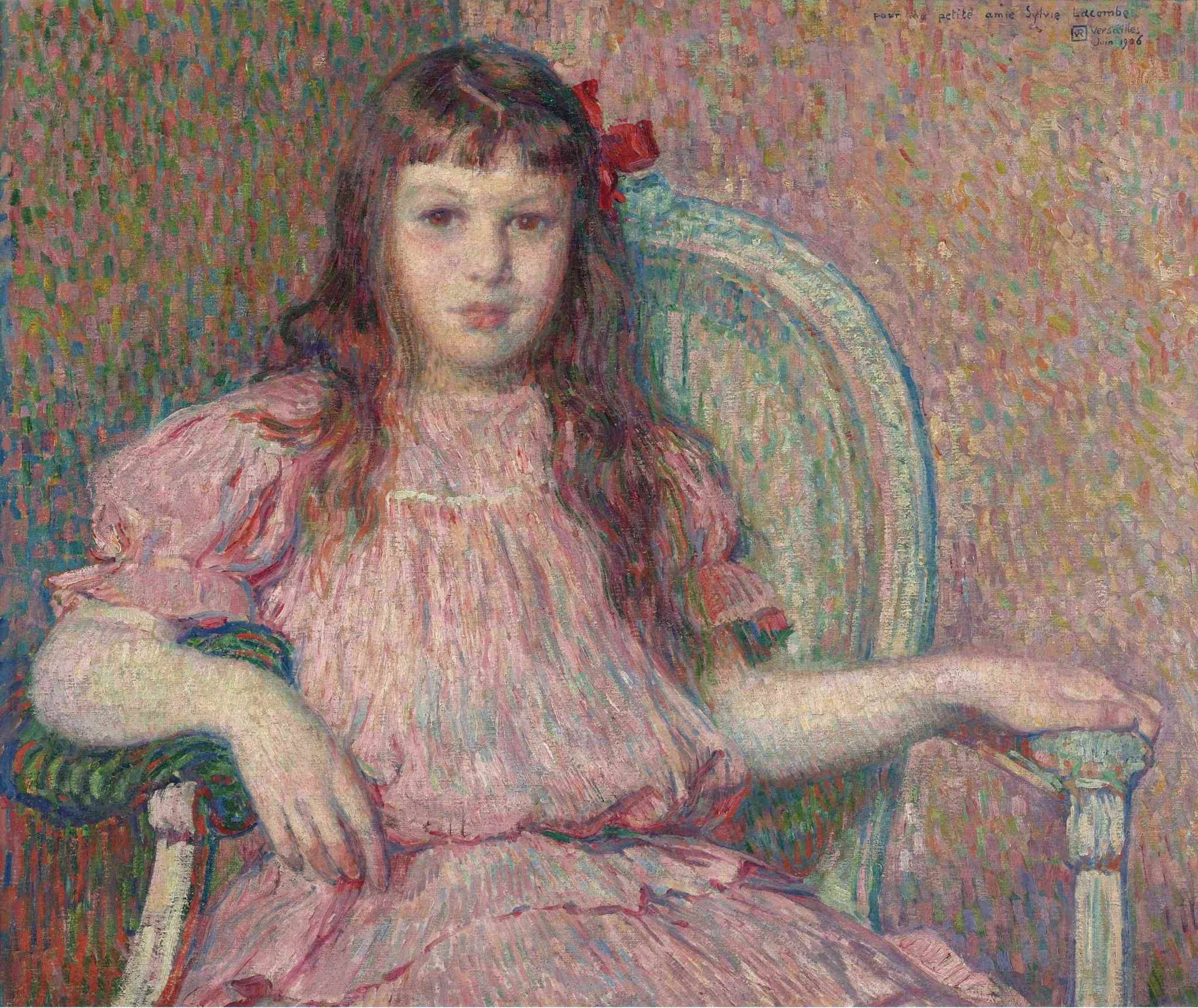
Portrait of Sylvie Lacombe (The Rose Ribbon) (Portrait de Sylvie Lacombe (Le Ruban Rose), 1906
Oil on canvas
58.4 × 71.7 cm (23 × 28 1/4 in.)
Auctioned at Sotheby’s in 2026 for $115,200 USD
Théo van Rysselberghe’s portrait of Sylvie Lacombe from 1906 carries an sense of quiet presence, as if the painter approached her not simply as the daughter of his friend Georges Lacombe, but as a young person whose inner life was beginning to take shape within an artistic world. She meets the viewer with a direct, unflinching gaze, a look that feels both curious and composed, suggesting a child accustomed to adults who observe closely, who talk about colour and form, who treat looking as a kind of discipline. Growing up in the orbit of Les Nabis — for her father Georges Lacombe was the group’s “Nabi sculptor” — Sylvie would have absorbed an unusual awareness of how people appear, how they hold themselves, how expression can shift with the slightest movement. Van Rysselberghe seems to recognise this, painting her not as a passive sitter but as someone already capable of a subtle self‑presentation, aware of the moment and willing to meet it.
Born in 1898, Sylvie was just eight years old when she sat for Van Rysselberghe, yet her life would quietly extend far into the late twentieth century, until 1984. In this portrait, there is a faint seriousness in her expression, thoughtful and steady, as though she is listening inwardly while offering her gaze outward. Her posture is calm, her features rendered with a delicacy that avoids sentimentality. In the softness around her mouth and the steadiness of her eyes, one senses a child who has grown up in rooms filled with canvases, pigments, conversations about Gauguin and Bonnard, and the gentle chaos of artistic households. Van Rysselberghe captures that atmosphere without describing it; it appears in the way she sits, in a slight reserve that feels less like shyness and more like early self‑possession.
The technique itself speaks to Van Rysselberghe’s position as a master exponent of Neo-Impressionism. Decades earlier, his artistic path had been permanently altered by a profound conversion to Pointillism after encountering Georges Seurat’s masterwork in Paris. By 1906, Van Rysselberghe had evolved beyond the rigid, scientific strictness of tiny dots, adapting the method into a freer, more fluid brushwork that remained deeply rooted in optical colour theory. The vibrant interplay of pinks, mauves, and soft reds juxtaposed against cool greens relies entirely on this pointillist heritage, allowing the colours to mix not on the canvas, but in the viewer’s eye. It is a calculated harmony that feels almost protective, as though these structured strokes are arranged to hold her in a calm, luminous space.
And then there is the rose-coloured bow, placed slightly off‑centre—a vivid, concentrated accent that anchors the composition without disturbing its serenity. It is a small but decisive gesture, a spark of intensity that reveals both the painter’s instinct for subtle drama and the child’s own individuality — a bright note that refuses to disappear into the background. In this portrait, Van Rysselberghe reveals how refined his art had become: letting a young sitter appear fully herself through a technique born of strict discipline, yet executed with mature, poetic freedom. Sylvie Lacombe remains permanently present through the painter’s gaze.
Leave a Reply