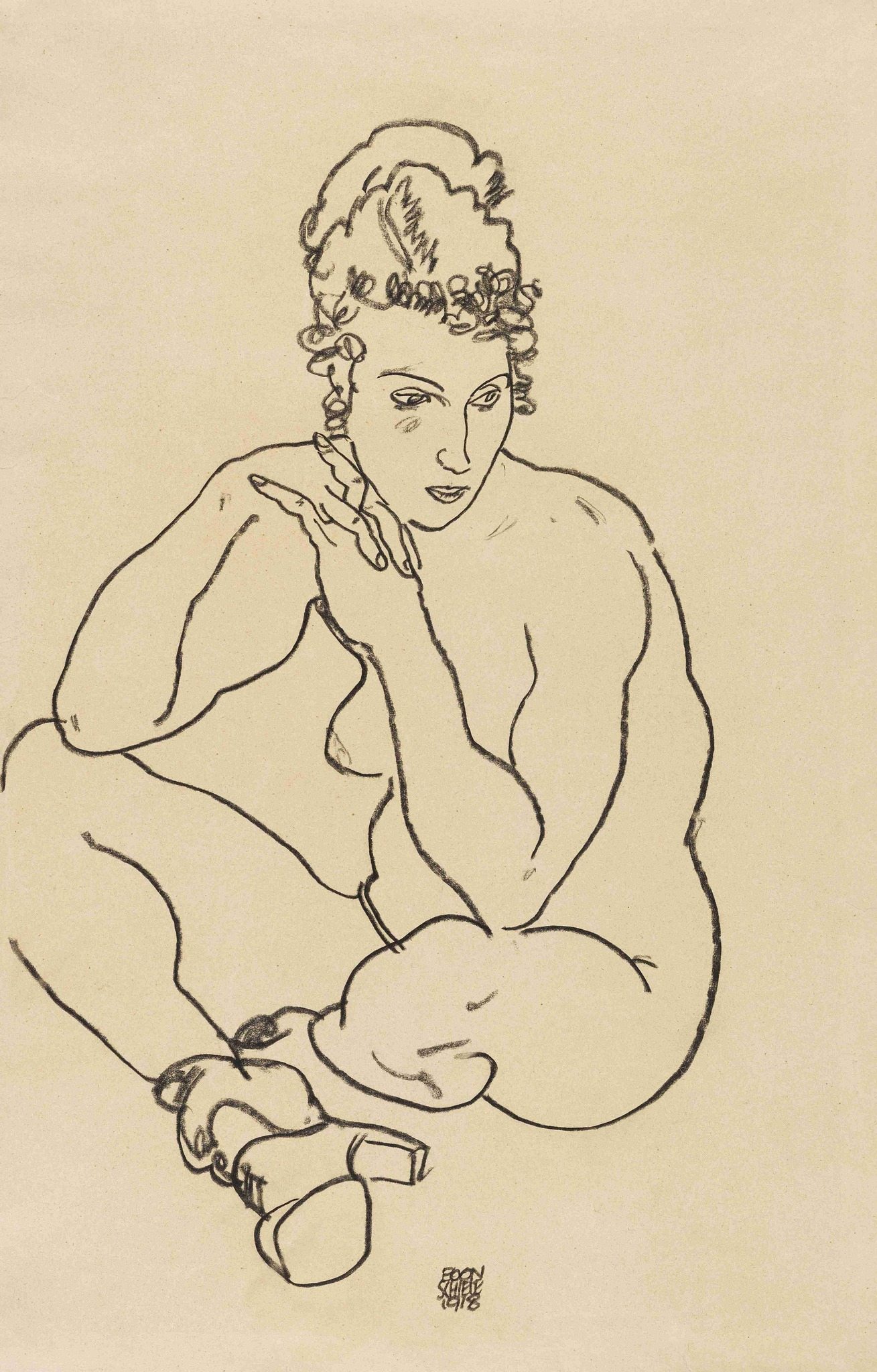
Egon Schiele:
Seated Female Nude, Arms Resting on Knees, Legs Crossed (Sitzender weiblicher Akt, die Arme auf die Knie gestützt, die Beine verschränkt) (1918)
Black chalk drawing
46.3 × 29.5 cm
Auctioned at Ketterer Kunst in 2021 for € 425,000
(Kallir d2314)
This late drawing from 1918 carries the quiet, inward intensity that marks Schiele’s final months. Those familiar with the sharp, fragmented work of his earlier career are often surprised by the formal shift in his style during his last two years. The characteristic hardness, the deliberate distortion, and the nervous, angular contours that defined his previous expressionism seem to have dissolved. In their place is a newfound softness: the lines move with a gentler pulse, as though Schiele no longer forces the contour but allows it to emerge from the pose itself. The figure sits close to the edge of the sheet, her arms resting on her knees, the body leaning slightly forward as if she has withdrawn into a small, private space of breath. The legs are crossed in a calm, protective gesture, and the black chalk follows that tension with a certain tenderness.
This stylistic transition was closely linked to changes in Schiele’s personal and professional life. His marriage to Edith Harms in 1915 and the circumstances of the First World War brought a greater sense of domestic stability and a sober awareness of human vulnerability. Consequently, his approach to the nude shifted. In these final years, the unclothed figure was no longer used to challenge bourgeois artistic boundaries, but became a subject for studying pure form, volume, and classical presence. With his growing success at the Vienna Secession, Schiele increasingly replaced his thin, sharp pencil lines with thick charcoal or black chalk, allowing for a more rounded, three-dimensional modeling of the human body.
The work remained in private hands for forty years, a long period of quiet stewardship that suits its intimate character. Another drawing from the same sequence, catalogued as Kallir d2315, is held by the Kunstmuseum Den Haag (formerly Gemeentemuseum), showing how Schiele returned to this pose in his final year with a particular sensitivity. What stands out here is how little he needs to suggest presence: shading is minimal, modelling restrained, yet the body feels complete, almost tangible. It is a drawing that avoids drama and instead seeks closeness, a moment of stillness rendered with a clarity that never becomes harsh.
Leave a Reply