
Gustav Klimt:
Fruit Trees (Obstbäume), 1901
Oil on canvas
90 × 90 cm
Private collection
(Natter no. 136)
Klimt painted Fruit Trees in the summer of 1901, at a moment when his landscapes were beginning to settle into a quieter, more deliberate register. In a letter from August of that year, he mentions this work among several he was developing, and the painting carries that sense of a new, more concentrated approach. The orchard fills the square format with a gentle density: the trees rise in a calm vertical rhythm, their crowns dissolving into a soft, shimmering mosaic of greens touched with blue, yellow, and orange. The ground beneath them vibrates with filtered light, and the distant band of yellow, edged by a thin line of blue, gives the scene depth without pulling the eye away from the intimate enclosure of the grove. It is still rooted in direct observation, yet already leaning toward the patterned language that would soon define his landscapes.
Alfred Weidinger has noted the kinship between this painting and Rudolf von Alt’s Apple Trees in Goisern from the same year.
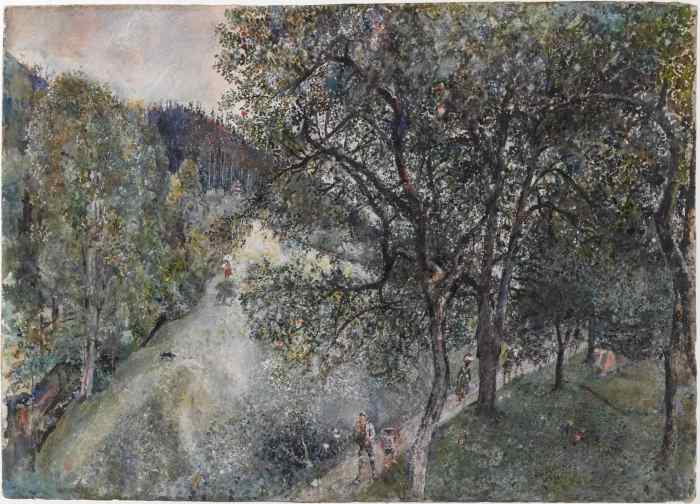
The connection feels natural. Von Alt, a founding figure and honorary president of the Vienna Secession, had long been admired by Klimt, and here the influence shows in the calm structure of the orchard and the tender attention to shifting light. But Klimt’s touch is unmistakable: the surface is more compact, more woven, as if he were testing how far he could push the decorative rhythm without losing the freshness of the scene.
The painting’s first owner, Sonja Knips, understood its quiet radiance. She gave it a prominent place in her apartment designed by Josef Hoffmann, where its balanced square format would have harmonised effortlessly with the clarity of the interior. Even in that refined setting, the work must have felt like a small, self-contained world—an orchard held in suspension, touched by Klimt’s growing confidence as a landscape painter.
Leave a Reply