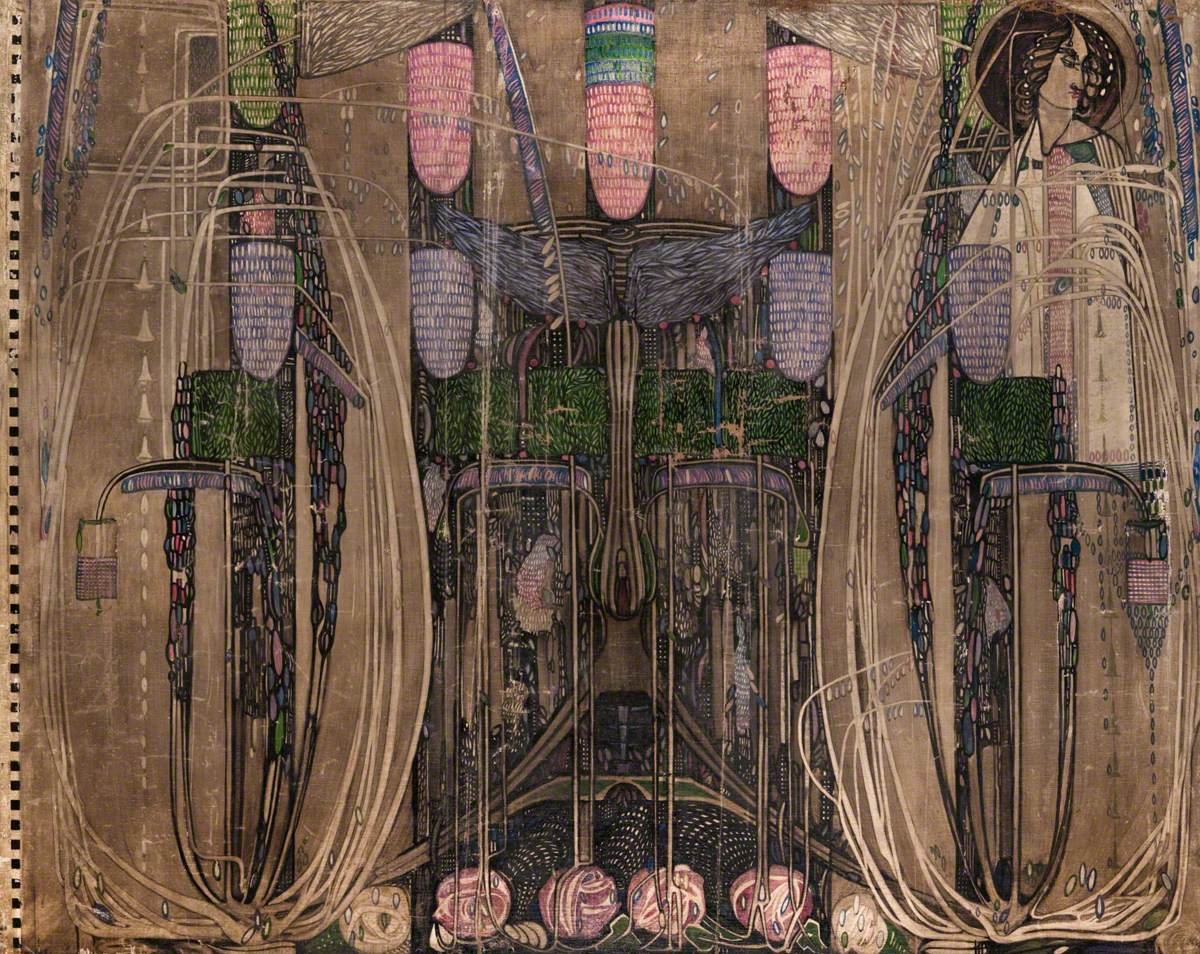
The Scottish Connection: Charles Rennie Mackintosh
Wall Panel for The Dug‑Out (Willow Tea Rooms, Glasgow) (1917)
Oil on canvas
137 × 173 cm
© The Glasgow School of Art, Scotland
This large canvas belongs to a late, mature moment in Charles Rennie Mackintosh’s career, a period when his collaborative interior designs for Catherine Cranston’s Glasgow tea rooms had evolved toward a more atmospheric, deeply meditative tone. While Mackintosh achieved global renown primarily as an architect and pioneer of total interior environments, he maintained a rigorous painting practice throughout his life. However, his pictorial output consisted almost entirely of delicate botanical watercolours and geometric landscape studies. This structural panel stands out as a significant anomaly within his oeuvre, precisely because it is executed in oil on canvas and was consciously conceived as a moveable, free‑hanging textile element rather than a rigid mural applied directly to a plaster wall.
The stylistic vocabulary of the panel reveals a complex web of shared artistic production. Its formal composition closely mirrors a group of smaller, abstract watercolours now preserved in the Hunterian collection, which art historians initially miscategorised as industrial textile patterns. Furthermore, the work shares a distinct formal and thematic resonance with The Little Hills, a painted canvas by Mackintosh’s wife and close collaborator, Margaret Macdonald. When analyzed together, these pieces suggest a carefully synchronized, avant-garde decorative language explicitly intended to shape the subterranean, immersive atmosphere of The Dug‑Out—the wartime basement extension of the Willow Tea Rooms. Despite these clear stylistic intentions, archival evidence remains inconclusive as to whether these specific large-scale panels were ever fully installed within the physical space before its opening.
The timeline of the commission also sheds light on the prolonged development of Mackintosh’s late style. The prominent embroiderer and educator Jessie Newbery later recalled that Mackintosh and Macdonald spent the winter of 1914 working intensely on two monumental decorative schemes for Miss Cranston. This creative period occurred during their residency in Walberswick, Suffolk, immediately after their difficult departure from the Glasgow architectural scene. Although the physical venue of The Dug‑Out was not officially completed and opened to the public until the final years of the First World War in 1917–1918, these accounts indicate that Catherine Cranston had been actively developing the conceptual framework for this experimental interior several years prior, providing the Mackintoshes with crucial patronage during a time of professional isolation.
For decades, the physical fate of the canvas remained entirely unknown to the public. It unexpectedly resurfaced at the Glasgow School of Art in 1981, having survived for years tightly rolled up and forgotten in an institutional storage room. Recognizing its immense historical value, conservationists subsequently cleaned the delicate paint layer and stabilized the fabric by mounting it onto two custom-built wooden stretchers for public display. Tragically, this rare document of late Scottish avant-garde painting was permanently lost to history. The canvas was completely destroyed in the catastrophic fire that swept through and devastated the historic, Mackintosh-designed school building on 23 May 2014.

Leave a Reply