Gustav Klimt:
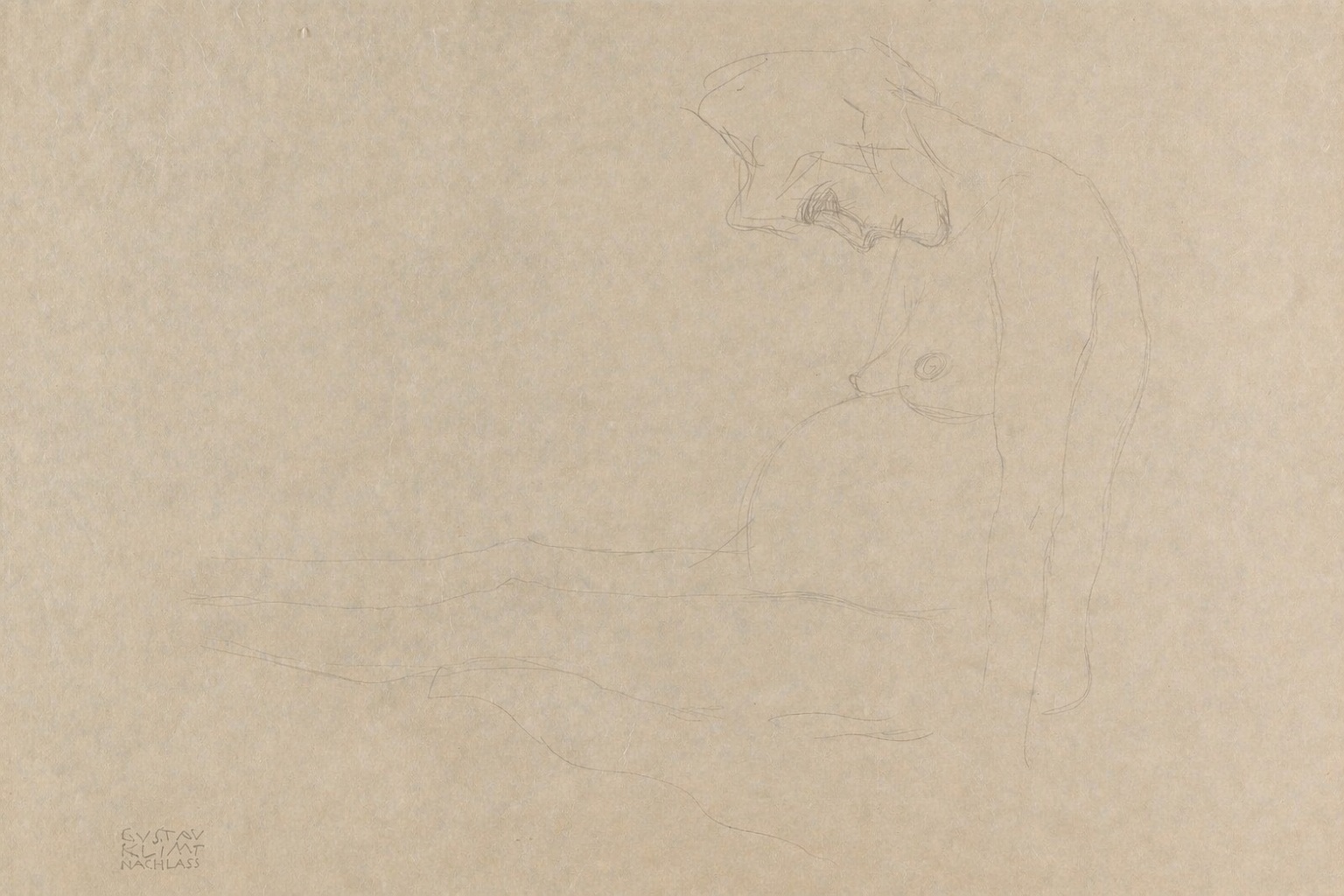
Seated Pregnant Woman with Legs Extended (Mit ausgestreckten Beinen nach links sitzende nackte Schwangere), 1904/05
Pencil drawing
35 × 55 cm (13.7 × 21.6 in)
Auctioned at Ketterer Kunst in 2017 for € 21,250
(Strobl s1746)
This drawing belongs to the group of studies Klimt made while preparing Hoffnung II, one of his most haunting allegories of maternity and mortality, painted in 1907–08. The emotional charge of the painting has often been linked to Klimt’s own experience: in 1902 he had a second child with Marie “Mizzi” Zimmermann, a boy named Otto, who died after three months. Klimt even made a small drawing of Otto after his death, a private gesture of grief that gives these studies an added, almost imperceptible weight. The seated pregnant woman, turned gently to the left with her legs extended, embodies the stillness and vulnerability that run through the studies. The pencil moves with extraordinary tenderness, tracing the curve of the abdomen and the bowed head with a line so light it seems to breathe. The figure’s posture — inward, protective, almost meditative — carries the emotional weight of the painting in its simplest form. Klimt’s sensitivity to the body’s rhythm and fragility is fully present here, stripped of ornament, reduced to pure contour and gesture.
The drawing’s simplicity gives it its intimacy. Without background or setting, the figure seems suspended in a moment of private reflection, the body curved around the life it carries. The soft, slightly textured surface of the paper allows the graphite to settle with a muted warmth, enhancing the quietness of the scene. The spareness of Klimt’s line — so light it almost dissolves at the edges — reveals how carefully he approached these studies, searching for the emotional core of the composition before the symbolic richness of the final painting took over.
Executed around 1904/05, the sheet captures Klimt’s deep empathy for the female form and his fascination with the fragile balance between creation and vulnerability. The woman’s lowered head and extended legs suggest both repose and surrender, a moment held between strength and uncertainty. In its restraint, the drawing preserves the human truth beneath Hoffnung II — the tenderness, the gravity, the quiet dignity of a body carrying new life.

Leave a Reply