Egon Schiele:
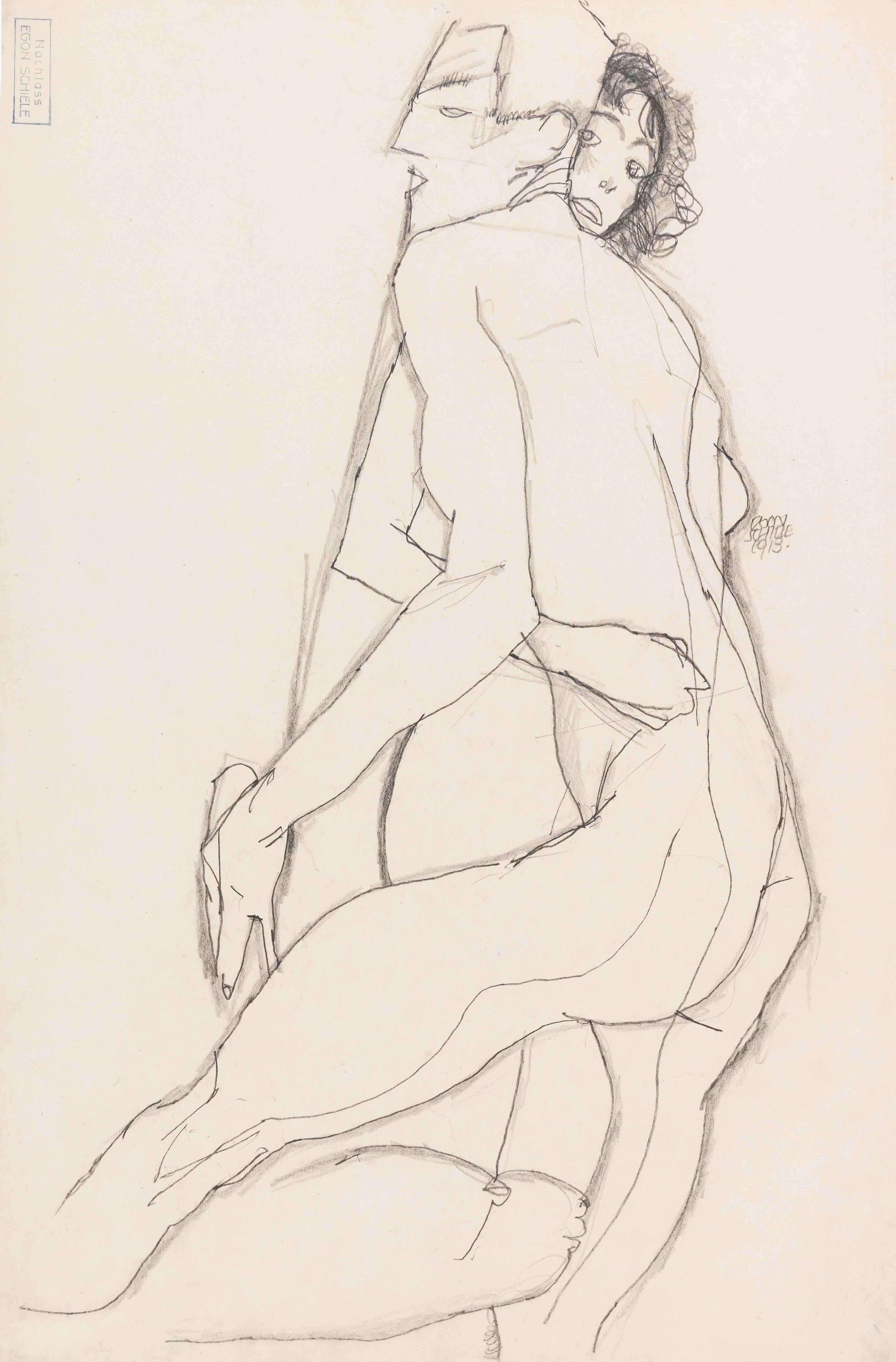
Lovers (Liebespaar), 1913
Pencil drawing
48 × 31.7 cm (18.8 × 12.4 in)
Auctioned at Ketterer Kunst in 2022 for € 175,000
(Kallir d1448)
This drawing belongs to the moment in 1913 when Schiele was exploring intimacy with a new directness, letting the line move with a kind of charged stillness that makes the figures feel both exposed and self‑contained. The woman’s head tilts slightly downward, her gaze cutting sideways with a sharp, assessing intensity that anchors the entire composition. Her eyes are the true center of the sheet — alert, unguarded, and fully aware of being watched. The couple has often been read as anonymous, yet the angularity of the man’s features and the woman’s unmistakable presence suggest, without confirming, that Schiele may have been drawing himself with Wally Neuzil, whose gaze in many of his works carries this same mixture of defiance and vulnerability. The man’s body curves protectively around her without fully enclosing her, a posture that heightens the tension between closeness and distance. His presence feels provisional, while hers is fixed and commanding. It is this imbalance — the woman fully present, the man almost dissolving into the sheet — that gives the drawing its unmistakable erotic voltage. Schiele’s pencil is quick and exact, tracing the curve of her shoulder, the tilt of her head, the slight tightening around the eyes that turns the drawing into an encounter rather than a pose.
The sheet carries that unmistakable 1913 energy: the line taut, the bodies close but not yet fused, the space around them left open so the tension has room to breathe. Schiele’s line here is unusually elastic; it tightens around the woman’s face and shoulders, then loosens into quick, searching strokes along the man’s torso, creating a rhythm that mirrors the emotional asymmetry between them. The woman’s look is the anchor — direct, almost confrontational — and it is this look that creates the voyeuristic charge so often noted in the literature. She is aware of being seen, and Schiele captures that awareness with a precision that feels almost cinematic. The man, by contrast, is rendered with a softer, more tentative line, as if Schiele were more interested in the emotional gravity between them than in his individual presence.
The drawing comes from the celebrated Serge Sabarsky Collection, a provenance that adds its own quiet resonance. Sabarsky understood Schiele’s works on paper with rare sensitivity, and this sheet fits naturally into the group he assembled: intimate, psychologically alert, and executed with the kind of immediacy that makes the viewer feel as if they have stepped into the room at the moment of its making. The Japon paper, with its slight warmth and delicate surface, catches the graphite in tiny, shimmering breaks along the contour, a texture that intensifies the drawing’s immediacy and gives the figures a softness that contrasts with the sharpness of their emotional exchange.
Seen within Schiele’s 1913 output, Lovers stands as one of those sheets where the artist’s instinct for human closeness — its beauty, its unease, its charged silences — is distilled into a few lines. The drawing feels as if it was made in a single, uninterrupted moment, a private exchange caught before either figure has fully settled into the pose, which gives the sheet its unmistakable sense of intrusion. It feels at once private and exposed, a moment held between tenderness and scrutiny, suspended in the fragile space between the two bodies.
Leave a Reply