Egon Schiele:
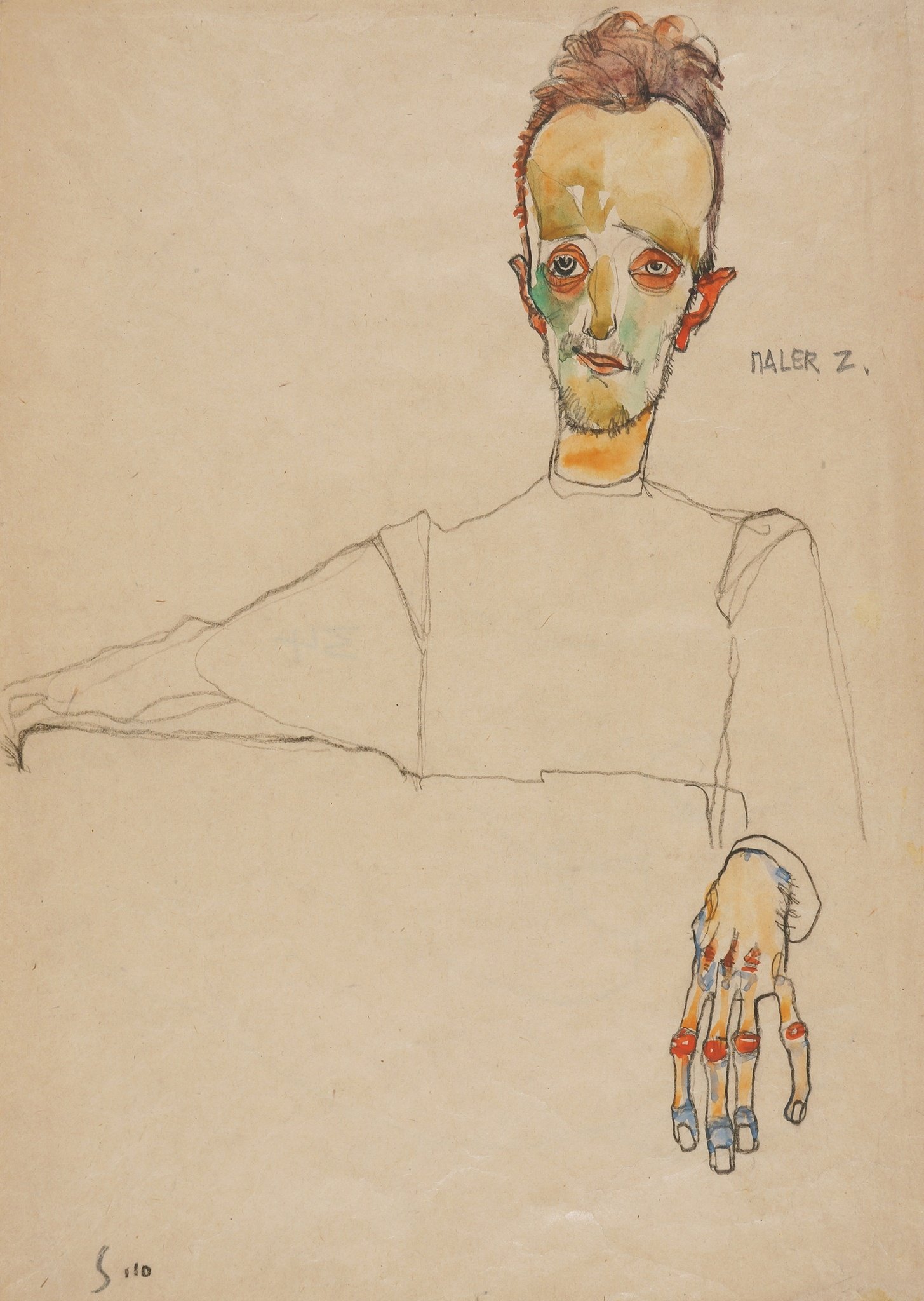
Painter Zakovsek (Maler Zakovsek), 1910
Watercolor and charcoal
31.6 × 44.7 cm
Private collection
(Kallir d612a)
This portrait of Zakovsek belongs to the moment when Schiele was still moving between the Academy’s rigid expectations and the raw, searching language he was beginning to claim as his own. Karl Zakovšek was an academy classmate of Schiele’s and one of the few fellow students he genuinely respected, someone who shared his impatience with the Academy’s rigid teaching and gravitated toward the same restless, modern direction. He was also a member of the Neukunstgruppe, the art group Schiele co‑founded after leaving the Academy of Fine Arts, and one of the early supporters of Schiele’s breakaway vision, part of the small circle that believed in him before exhibitions, before notoriety, when everything still felt precarious. Schiele approaches him with a mixture of curiosity and intensity, letting the watercolor settle in thin, translucent layers while the charcoal line holds the structure in place. The sheet feels both spontaneous and deliberate, as if Schiele were testing how far he could push the likeness before it slipped into something more psychological.
There is a quiet tension in the way Zakovsek leans forward, the shoulders slightly hunched, the gaze directed somewhere just beyond the edge of the paper. Schiele captures that moment of thoughtfulness with remarkable economy: a few strokes around the eyes, a tightening of the mouth, the faint suggestion of weight in the neck and jaw. The watercolor gives the face a fragile luminosity, while the charcoal anchors the drawing with its familiar sharpness. Even at this early stage, Schiele is already drawn to the inner life of his sitters — the sense that a portrait is not simply a likeness but a record of a person’s private weather. Schiele often drew Zakovsek with a quiet, inward concentration, a temperament that seemed to steady the intensity of the young artist’s studio.
Schiele made several studies of Zakovsek around this time, circling the figure as if trying to understand him from different angles before committing to the painted version. He was one of the sitters Schiele returned to when he needed someone who understood his pace — the urgency, the long hours, the intensity of looking. The sheet carries that searching quality: the feeling of an artist working quickly, urgently, aware of the limits of his materials. He sold the piece just in time, as it appears he had intended to paint over it — he was often short on painting materials. Zakovsek’s own career was brief, overshadowed by stronger personalities around him, which lends a gentle poignancy to these early portraits. He belonged to that small, loyal group around Schiele who shared the sense that something new was beginning, even if none of them yet knew what shape it would take.
In this portrait, you see Schiele on the cusp of becoming himself: the taut line, the heightened sensitivity to the sitter’s inner state, the instinct for capturing a presence that feels both immediate and slightly withdrawn. It is a study, yes, but one that already carries the unmistakable charge of his mature work.
Leave a Reply