Egon Schiele:
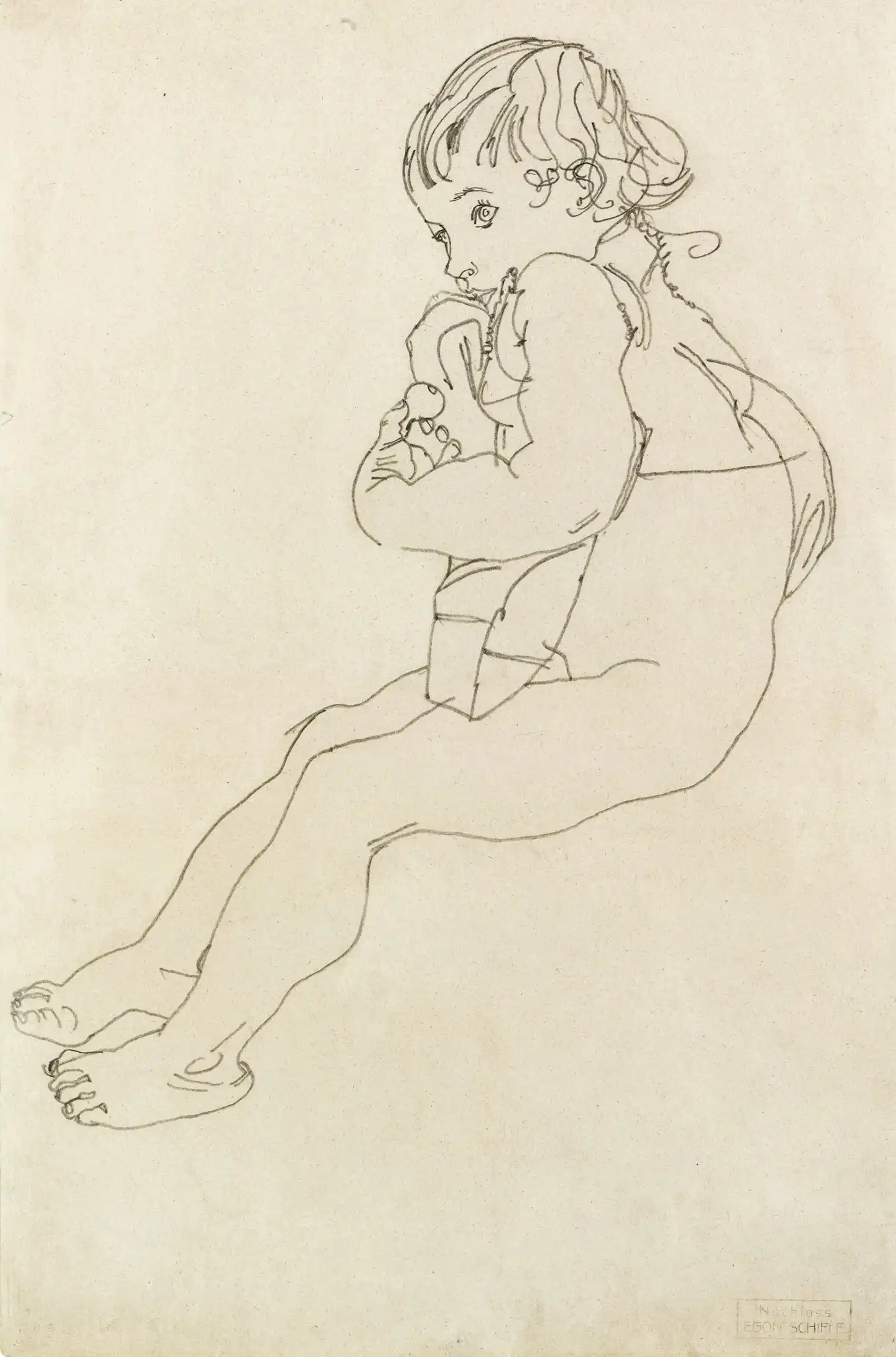
Seated Child (Sitzendes Kind), 1916
Pencil on paper
44.6 × 29.2 cm
Auctioned at Christie’s in 2017 for USD 211,500
(Kallir d1819a)
Egon Schiele’s lifelong attention to children was never sentimental; he saw in them the beginnings of life, the first flicker of individuality, and a kind of unfiltered presence that adults rarely retain. Even in his earliest years he understood childhood as a threshold state—full of vitality, curiosity, and the first stirrings of selfhood—yet always shadowed by the fragility that preoccupied him throughout his career. The polarity between life and its limits, so central to Schiele’s imagination, runs through his depictions of mothers and infants, and finds its starkest early expression in the 1910 Tote Mutter, where birth and death are held in a single, unsettling balance.
From 1910 onward, Schiele often turned to the children of the streets as models, drawn to their immediacy and lack of artifice. At times he pushed these studies into provocative territory, using adolescent bodies to probe the boundaries of awakening sexuality and human instinct. His arrest in Neulengbach in 1912—after accusations of exposing minors to drawings deemed “immoral,” leading to 24 days in custody—left a lasting mark on him. It matters to mention the affair here because this moment of public scrutiny and confinement redirected his focus away from provocative adolescent studies toward the quieter, domestic child portraits that shape works like this one.
Against this backdrop, Sitzendes Kind from 1916 feels especially tender. Instead of the edgy, angular line of 1910–11, Schiele adopts a softer, more rounded contour, as though approaching the child with a quieter, steadier hand. The toddler—likely from a comfortable middle‑class household—sits with legs stretched forward in a loose, slightly awkward sprawl, the right foot turning outward in that unselfconscious way small children often settle into. The child grips a small piece of cloth with both hands, the head tilting gently downward and to the left in absorbed concentration. With only a few continuous strokes, Schiele captures not just the form but the inwardness of the child, its self‑contained seriousness, its unguarded presence. The drawing’s economy is part of its charm: nothing is overstated, yet everything essential is there.
After the Neulengbach affair and with greater stability in his own life, Schiele increasingly drew the children of his immediate bourgeois circle—relatives, acquaintances, and the offspring of patrons. The child in this sheet appears again in two further drawings from 1916 (Kallir d1819 and d1820), suggesting a familiar sitter. A later inscription on the verso indicates that the child belonged to the household of the Harms family, Schiele’s parents‑in‑law, placing the drawing within the intimate domestic sphere that shaped his final years.
Leave a Reply