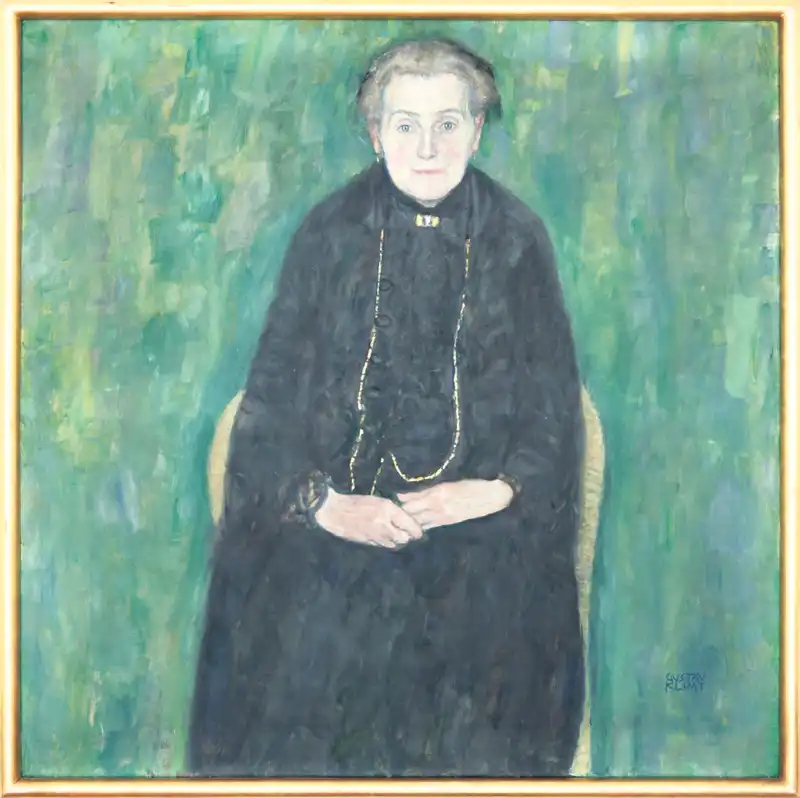
Gustav Klimt:
Portrait of Barbara Flöge (Bildnis Barbara Flöge), 1915
Oil on canvas
110 by 110 cm
Private collection
(Natter no. 211)
Barbara Flöge (1857–1937), mother of Emilie Flöge, is portrayed at the age of fifty‑eight with a calm, monumental stillness that reflects the long, almost familial intimacy Klimt shared with her household. His summers at Lake Attersee had made the Flöge home a place of refuge, and this portrait carries that closeness in its unembellished, frontal pose. She wears a deep, matte black dress that absorbs nearly all surrounding light, falling in a single vertical sweep that gives her figure a sculptural gravity. A long gold chain, the sole bright accent against the dark fabric, hangs straight down her torso like a quiet thread of dignity, while her hands rest clasped low in her lap with a settled composure that softens the austerity of her attire.
Her face is rendered with Klimt’s late restraint: no ornament, no decorative patterning, only a steady, introspective gaze. Behind her, the background reveals itself not as a flat monochrome but as a cool, moss‑toned field of layered greens, its brushstrokes shifting between vertical and diagonal. This subtle movement creates a soft atmospheric depth, almost like a garden wall blurred by light, and gently counters the severity of the pose. In its simplicity, it recalls the lost portrait of Klimt’s own mother, Anna, whose directness seems to echo here like a remembered gesture of maternal steadiness.
Barbara had raised four children with her husband, the master turner and businessman Hermann Flöge (1837–1897): Pauline (1870–1917), Helene (1871–1936), Emilie (1874–1952), and Hermann junior (1878–1932). After her husband’s early death, she guided the family with a quiet resilience that Klimt, who had known them since the early 1890s, would have witnessed intimately. That history of strength and continuity seems to rest in her expression, giving the portrait a gravity that is both personal and unsentimental.
For decades the painting disappeared from view, last recorded in 1928 before resurfacing unexpectedly in 2011, restoring a missing link in Klimt’s late portraiture. Barbara had appeared earlier in his work as well, though only a careful eye will find her among the figures in Hanswurst Delivering an Impromptu Performance in Rothenburg (1893/1894), a composition begun by Ernst Klimt and completed by Gustav after Ernst’s death. In that early crowd she is woven discreetly into the scene; here, more than twenty years later, she stands alone, granted the full, quiet attention of an artist who had long been part of her family’s world.


Leave a Reply