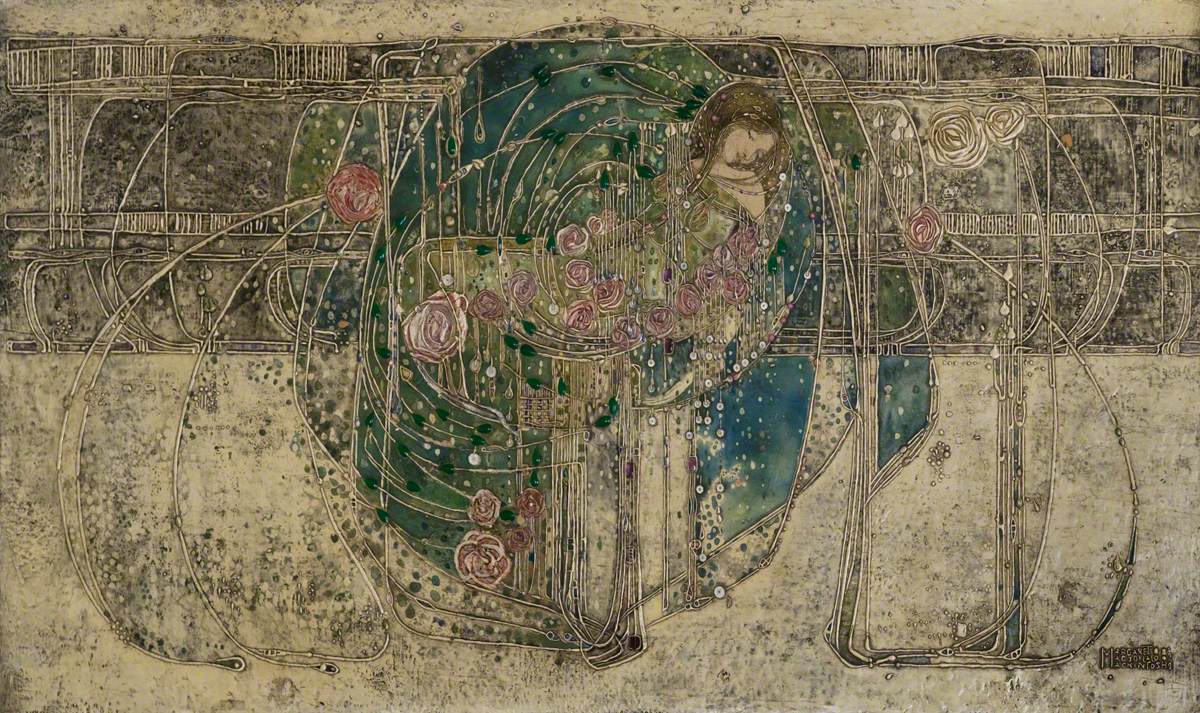
The Glasgow Girls: Margaret MacDonald
The Sleeping Princess, 1908
Oil and gesso on panel
54.2 × 105 cm
©The Hill House, Helensburgh
Margaret MacDonald’s The Sleeping Princess occupies the quiet architectural recess above the fireplace in the drawing room of The Hill House, where its long, horizontal panel seems to hover between ornament and dream. The figure lies enclosed within a circular wreath of stylised roses and curving lines, her form emerging from a surface worked in gesso and soft colour—greens, blues, pinks, greys, and the gold‑toned highlights that catch the shifting light. The fairy‑tale subject, drawn from Sleeping Beauty, resonated deeply with the Blackie family, whose publishing house specialised in children’s books; the theme was both a personal emblem and a natural extension of their world.
MacDonald’s technique is as distinctive as her imagery. She built the relief with gesso—a mixture of whiting, plaster of Paris, and rabbit‑skin glue—applied through a piping bag in raised, sculptural lines that give the panel its tactile presence. Cabochons, beads, and pearls punctuate the surface, lending the work a jewelled delicacy. The roses, rendered as spiralling, geometric forms, echo the vocabulary of Mackintosh’s signature rose motif, while the princess’s hair unfurls in structured, ribbon‑like waves that bind her figure to the architecture around her. The result is a fusion of material richness and ethereal stillness, a sleeping figure held in a web of ornament that feels both protective and otherworldly.
MacDonald was a central figure of the Glasgow School and one of the artists later grouped under the name “Glasgow Girls,” a term applied to the women who emerged from the institution at the turn of the century. Her collaborations with her husband, Charles Rennie Mackintosh, and with her sister Frances were integral to the development of the Glasgow Style, though her own authorship has too often been overshadowed by Mackintosh’s reputation. In Europe, however, her work was widely exhibited and recognised for its originality. Poor health curtailed her output after 1921, but in works like The Sleeping Princess her voice remains unmistakable: a blend of symbolism, craftsmanship, and quiet, dreamlike intensity that shaped the visual language of an entire movement.

MacDonald’s panel feels inseparable from the architecture it inhabits. At The Hill House, Mackintosh’s cool geometry and pale, atmospheric interiors create a setting in which the work seems less like an inserted artwork than a quiet apparition rising from the room itself. The elongated format, the circular enclosure of roses, and the suspended figure echo the rhythms of the house, binding ornament, narrative, and structure into a single gesture. The background’s dense interplay of geometric and curvilinear motifs creates a rhythmic field that feels almost musical, amplifying the sense of ritual stillness. The princess lies in a state of enchanted sleep, yet her expression carries a serene ambiguity—less a literal slumber than a symbolic suspension. The work hovers between painting and relief, between fairy tale and abstraction, between the intimate scale of craft and the ambition of a total artwork. It is this ambiguity, this refusal to settle into a single category, that makes MacDonald’s contribution to the Glasgow Style so distinctive. Her art does not simply illustrate a story; it creates a world in which the story feels inevitable.

Leave a Reply