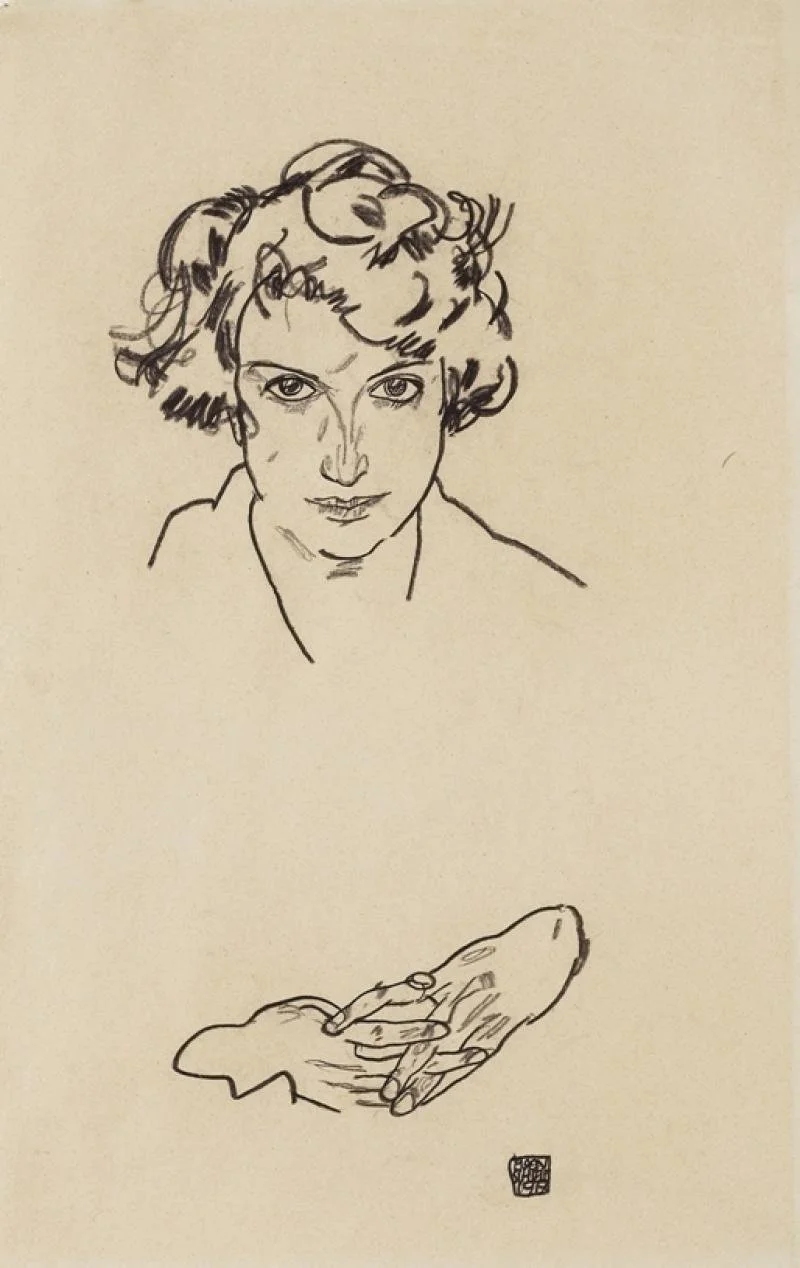
Egon Schiele:
Portrait of a Girl (Mädchenporträt), 1917
black crayon
33.5 × 16.5 cm
Private collection
(Kallir d1895)
The tall, narrow sheet gives the drawing its quiet, suspended rhythm. The girl’s head, placed high on the page, is shaped by a line that moves with a softened confidence. Her wide, searching eyes form the emotional centre of the work, holding a mixture of attentiveness and inward retreat. The softly parted lips and the gentle modelling of the cheeks heighten the sense of a moment observed rather than posed. Her wavy hair, drawn in loose, fluid strokes, frames the face with a warmth that softens the austerity of the black crayon.
Far below, her hands rest one over the other in a gesture of calm composure. Schiele’s treatment of the hands is unusually restrained: no angular tension, no expressive distortion, only a quiet, natural fold that anchors the composition. The long interval of empty space between head and hands becomes a field of stillness, giving the portrait its contemplative gravity. The emptiness is not a void but a breathing space, allowing the viewer to feel the sitter’s presence without intrusion.
The beige paper lends the drawing a muted radiance, warming the crayon and softening the contours. Variations in pressure—firmer around the eyes and hair, lighter along the fingers and jawline—give the figure a sense of emergence, as if she is rising gently from the surface rather than being fixed upon it. The small signature mark in the lower right corner sits modestly, reinforcing the intimacy of the sheet.
Created during Schiele’s late‑war period, the portrait reflects the shift in his sensibility after 1915: a quieter, more humane attention, a softening of psychological intensity, and a renewed interest in the dignity of stillness. The drawing feels immediate and unguarded, a private encounter rendered with care, where the sitter’s presence is allowed to unfold without strain or theatricality.

Leave a Reply