The Berlin Secession/degenerate art: Karl Hofer
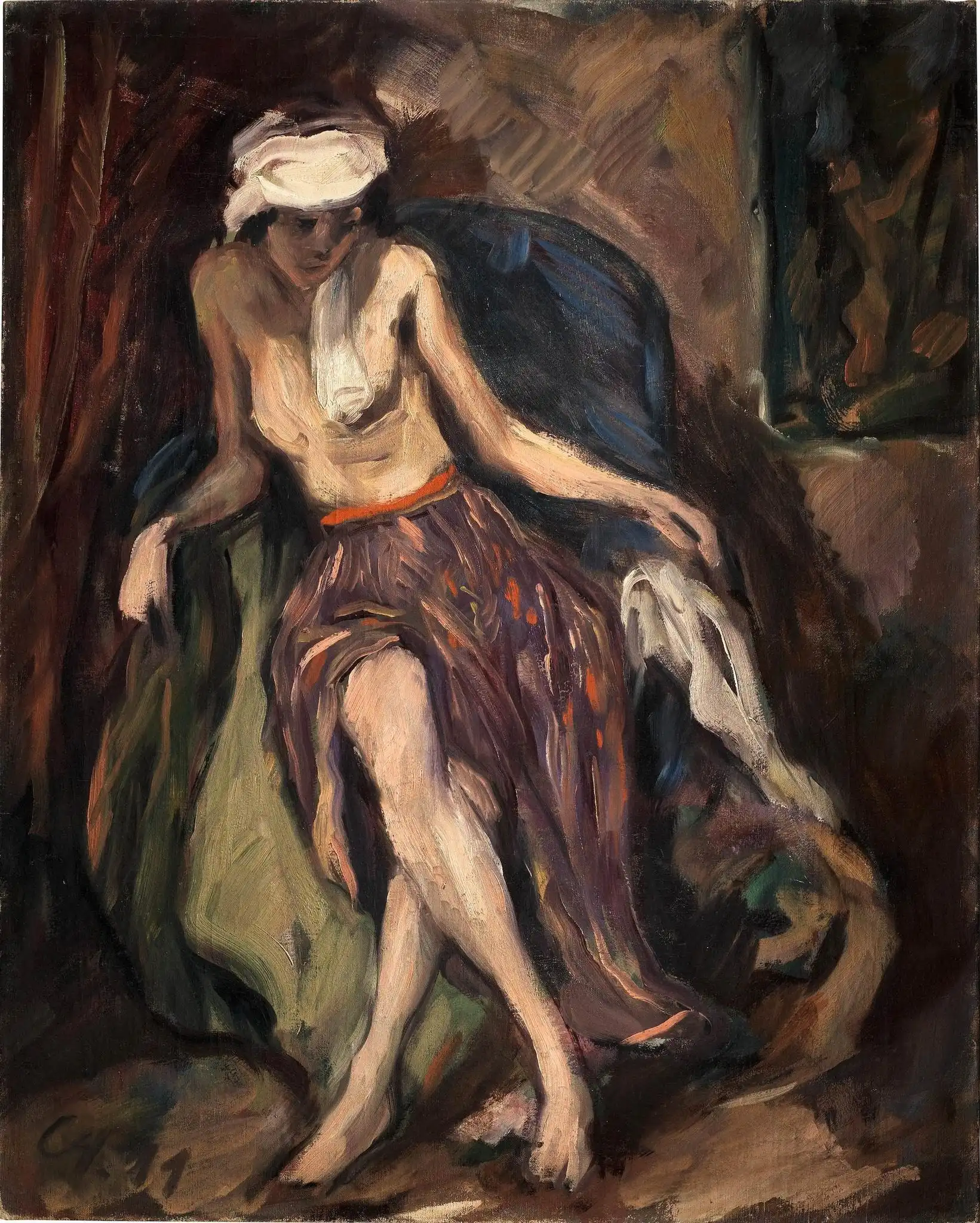
Seated Indian Half‑Nude (Sitzender indischer Halbakt), 1911
oil on canvas
81.4 × 65 cm (32 1/16 × 25 9/16 in)
Auctioned at Bonhams in 2020 for USD 81,325
The painting presents the figure in a semi‑reclined pose, her body arranged with a natural ease that feels neither staged nor ornamental. The upper torso, bare and softly modelled, emerges from a field of deep, earthy tones that give the scene a quiet interior gravity. Hofer’s brushwork is deliberate yet fluid: the warm reds and violets of the draped skirt gather around the figure like a low, glowing ember, while the headscarf—rendered in muted, harmonious tones—frames the sitter with a calm dignity. The white cloth held loosely in her hand introduces a gentle counterpoint, a small moment of brightness that draws the eye back into the composition.
The figure’s posture conveys a sense of inwardness rather than display. One arm rests along the chair with relaxed assurance, while the other folds inward, creating a subtle diagonal that stabilises the composition. Her gaze is directed away, deepening the contemplative mood that runs through so much of Hofer’s work. Even in this early period, he avoids the overt emotional charge of the expressionists, favouring instead a quiet, human presence that feels grounded and self‑contained.
The background, built from broad, textured strokes of dark umber and olive, does not describe a specific space but rather creates an enveloping atmosphere. It pushes the figure gently forward, allowing her form to emerge with clarity against the subdued surroundings. This interplay between solidity and softness—between the figure’s sculptural weight and the painterly looseness of the setting—reveals Hofer’s growing command of mood and structure.
Although painted during a time when Hofer was in contact with the expressive tendencies of Die Brücke, the influence appears only as an undercurrent: a slight intensification of colour, a willingness to let the brushwork breathe. What dominates instead is the calm order that would later align him with New Objectivity. The figure is neither idealised nor distorted; she is simply present, held in a moment of quiet introspection.
This work also stands at the threshold of a career soon disrupted by political violence. In 1933 Hofer was removed from his teaching position, and in 1937 more than 300 of his works were confiscated as “degenerate art,” with nine displayed in the Munich exhibition. The destruction of his Berlin studio in 1943 erased much of his early production. Paintings like this one, preserved despite these losses, offer a rare view into the early development of an artist whose commitment to human dignity, clarity, and stillness endured through the most turbulent years of German modernism.

Leave a Reply