The Italian Connection: Luigi Russolo
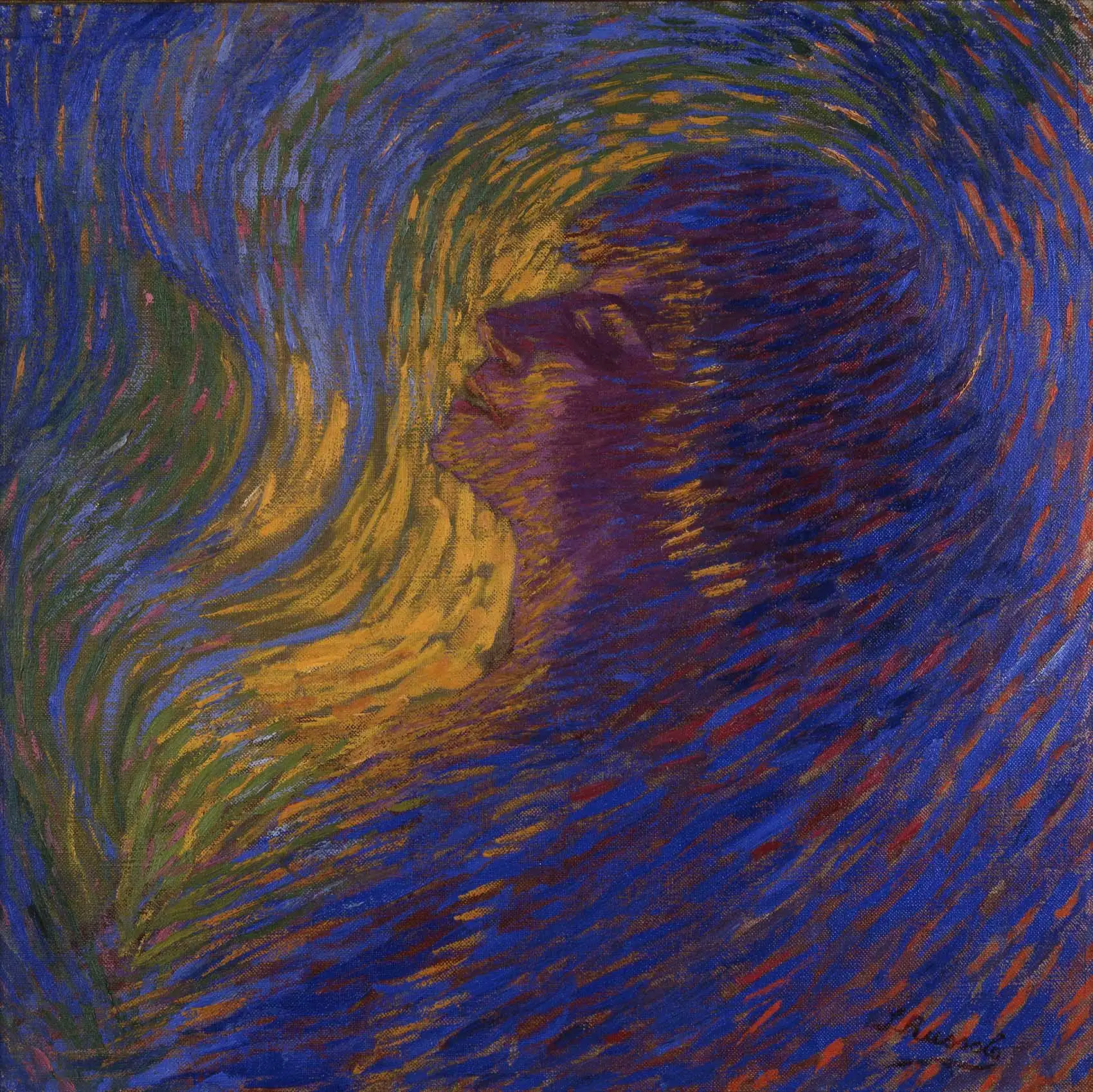
Perfume (Profumo), 1910
Oil on canvas
64.5 × 65.5 cm (25.3 × 25.7 in)
© MART, Museum of Modern and Contemporary Art of Trento and Rovereto
In Perfume, Russolo attempts something quietly radical: to give scent a visible form. The canvas unfolds in vibrant, radiating colour, as if waves of fragrance were expanding outward into the surrounding space. Rather than depicting an object that emits a smell, Russolo evokes the sensation of smelling itself — a synesthetic experience meant to stir memory, atmosphere, and emotion. The composition is built from rhythmic, concentric forms that seem to pulse outward, suggesting how a perfume might diffuse, linger, and dissolve in the air.
Created at a moment when Futurism was still shaping its visual vocabulary, Perfume captures the movement’s fascination with energy, sensation, and the heightened intensity of modern life.
Futurism, founded in Italy in 1909, championed speed, energy, modern technology, and the sensory intensity of the new century, urging artists to break decisively with the past. Russolo was searching for ways to expand perception, to make painting respond to the full spectrum of human experience, not just sight. This work stands as one of his most poetic early attempts to push beyond the boundaries of traditional representation.
Luigi Russolo (1885–1947) was among the most inventive figures of the Futurist generation — a painter, theorist, and later a pioneering experimental musician. Born in Portogruaro and active in Milan, he embraced the Futurists’ call to break with the past and celebrate the dynamism of contemporary life. In 1913, he published his influential manifesto The Art of Noises, arguing that the mechanical roar of the modern city — engines, factories, crowds, sirens — should become the raw material of a new music. To realise this vision, he built the Intonarumori, noise‑generating instruments that he used to form an entire “noise orchestra.”
His paintings share the same restless curiosity as his musical experiments: bold colours, rhythmic forms, and scenes that pulse with movement and speed. Perfume stands at the threshold of this evolution — a work that hints at the sensory expansion Russolo would soon pursue across multiple disciplines, always searching for new ways to make the modern world not only seen, but felt.


Leave a Reply