Egon Schiele:
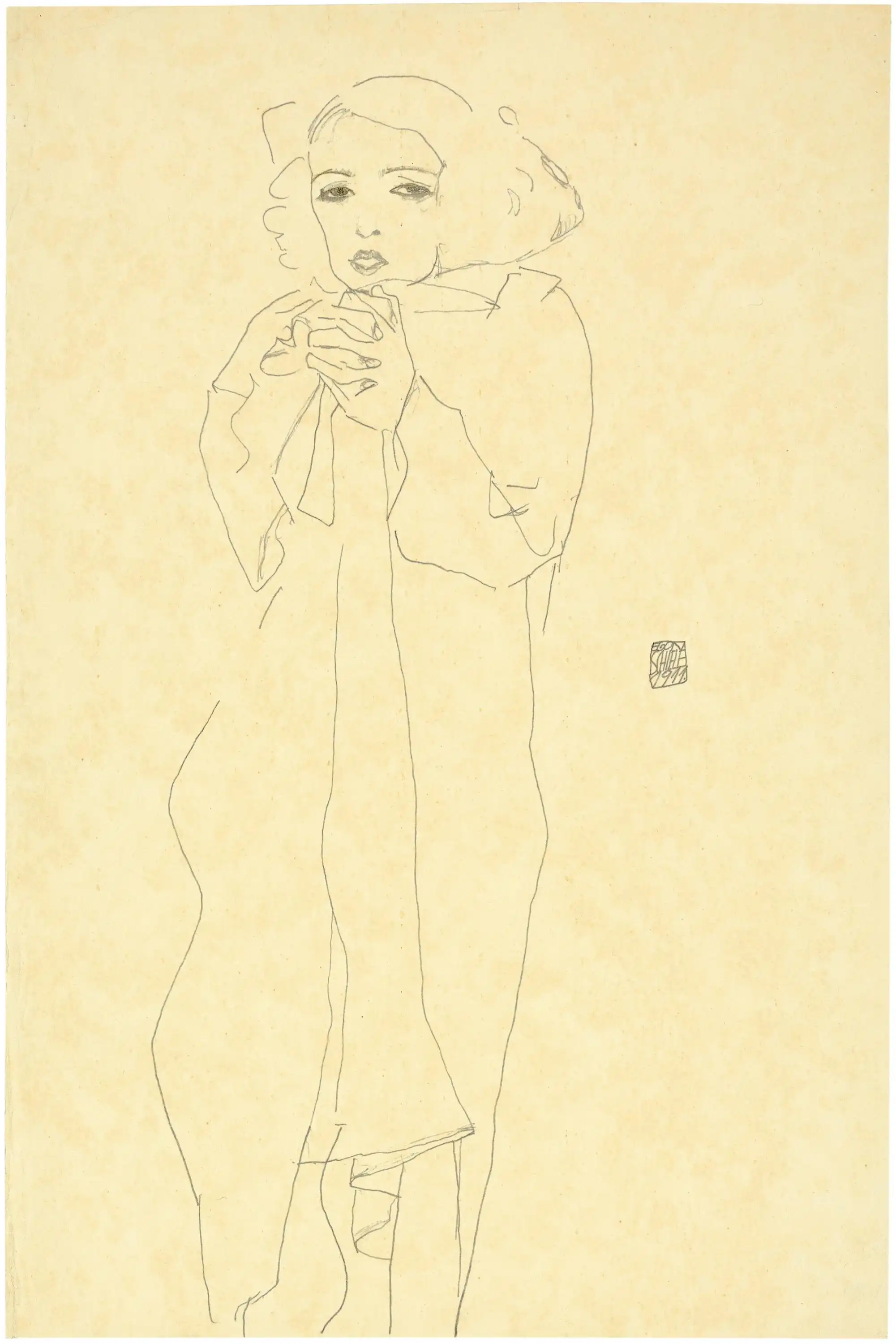
Portrait of the Dancer Moa (Bildnis Tänzerin Moa), 1911
Pencil drawing on yellowish imitation Japan paper
48.2 × 32 cm
Auctioned at Kornfeld, Bern (Switzerland), in 2025 for CHF 240,000 (approx. EUR 250,000)
(Kallir d901)
This 1911 portrait of the dancer Moa is drawn with the quiet radiance that marks Schiele’s most sensitive works on paper from this year. The warm, slightly textured imitation Japan paper allows the pencil to settle in soft, breathing lines, giving the contours a gentle vibration that feels unmistakably alive. Schiele’s rectangular signature cartouche, placed with deliberate clarity at the right, reflects his habit during this period of integrating the signature as a visual element within the composition.
Very little is known today about the dancer Moa Mandu, yet she appears in several of Schiele’s drawings from this period. She belonged to the loose circle of performers and models who moved around the artist, reportedly introduced to him by his friend Erwin Osen. Osen, who navigated Vienna’s theatrical and cabaret milieu with ease, often brought Schiele into contact with figures whose expressive presence intrigued him. This connection opened a small but meaningful pathway into a world of heightened gesture and unconventional personalities — a milieu that resonated deeply with Schiele’s evolving interest in psychological and physical expressiveness. Through Osen, Moa entered Schiele’s orbit, and her striking, somewhat extravagant appearance made her a sought‑after model for other artists as well. Schiele responded to her with a particular tenderness: his depictions of Moa are quieter and more inward than many of his figure studies from 1911, revealing a gentler register within his early Expressionist vocabulary.
Seen in this light, the present sheet also reflects how Schiele, even at this early stage, was probing questions of physical representation and gradually distancing himself from the ornamental influence of Gustav Klimt. As so often in his work, the hands form a central motif. For Schiele they were, alongside facial expression, a primary vehicle of emotion — a focus that recurs throughout his portraiture and is especially evident in his self‑portraits.
The figure emerges through a line that is both searching and assured. Schiele’s pencil moves with a sensitivity that captures not only the structure of the body but also the fleeting immediacy of the sitter herself. The restraint of the medium heightens the sense of nearness: with no color to mediate the encounter, the drawing relies entirely on the expressive intelligence of Schiele’s hand. The luminous tone of the paper, the subtle interplay of pressure and release in the graphite, and the intimate scale all contribute to a sense of presence that is both immediate and unmistakably Schiele.


Leave a Reply