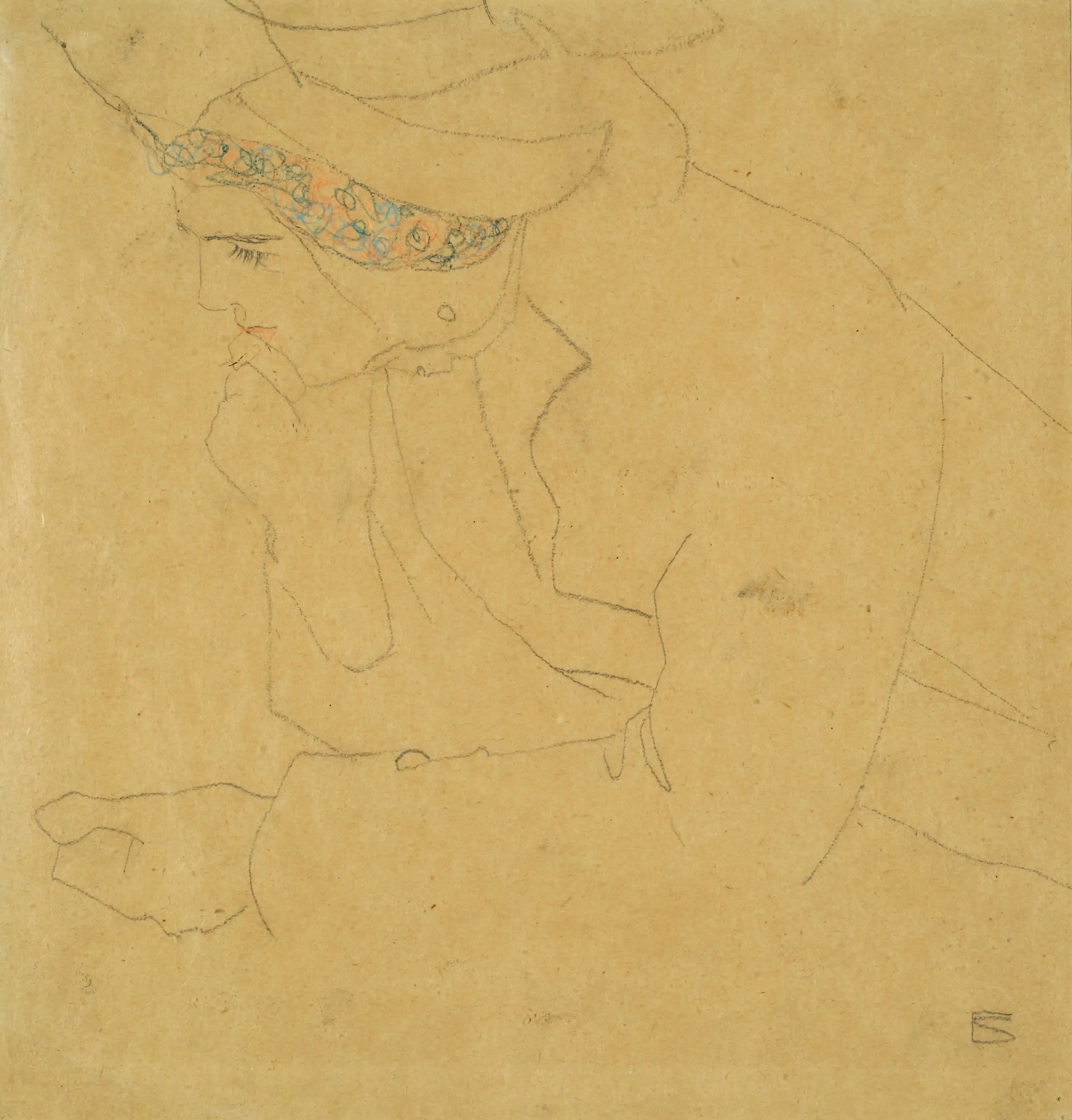
Egon Schiele:
Seated Lady Wearing a Hat (Seated Lady Wearing a Hat), 1909
Color pencil and graphite on paper
31.2 × 29.8 cm
Auctioned at Bonhams in 2007 for US$114,000
Estate of Fay Shwayder, Denver, Colorado
(Kallir d286)
This early drawing is a remarkably delicate example of Schiele’s formative draftsmanship, created at a moment when he was still shaping the visual language that would soon define him. Long known to me only from a small, indistinct reproduction, the sheet has rarely been seen in person, and its reappearance offers a far clearer sense of Schiele’s sensitivity during these years. The work reveals a young artist still grounded in observation, yet already beginning to distill the figure into essential lines and expressive accents.
The sitter is shown in profile, her chin resting lightly on her hand, a pose that conveys a quiet, introspective mood. Schiele’s line is fine and economical, capturing the tilt of the head and the curve of the shoulders with minimal means. The floral headband — rendered in small touches of blue and pink — introduces a surprising note of color, echoed subtly in the red of the lips. These restrained chromatic accents stand out against the otherwise monochrome drawing, hinting at Schiele’s early interest in isolating expressive details within an otherwise pared‑down composition.
Although Schiele would soon move toward a sharper, more angular line, this sheet shows him working through the fundamentals of proportion, contour, and psychological presence. The empty background, a device he would later use to heighten emotional intensity, already appears here in embryonic form, giving the figure a sense of quiet isolation. There is also a distinctly Jugendstil character to the drawing — the flowing contour, the decorative headband, the gentle stylization — entirely consistent with the period around 1908–1909, when Schiele was still strongly influenced by Klimt and the ornamental language of the Vienna Secession.
The drawing’s intimacy and restraint mark it as a rare survival from a period in which many works were lost, destroyed, or remain undocumented. Early colored‑pencil portraits of this type are uncommon in Schiele’s surviving oeuvre, underscoring the sheet’s significance within his early production.
The drawing’s rarity is further emphasized by its limited public history. It was exhibited only once, in 1968, at Christian M. Nebehay’s gallery in Vienna — a key venue in the postwar rediscovery of Schiele’s work. Since then, it remained in the private collection of Fay Shwayder in Denver, unseen by the public and largely inaccessible to scholars. Its inclusion in Jane Kallir’s 1990 catalogue raisonné (d286) secured its place in the documented corpus, but the drawing itself has circulated only in a small reproduction until now.
As an early work, Seated Lady Wearing a Hat offers a rare glimpse into Schiele’s artistic vocabulary before it crystallized into the radical expressiveness of his mature period. It stands as a quiet, revealing document of the young artist’s search for form, presence, and identity — a moment of experimentation that foreshadows the intensity of the years to come.
Leave a Reply