Die Brücke: Ernst Ludwig Kirchner
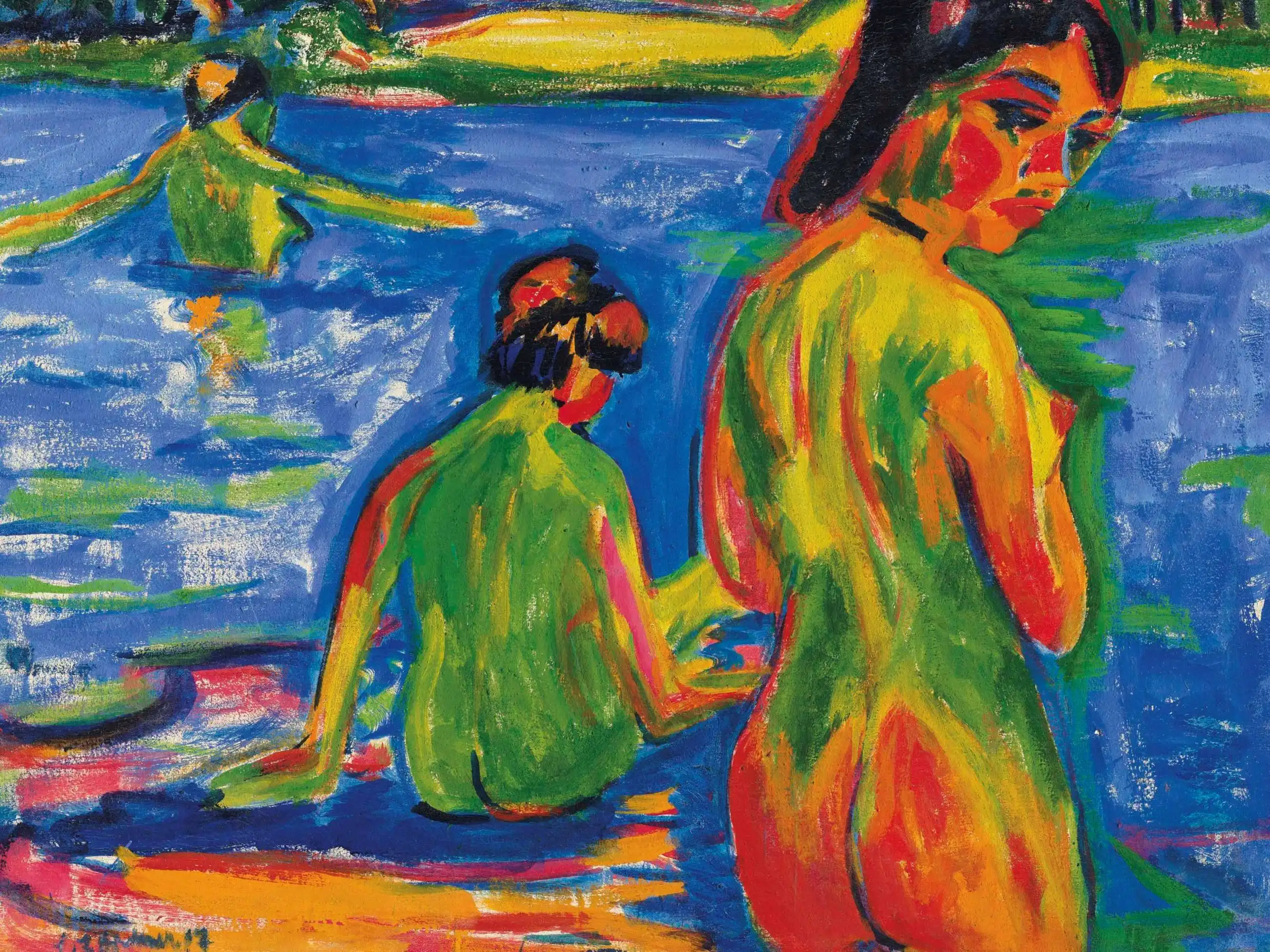
Girls Bathing in the Lake, Moritzburg (Im See badende Mädchen, Moritzburg), 1909
Oil on canvas
91.2 × 120 cm
Auctioned at Christie’s in 2015 for USD 13,605,000
Painted in 1909, Girls Bathing in the Lake, Moritzburg is one of the earliest and finest works from the series Kirchner created during three radiant summers at the Moritzburg lakes between 1909 and 1911. These summers marked a turning point for Die Brücke — a moment when art and life merged completely, and when the group’s radical ideals found their purest expression in nature.
It was here, in the secluded lakes outside Dresden, that Kirchner and his close friend Erich Heckel immersed themselves in an artistic idyll. Working side by side in the open air, they painted their girlfriends, their models, and each other as they lived, bathed, and played together in a state of unguarded freedom. The Moritzburg lakes offered a refuge from the constraints of bourgeois Dresden, allowing the artists to shed not only their clothes but the expectations of academic tradition. In this liberated environment, they pursued a direct, unfiltered response to nature — the very essence of the Brücke vision.
Four years earlier, in 1905, Kirchner, Heckel, Fritz Bleyl, and Karl Schmidt‑Rottluff had founded Die Brücke in Dresden, later joined by Max Pechstein. United by a desire to break away from convention, they sought an art that was immediate, spontaneous, and emotionally charged — an art that captured the raw vitality of life. The Moritzburg summers allowed them, for the first time, to fully realize these aims. Here, the boundaries between artist, model, and landscape dissolved; the group lived a blissful, almost primitive existence, at one with the natural world.
This canvas radiates that spirit of liberation. The figures — one standing with her head turned, another seated at the water’s edge, a third wading with outstretched arms — are rendered with sweeping, confident strokes. Their bodies are simplified and elongated, their gestures full of youthful energy. Kirchner’s palette is bold and sun‑drenched: greens, reds, blues, and ochres collide in a harmony that feels both spontaneous and intentional. The landscape pulses with the same expressive urgency as the figures, merging into a unified field of color and movement.
Kirchner and Heckel often painted the same motifs, and Heckel’s Badende im Teich echoes this composition closely. Yet Kirchner’s version carries his unmistakable signature — the vibrating line, the heightened contrasts, the emotional immediacy. Girls Bathing in the Lake, Moritzburg shows how he absorbed developments from across Europe and transformed them into something wholly his own: a style that was modern, primal, and deeply personal.
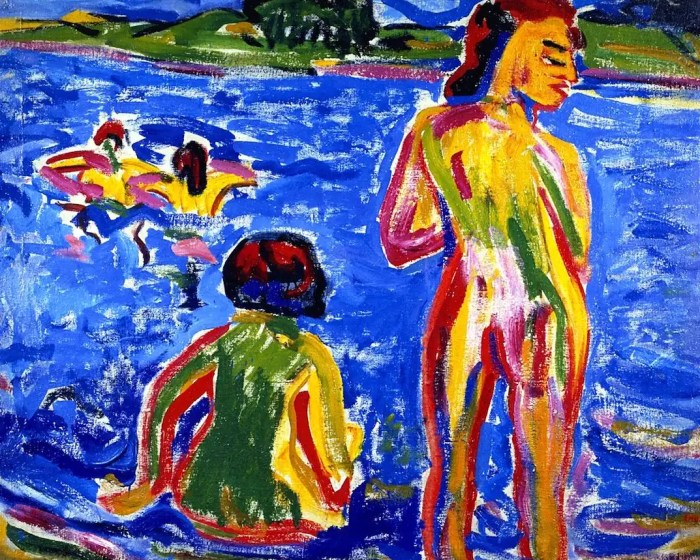
This is Kirchner before the anxieties of Berlin, before the sharp urban edges and psychological tension of his later work. Here, the mood is open, physical, and sunlit. The bathers are unselfconscious, at ease in their bodies, and intimately connected to the landscape around them. The painting feels like a memory held in warm light — a moment of pure, unfiltered life at the dawn of Kirchner’s artistic maturity.
Leave a Reply