Egon Schiele:
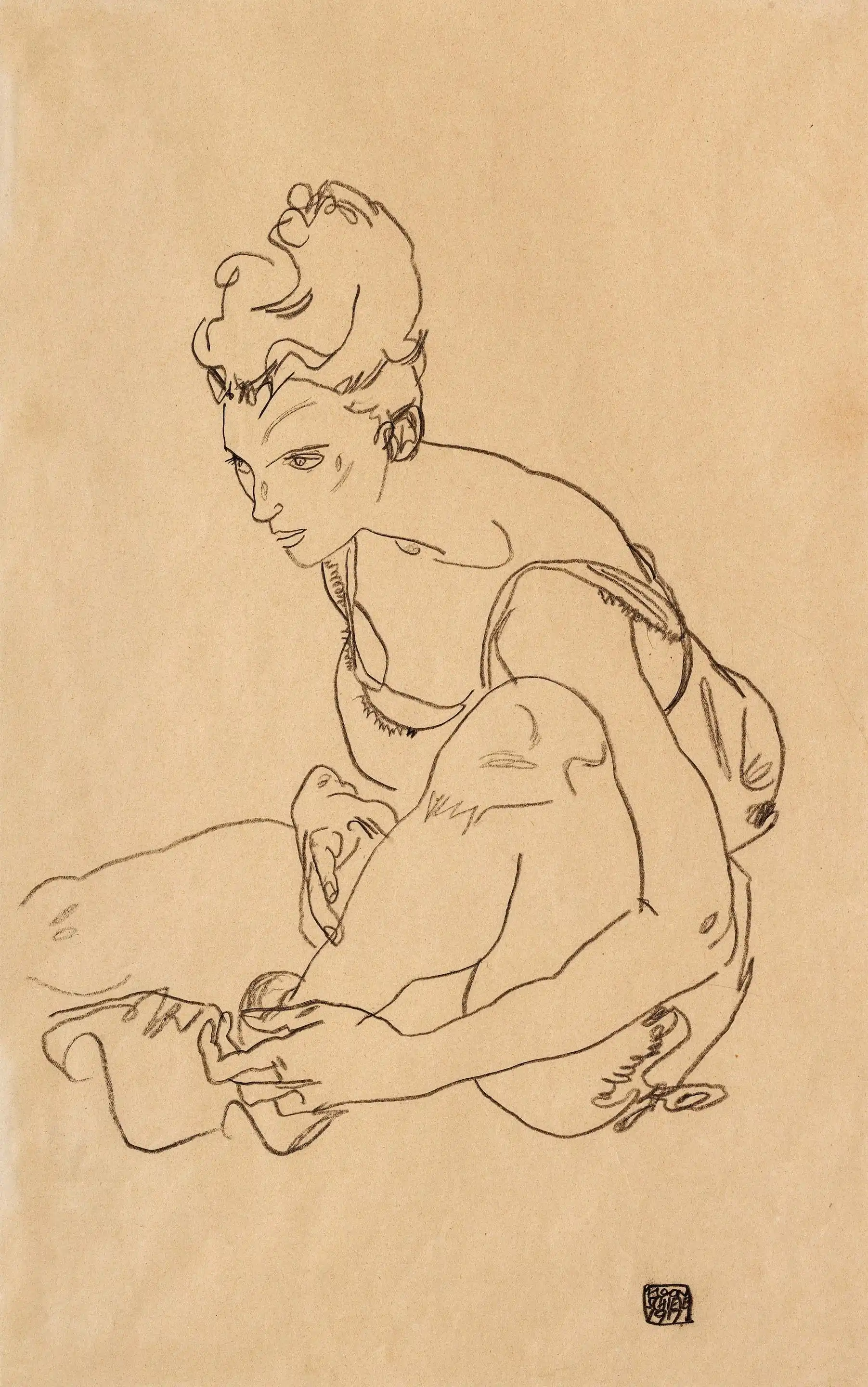
Seated Woman (Sitzende Frau), 1917
black pencil on paper
46.1 × 29.6 cm (18 1/8 × 11 5/8 in)
Auctioned in 2022 at Bonhams for £365,700
(Kallir d1999)
Executed in 1917, this drawing belongs to the quieter, more concentrated group of works Schiele produced during his wartime service. Although conscripted, his weak heart and precise handwriting kept him away from the front, allowing him to continue drawing in the small intervals military life permitted. These conditions shaped the pared‑back clarity of his late style: a confident, economical line and a heightened sensitivity to the sitter’s presence.
In Sitzende Frau, Schiele relies entirely on black pencil, sculpting the figure with a handful of loose, assured strokes. The model has begun to slide a stocking from her raised knee, her undergarments slipping from her shoulders, her hair loosely bound and moments from falling free. With minimal means he conveys the immediacy of a finished painting. What strikes me most is the sitter’s composure: the vulnerability of his 1914–15 figures has vanished, replaced by a quiet, self‑possessed confidence. She knows exactly how she occupies the space, and Schiele responds with a line that feels both tender and alert.
The drawing belongs to a sequence of closely related sheets in the catalogue raisonné, some associated with Adele Harms. In 1917–18, Adele — living directly opposite Schiele’s Hietzinger studio — became one of the most significant presences in his late work. Edith, already married to Schiele, appears less frequently in these intimate modelling sessions, while Adele’s proximity and her complex relationship with the artist shaped the emotional atmosphere of these final years. She later confirmed to Alessandra Comini that their relationship had crossed into intimacy, a detail that adds a certain charge to these late figure studies.
A photograph Schiele made of Adele in 1917 gathers many of the motifs that animate this sequence: the high‑heeled shoes, black stockings, garters, scalloped slip, and loosely bound hair. These elements recur throughout his late erotic vocabulary and resonate strongly in Sitzende Frau, where suggestion replaces explicitness and the sitter’s agency becomes central.
A companion work, Sitzende Frau mit Hut, reveals a different dynamic. Here the sitter meets the viewer directly, fully clothed in a striped blouse associated with Edith, her sensuality shaped not by undress but by Schiele’s familiar motifs — the laced boot, the sculpted calf, the deliberate reveal of skin. Together, the two drawings chart the evolution of his late eroticism: less confrontational, more nuanced, and grounded in the sitter’s own presence. As Jane Kallir has noted, the women of 1917–18 “own their sexuality” and appear as independent, modern figures — a sentiment that feels entirely true when standing before this sheet.
The modest scale and single‑medium execution reflect the material shortages of wartime Vienna, yet the drawing’s presence is unmistakable. Offered in 2022 as part of the Bunzl Family Collection, it stood out for its clarity, emotional directness, and excellent preservation — qualities that contributed to its strong result at Bonhams.
For me, Sitzende Frau is one of those late works where Schiele’s maturity is felt not in grand gestures but in restraint: a handful of lines, a moment of stillness, and a sitter who feels fully alive in her own right. It is a drawing shaped by concentration, empathy, and the quiet confidence of an artist nearing the end of his brief, brilliant arc.


Leave a Reply