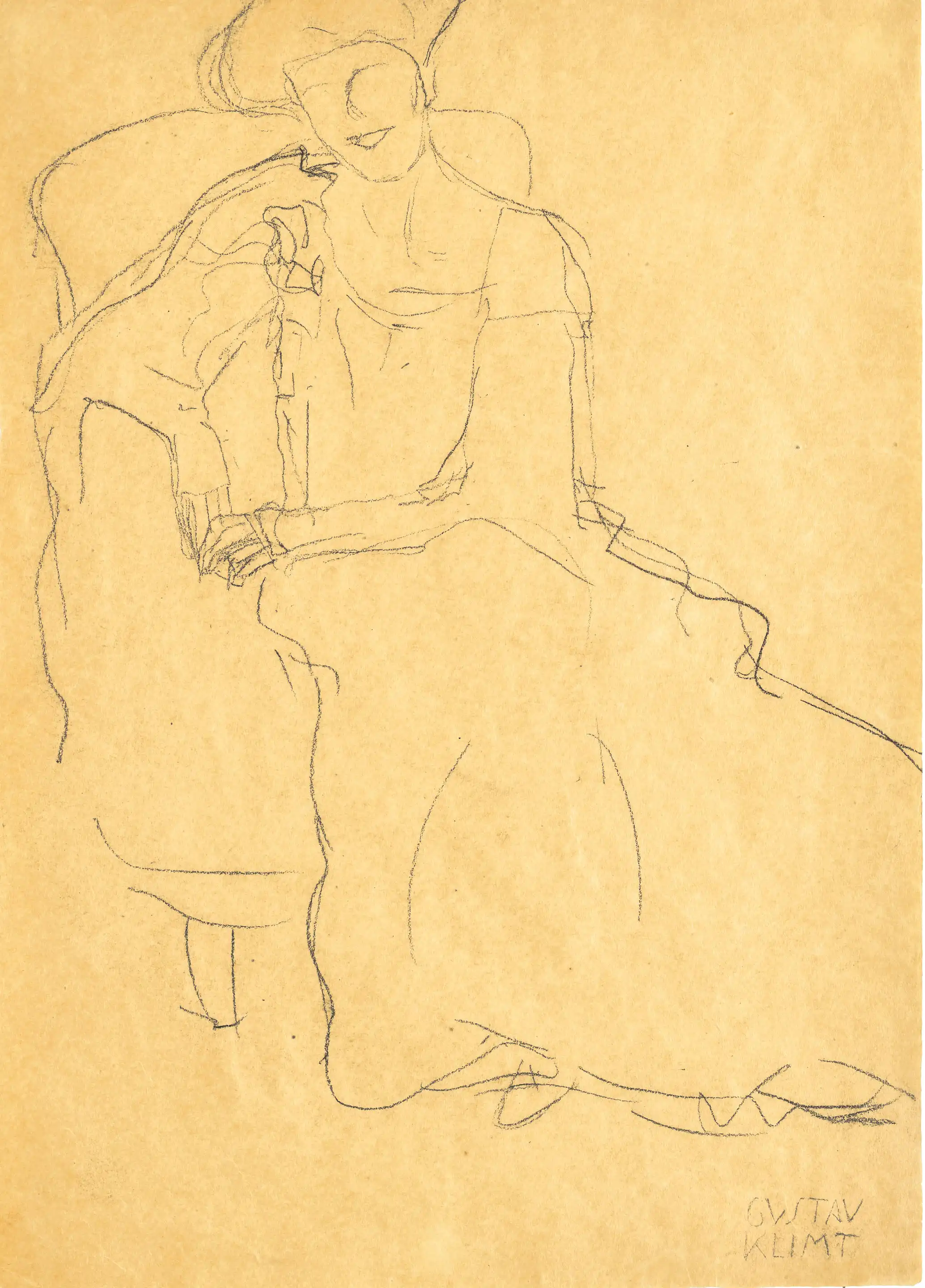
Gustav Klimt:
Seated in an Armchair, Frontal View, Forearms Resting in Lap (Im Lehnstuhl sitzend von vorne, beide Unterarme aufgestützt), 1903
graphite and pencil on paper
45 × 31.7 cm (17 3/4 × 12 1/2 in)
Auctioned at Bonhams in 2022 for US$25,312.50
(Strobl s1085)
Executed in 1903, this drawing is part of the extensive group of preparatory studies Klimt made for the Portrait of Adele Bloch‑Bauer I, now in the Neue Galerie, New York. Commissioned by Ferdinand Bloch‑Bauer as an anniversary gift for his wife’s parents, the portrait became one of Klimt’s most iconic works — and one of the most intensively prepared. Between 1903 and 1904, Klimt produced over a hundred studies, many of which were acquired by the Bloch‑Bauer family.
This sheet shows Adele seated with her forearms gently resting in her lap, her head slightly tilted, and her gaze directed forward. The chair is only lightly suggested, allowing the figure to float in space. Klimt’s line is fluid and economical, capturing the posture with minimal detail but unmistakable presence. The drawing feels quiet and intimate — a moment of stillness shaped by close observation.
Adele Bloch‑Bauer was not only a patron but a central figure in Klimt’s circle. Intelligent, politically engaged, and deeply involved in Vienna’s cultural life, she hosted salons that brought together artists, writers, and thinkers. Her relationship with Klimt was marked by mutual respect and artistic trust, and she remains the only woman he painted twice in formal portrait. Alongside Serena Lederer and August Lederer, the Bloch‑Bauers were among Klimt’s most loyal supporters, collecting his work and preserving his legacy.
These early studies reflect the beginning of that relationship. There is no ornament here, no gold, no pattern — only the first steps toward understanding Adele’s presence, her stillness, and the emotional tone that would later define her painted likeness.
This drawing stands among the quieter sheets in the 1903 group, offering a glimpse into Klimt’s working rhythm: slow, attentive, and emotionally attuned. It is not just a preparatory sketch, but part of the foundation of one of the most celebrated portraits of early modernism.
Leave a Reply