Egon Schiele:
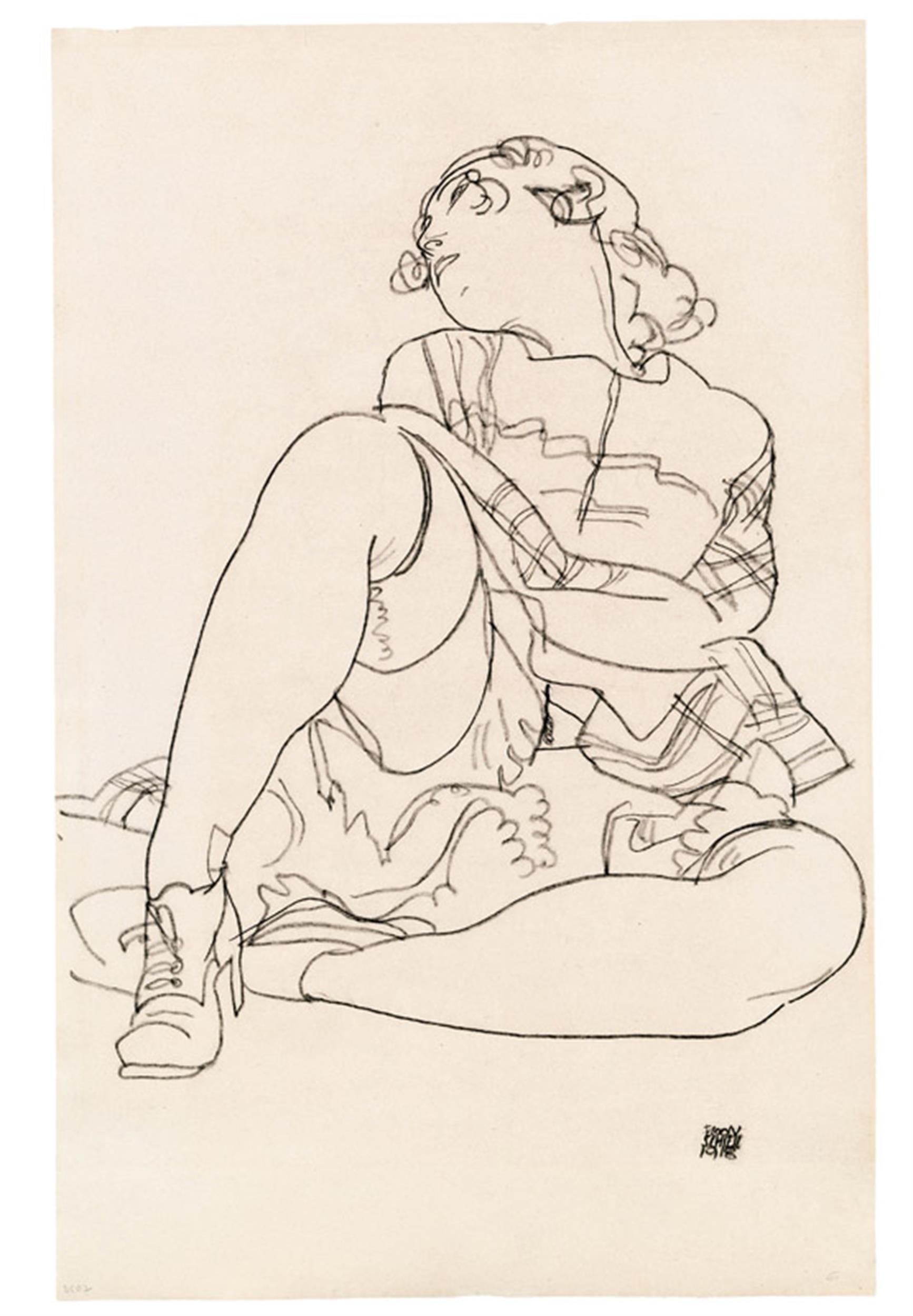
Seated Girl with Head Thrown Back (Sitzendes Mädchen mit zurückgeworfenem Kopf), 1918
charcoal on paper
46 × 29.5 cm
Auctioned at Im Kinsky, Vienna, in 2012 for EUR 384,000
(Kallir d2413)
Egon Schiele’s final year is shaped by an extraordinary devotion to drawing — works that feel distilled, concentrated, and quietly urgent. Seated Girl with Head Thrown Back belongs to this intimate late moment, when his line became both more economical and more tender. With nothing more than charcoal, Schiele captures a presence that feels immediate and unguarded. The girl’s sharply tilted head opens her posture to the viewer, while the compact seated pose lends the sheet a sense of inwardness, as if the figure is caught between exposure and retreat.
Throughout 1918 Schiele relied on the expressive clarity of contour. Colour appears only rarely; instead, he trusted the line to carry everything — structure, emotion, and the subtle weight of the body. In this drawing, the contours flow with a calm assurance, while the interior markings build volume with remarkable sensitivity. The girl’s strong calves, rounded cheeks, and dense curls emerge with a softness that contrasts with the firmness of the pose. Her dress, pushed upward by the provocative seated position, reveals a fleeting glimpse of the body beneath. The stockings and ruffled edges, almost pressing forward, add a gentle erotic tension — not loud or theatrical, but woven into the natural rhythm of the figure. Schiele often worked with this kind of intimacy: a mixture of sensuality, vulnerability, and quiet observation.
What makes this sheet especially moving is the sense of stillness it carries. Schiele’s late drawings often feel like moments held in suspension — as if he were trying to fix something fragile before it slipped away. The girl’s backward‑tilted head, the slight torque of her torso, the way her hair gathers into soft curls: all of it is rendered with a warmth that suggests both closeness and care. Even the untouched areas of the paper contribute to the atmosphere, allowing the figure to breathe within the space.
The provenance adds its own layer of history. Once owned by Direktor Blauensteiner and later handled by Galerie Würthle — a gallery deeply intertwined with the early preservation of Schiele’s legacy — the drawing eventually entered a private collection in Lower Austria.
It’s a gentle reminder of how Schiele could capture a life with almost nothing: just charcoal, paper, and a moment of human nearness.

Leave a Reply