Młoda Polska: Władysław Ślewiński
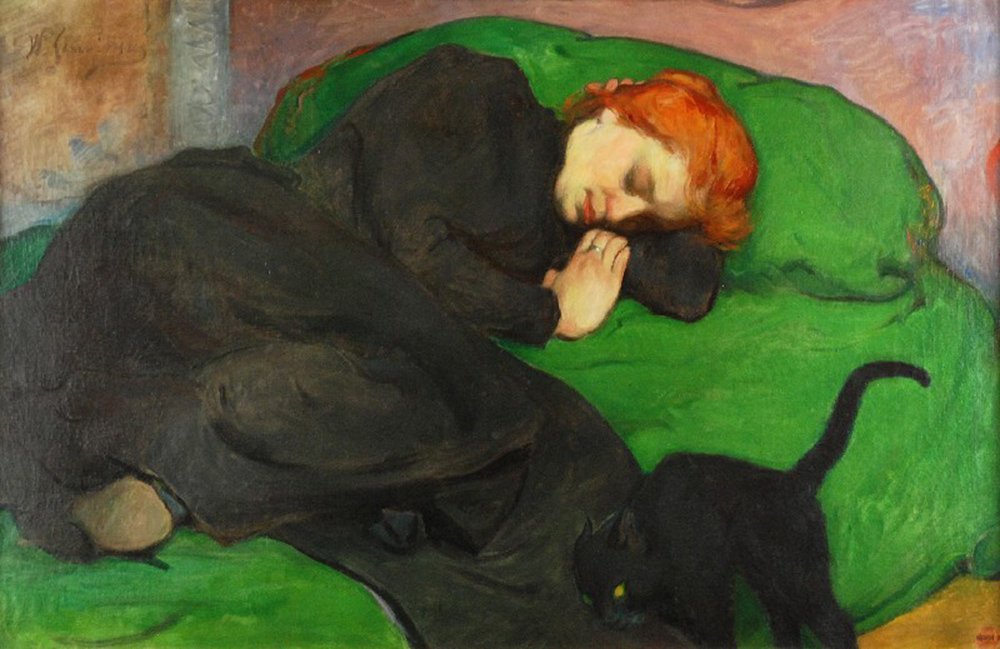
Sleeping Woman with a Cat (Śpiąca kobieta z kotem), 1896
Oil on canvas
66 × 100 cm
Private collection
Auctioned at Rempex, Warsaw, 2005 for approx. USD 1,000,000
Although Ślewiński’s artistic language was shaped above all by his close affinity with Paul Gauguin, this serene interior comes surprisingly close to the sensibility of les Nabis. The flattened planes, muted harmonies, and decorative stillness echo their search for a contemplative art—one that transforms everyday life into something quietly symbolic.
Ślewiński often returned to scenes of resting women, moments of unguarded domestic intimacy that allowed him to explore simplified form, soft contour, and a subdued, earthy palette. In this work, the contrast between the vibrant green bedding, the figure’s red hair, and the deep black of her dress and the cat creates a striking chromatic harmony—at once bold and hushed. The cat, with its luminous eyes and quiet presence near the woman’s legs, adds a note of watchful companionship, anchoring the composition in a mood of tranquil domesticity.
Before its appearance on the market, the painting had been on long-term deposit at the National Museum in Warsaw, where it was shown in the permanent collection. Its emergence at auction in 2005 drew considerable attention: works of this quality by Ślewiński rarely surface, and the price achieved was regarded as exceptionally high for the Polish art market at the time.
Władysław Ślewiński (1856–1918) was one of the key painters associated with the Young Poland (Młoda Polska) movement, and among the few Polish artists who absorbed Post‑Impressionist ideas directly at their source. He likely met Gauguin as early as 1888, and the two soon became part of the same Parisian circle. At the restaurant Chez Madame Charlotte, they mingled with the artistic and intellectual elite—August Strindberg, Alphonse Mucha, and, from the Polish community, Zenon Przesmycki, Stanisław Wyspiański, Józef Mehoffer, and Karol Maszkowski.
It was at the Café Volpini that Ślewiński first encountered Gauguin’s theory of Synthetism, with its emphasis on expressive contour and the primacy of the artist’s inner vision. Between 1889 and 1896 he worked in Pont‑Aven, becoming part of the colony gathered around Gauguin and the aesthetics of Cloisonnism. These years shaped his mature style and, in turn, fed back into the decorative and symbolist tendencies of the Young Poland movement.
In Sleeping Woman with a Cat, these influences converge with unusual softness: a Pont‑Aven structure, a Nabis‑like quietude, and Ślewiński’s own instinct for intimate, human warmth.


Leave a Reply