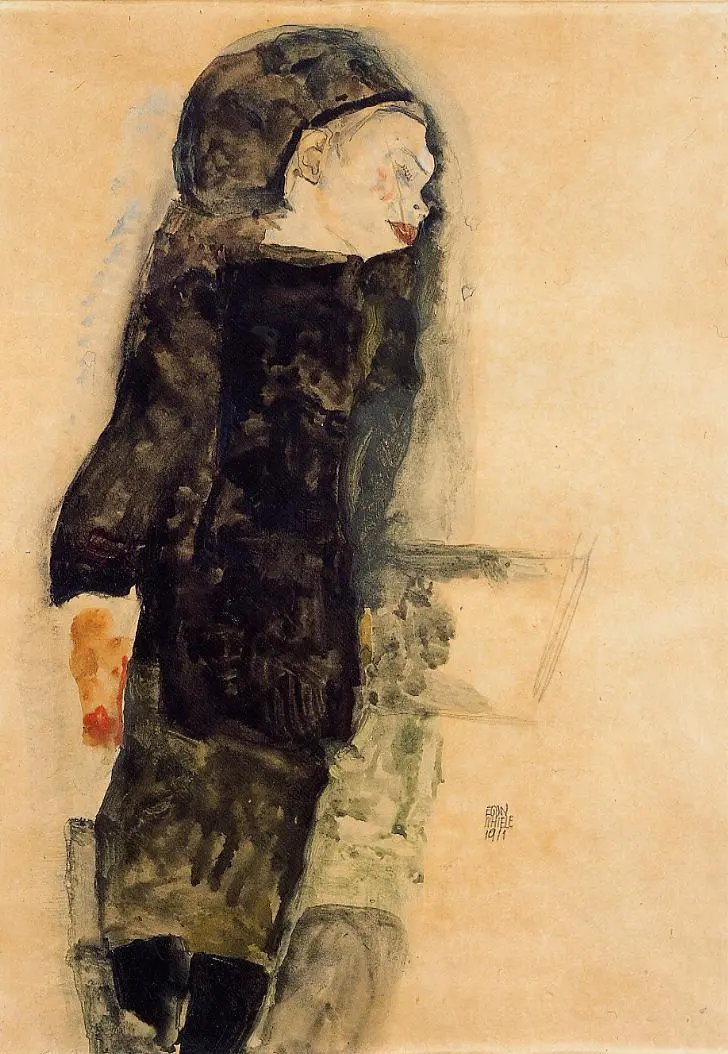
Egon Schiele:
Child in Black (Kind in Schwarz) (1911)
Gouache, watercolor, and pencil on paper
47.7 × 31.8 cm
Private collection
(Kallir d767)
Egon Schiele often turned his gaze toward the quiet complexities of human emotion. In Child in Black (Kind in Schwarz), painted in 1911, he captures a young girl wrapped in dark clothing, her expression calm but distant — somewhere between introspection and detachment. The background is left bare, sharpening the focus on her presence. She doesn’t pose or perform; she simply exists, still and self-contained.
Schiele’s use of gouache, watercolor, and pencil gives the work a delicate, almost translucent texture. The black garment envelops the child like a shadow, while her pale skin and fine features emerge with gentle clarity. His lines are confident yet sensitive, tracing the figure with a kind of reverence that feels both tender and unflinching.
What’s striking is the emotional openness of the piece. It doesn’t dictate how we should feel — instead, it invites us to sit with the ambiguity. There’s no idealized innocence here, no sentimental gloss. Just a moment of quiet presence, rendered with honesty and care.
At this point in his career, Schiele was stepping away from the ornamental influence of Gustav Klimt and carving out his own voice — one that leaned into raw emotion and psychological depth. Child in Black is part of that evolution: a portrait that’s less about likeness and more about essence.
Now held in a private collection, this work continues to resonate. It reminds us that even in stillness, there’s a world of feeling — and that sometimes, the most powerful portraits are the ones that whisper rather than shout.


Leave a Reply