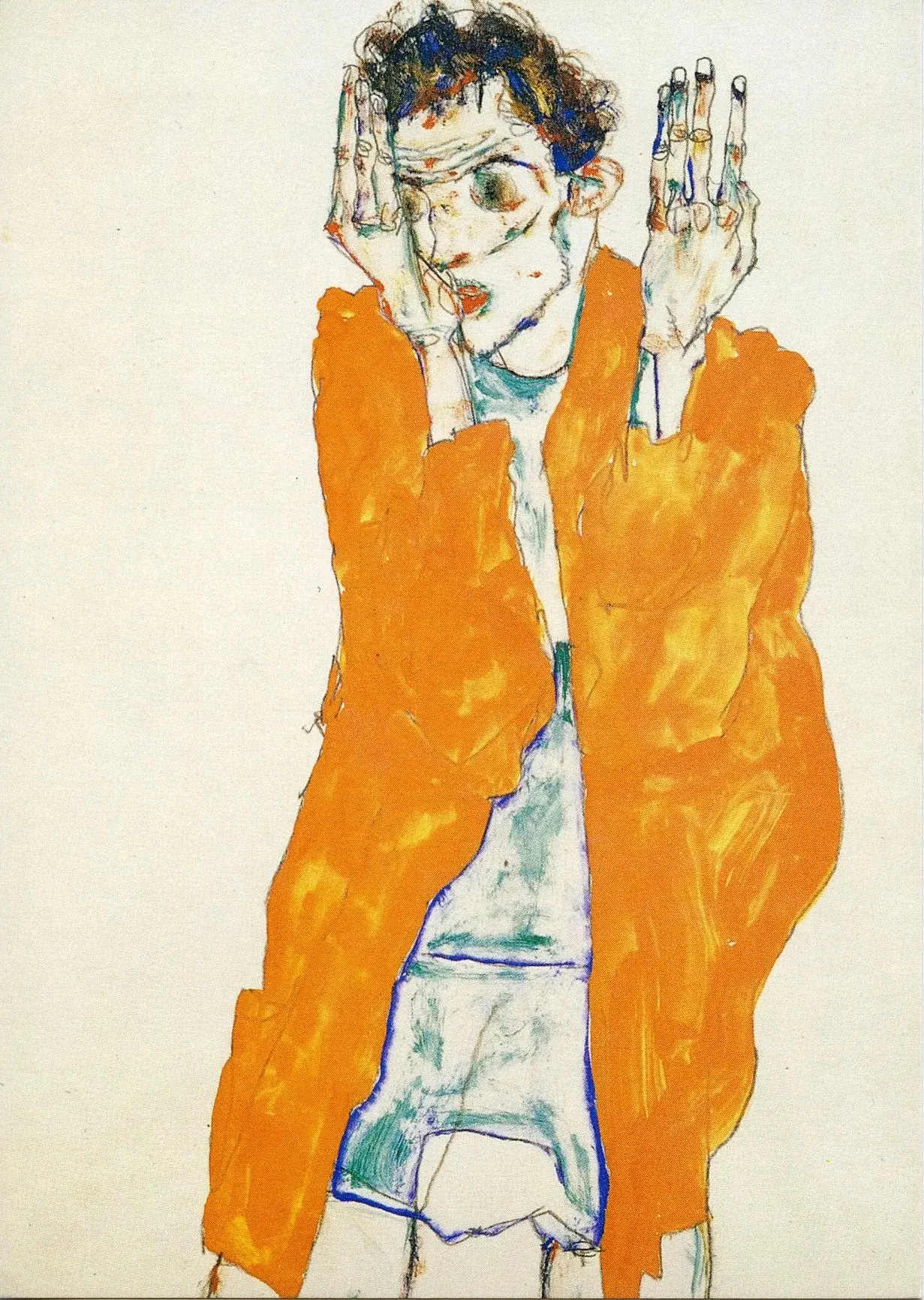
Egon Schiele:
Self-Portrait with Raised Arms (Selbstbildnis mit erhobenen Armen) (1914)
Gouache and pencil on paper
48.4 × 32.1 cm
Private collection
(Kallir d1648)
This gouache and pencil drawing from 1914 shows Schiele in a moment of stark self-exposure. The title suggests openness or surrender—but what we see is more guarded, more ambiguous. His arms are bent at the elbows, framing his face in a tense, almost defensive gesture. The hands are exaggerated: long fingers, blackened nails. They seem to shield and accuse at once.
The face is pale and tightly drawn, the eyes wide and unflinching. There’s no theatricality—just a direct, unsettled gaze. The orange garment, possibly a robe or coat, dominates the composition. It wraps the figure in a kind of emotional armor, vivid and impenetrable, while the body beneath remains exposed and skeletal.
Schiele’s line is jagged and urgent. The gouache flares in the garment, while the pencil lines stay sharp and skeletal—creating tension between surface and structure. The application is uneven, with parts of the figure fading or left unfinished. This isn’t a polished portrait—it’s a psychological sketch, caught mid-thought. The blank background isolates the figure completely. There’s no room, no setting—just Schiele, suspended in paper and self-awareness.
This drawing belongs to a series of self-portraits from 1914, a year marked by rupture: the outbreak of war, the lingering shadow of his 1912 imprisonment, and a growing tension between eroticism and doubt. Unlike his earlier, more stylized self-images, this one is stripped down. The nudity isn’t provocative—it’s brittle. The gesture isn’t performative—it’s unresolved.
Its relative obscurity only adds to its intensity. It’s not a Schiele that seduces—it confronts.
More self-portraits from 1914 will follow in future posts, tracing this shift in tone and gesture.
Leave a Reply