
The Imitation Game: The Dancer (1916)
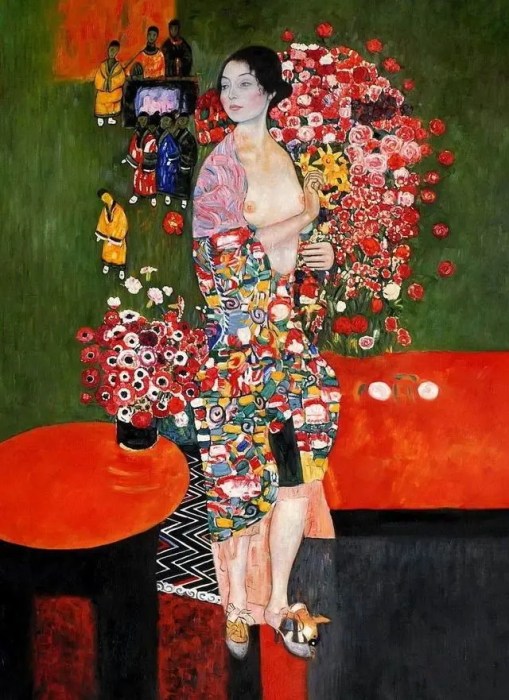
The image above is not a real Klimt—it’s a widely circulated fake. In the past, I maintained a large visual archive documenting the many forged or misattributed Klimt paintings that continue to appear online and in print. That album is gone now, and I’m slowly rebuilding it here—piece by piece. These forgeries surface regularly, and it’s important to address them clearly and publicly. I often notice that images shared on social media, in auction listings, or even in gallery contexts are clearly not by Klimt, despite being labeled as such.
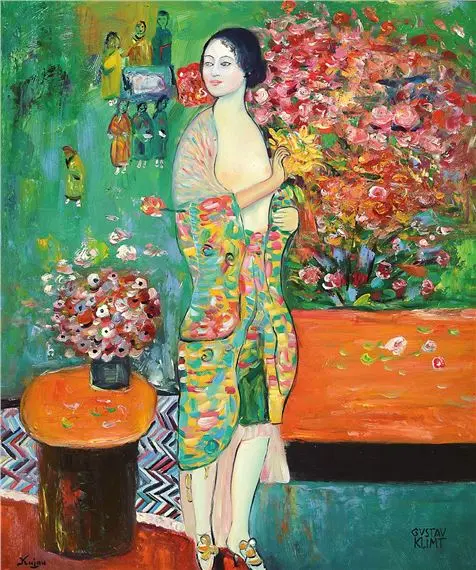
One persistent example is the painting often referred to as “The Dancer” (1916). A reproduction of this work appears frequently, but it diverges significantly from the original held at the Neue Galerie in New York. The most common fake version is noticeably larger in scale, and the vibrant orange tones of the original have been replaced with a saturated red. This altered version is not a Klimt—it is a handmade copy, typically produced by a commercial firm in Asia. These reproductions are available to order and are often marketed as “authentic-style” Klimts, which they are not.
The original Dancer will be featured in a dedicated post to come, where I’ll highlight its provenance, exhibition history, and visual subtleties. For now, a few key distinctions are worth noting:
-The authentic painting is part of the Neue Galerie’s permanent collection and reflects Klimt’s late-period restraint. It was likely completed in the final years of his life, when his palette had softened and his ornamental language grew more introspective.
-Visually, the real Dancer is slightly off-center, her left arm raised as she holds a yellow flower. She is framed by a vivid robe—dense with geometric and organic motifs—and surrounded by a layered background: a floral field on the right, a chevron-patterned rug and vase below, and a narrative tableau on the left featuring four figures and a glowing hearth.
-These imitations persist partly because Klimt’s style is so iconic—and so often misunderstood. The allure of ornament, gold, and sensuality leads many to equate surface with authenticity. But Klimt’s late works often shift from gold-leaf opulence to layered symbolism and textile-like patterning. The Dancer is a prime example—ornamental, yes, but emotionally restrained.
If you search for “The Dancer” Klimt online, you’ll encounter a wide array of versions—some cropped, some recolored, some entirely invented. None of these have any legitimate connection to the original painting. I’ll be adding a selection of these misleading variants beneath this post, as part of the ongoing effort to document and clarify.
So, a gentle reminder: don’t be fooled. Whether you’re buying, posting, or sharing, please take a moment to verify the source and authenticity of the image. Klimt’s work deserves that care—and so do you.


Leave a Reply