Dutch Modernism: Jan Sluijters
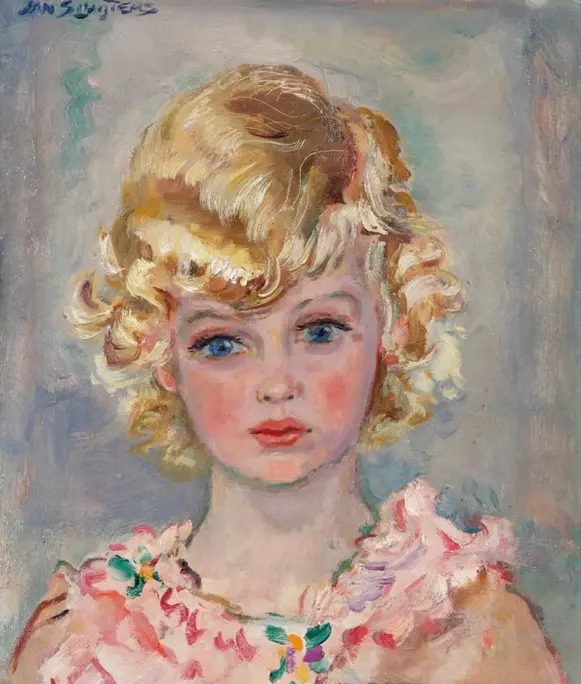
A Portrait of a Young Girl (n.d.) – Jan Sluijters
Oil on canvas
41.5 × 36.5 cm
Auctioned at Christie’s in 2013
This intimate portrait of a young girl offers a quiet counterpoint to Jan Sluijters’ more exuberant urban scenes and nudes. Undated and modest in scale, the painting was auctioned at Christie’s in 2013. Based on provenance and style, it was likely painted between the 1930s and 1950s, during Sluijters’ mature period. It reflects his sensitivity to character and mood, even in small-format works.
The girl’s gaze is direct but unforced—serene, not staged. Her blue eyes hold the viewer without theatricality, suggesting quiet confidence rather than innocence. The soft curls, flushed cheeks, and floral garment are rendered with affection, but the painting avoids sentimentality. It’s composed, not decorative.
Sluijters’ brushwork is loose and expressive, especially in the hair and dress. Warm tones in the face and clothing contrast with the cooler, atmospheric background, creating a sense of depth without formal modeling. Though impressionistic in execution, the portrait shows restraint. It’s a study in presence—colorful, yes, but grounded.
Jan Sluijters (1881–1957), born in ’s-Hertogenbosch, was one of the leading figures in Dutch modernism. After studying at the Rijksakademie van Beeldende Kunsten in Amsterdam, he won the Prix de Rome in 1904, which allowed him to travel through Italy and Spain. But it was his time in Paris that proved transformative: there, he encountered Fauvism and the early stirrings of Cubism, both of which would leave lasting marks on his palette and composition.
He moved fluidly between luminism, expressionism, and cubist-inflected abstraction, often returning to figuration with renewed intensity. His subjects ranged from nightlife and dancers to domestic scenes and commissioned portraits. He was a founding member of the Moderne Kunstkring, a group that introduced international avant-garde art to Dutch audiences and helped shape the country’s modernist trajectory.
Throughout his career, Sluijters remained responsive to contemporary movements while maintaining a distinct voice. His commissioned portraits of prominent Dutch figures added to his reputation, but it was his restless experimentation and commitment to color that defined his legacy. He died in Amsterdam in 1957, leaving behind a body of work that continues to bridge tradition and innovation.

Leave a Reply