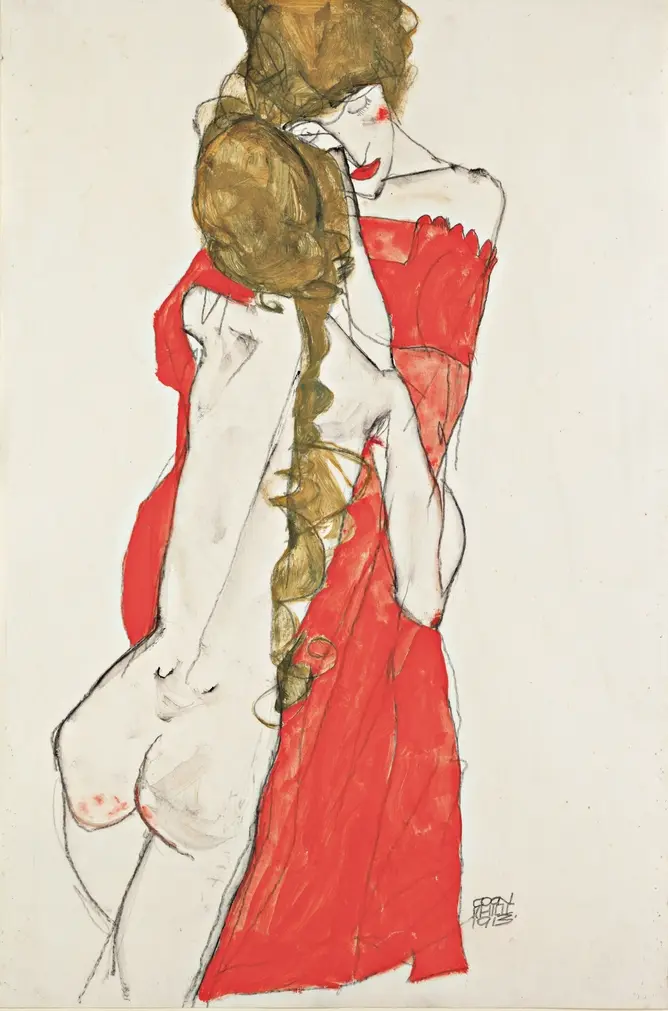
Egon Schiele:
Mother and Daughter (Mutter und Tochter) (1913)
Pencil, gouache on paper
47.9 × 31.1 cm
© Leopold Museum, Vienna
(Kallir d1298)
Egon Schiele’s Mother and Daughter (Mutter und Tochter) (1913) is a work of aching intimacy and stark psychological tension. Rendered in pencil and gouache on paper, the composition captures a moment of fragile proximity between two figures—mother and daughter—whose entwined forms suggest both tenderness and estrangement.
The mother’s angular limbs and protective posture echo Schiele’s fascination with corporeal vulnerability, while the child’s gaze—direct, almost accusatory—pierces the viewer with unsettling clarity. Their bodies, outlined with Schiele’s characteristic urgency, seem suspended in a space devoid of comfort or domestic warmth. Gouache washes lend a bruised pallor to the skin, heightening the sense of psychic exposure. Even the negative space around them feels charged, as if silence itself has weight.
Created during a period of personal upheaval and artistic maturation, this drawing belongs to a defining year in Schiele’s development, when his palette darkened, his lines grew more skeletal, and his subjects—especially women and children—became vessels of emotional ambiguity. The influence of Gustav Klimt had begun to recede, replaced by a more ascetic, introspective language of form.
Mother and Daughter resists sentimentality. Instead, it offers a raw meditation on dependency, identity, and the silent distances that can exist even within the closest relationships. It is not a portrait of motherhood as ideal, but as lived—complex, unresolved, and deeply human.

Leave a Reply