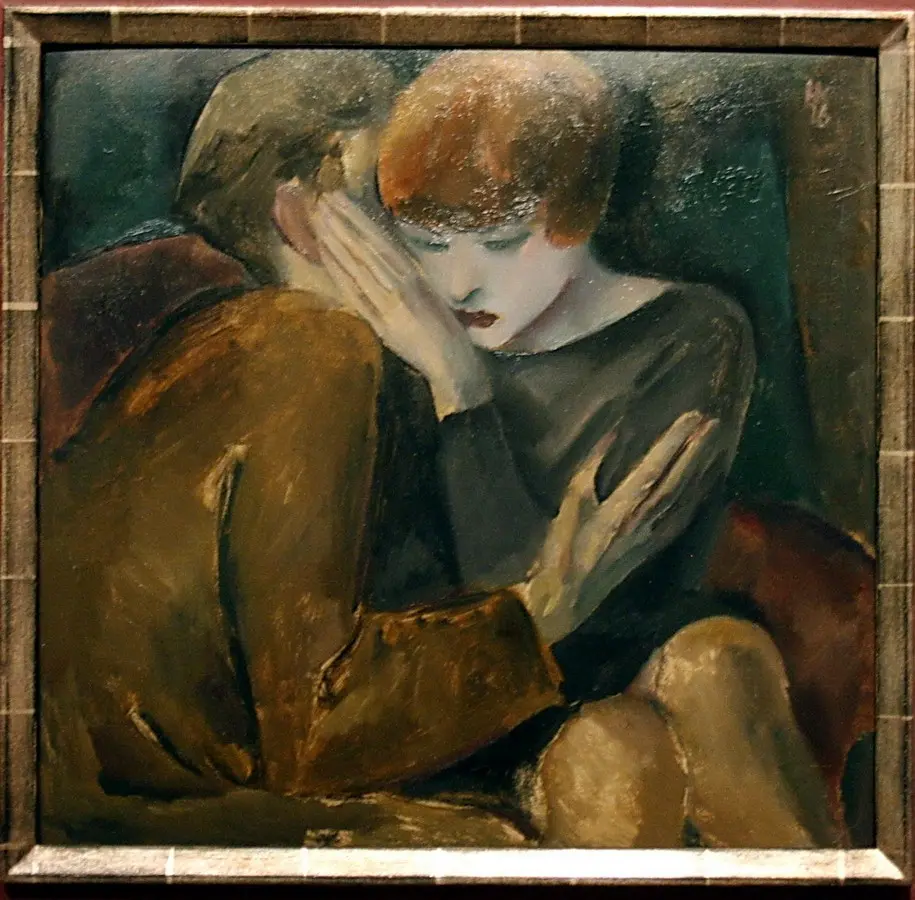
Austrian Modern Art: Karl Hauk
Lovers (Liebespaar), 1928
Oil on cardboard
57.5 × 59.5 cm
Wien Museum or Brücke Museum (location uncertain)
Karl Hauk (1898–1974) was born in Klosterneuburg, just outside Vienna—a town also associated with Egon Schiele. After his early years there, Hauk moved to Linz, where his artistic path began to take shape. He studied under Alois Delug, a professor at the Vienna Academy of Fine Arts—perhaps best known today for having rejected Adolf Hitler’s application.
Hauk’s career as a painter began in earnest after the First World War. He exhibited at the Vienna Secession, which, contrary to popular belief, did not dissolve with Klimt’s departure. The Secession remained active well into the 1920s and still exists today as an institution. In 1927, Hauk also joined the Hagenbund, a progressive artists’ association that often served as a counterpoint to the more conservative Künstlerhaus.
Painted in 1928, Lovers (Liebespaar) captures a moment of quiet intimacy: two figures rendered with the cool detachment of Neue Sachlichkeit, yet softened by the warmth of Hauk’s palette. The composition suggests both closeness and emotional distance—a hallmark of interwar ambivalence. The figures are neither idealized nor caricatured; instead, they seem suspended in a moment of psychological stillness, their relationship defined as much by silence as by touch.
Hauk’s work from this period aligns with the broader currents of Austrian modernism, though he remains less well-known than contemporaries like Carry Hauser, Sergius Pauser, or Anton Kolig. While Hauser leaned toward expressionist allegory and Pauser toward realist portraiture, Hauk’s style occupied a quieter register—introspective, restrained, and often tinged with melancholy.
Tragically, many of Hauk’s most ambitious works were destroyed during the Second World War. These included monumental frescoes painted in 1928 for the assembly halls of the Upper Austrian Chamber of Labor and the central railway station in Linz. Both cycles were lost to fire during the war, erasing a significant chapter of his public oeuvre.
From 1933 onward, Hauk lived primarily in Vienna and turned increasingly toward religious themes. This shift may have offered a degree of protection during the Nazi period, allowing him to continue working while many of his contemporaries faced persecution or exile. Like many interwar artists, Hauk’s reputation faded in the postwar years.
Recent exhibitions at the Albertina and the Wien Museum have helped restore his place in Austrian art history. His rediscovery reflects a broader reappraisal of interwar Austrian modernism, as institutions revisit artists whose careers were interrupted or obscured by war and regime change.

Leave a Reply