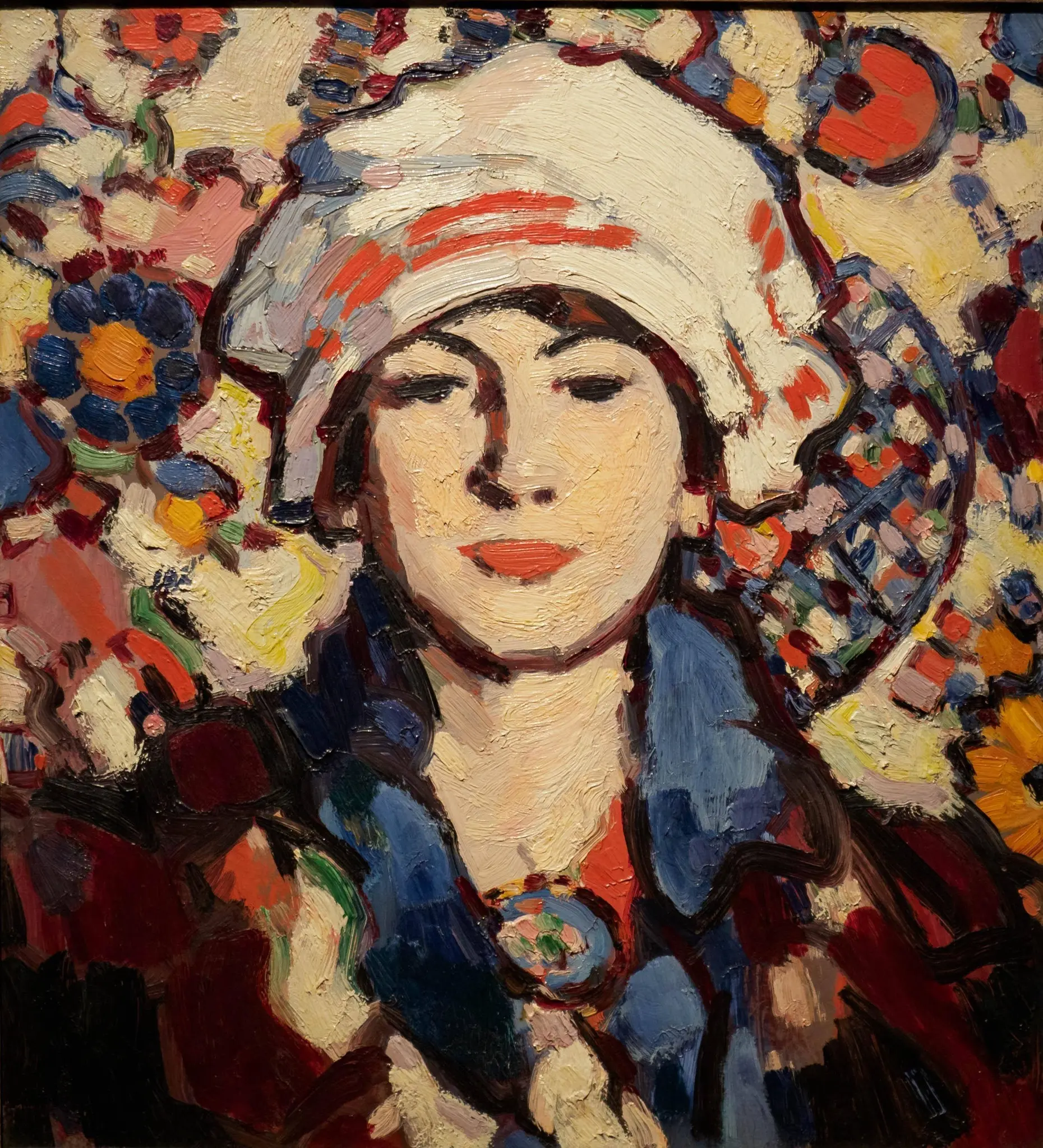
Scottish Colourists: John Duncan Fergusson
Le voile Persan (1909)
Oil on board
51.2 × 45.9 cm
©The Hunterian, University of Glasgow, Scotland
The sitter in Le voile Persan is widely believed to be Anne Estelle Rice, one of the most influential figures in Fergusson’s life and work. Born in Pennsylvania in 1877, Rice was an Irish-American painter whose early career defied convention. Despite her parents’ objections, she completed her art degree in 1897 and began working as an illustrator for major publications, including Harper’s Bazaar. In 1905, she was sent to Paris by Rodman Wanamaker—owner of a prominent department store—to document the latest Parisian fashions for his magazine. She collaborated with her friend Elizabeth Dryden, who provided the accompanying reviews.
Rice met Fergusson in 1907 at Paris-Plage, a fashionable seaside resort. Their connection was immediate and profound. They became lovers and artistic collaborators, remaining closely involved for six formative years. Fergusson, already attuned to the rhythms of modern life, encouraged Rice to shift her focus from illustration to painting. In turn, Rice became one of his most influential muses—her presence and spirit animating many of his works from this period.
Together, they contributed to the Philadelphia Public Ledger and later to Rhythm, the journal Fergusson co-founded with John Middleton Murry. Rhythm became a crucible for modernist experimentation, bridging visual art, literature, and musical theory. Fergusson’s editorial vision helped shape its interdisciplinary tone, with Rice contributing both illustrations and aesthetic direction.
Rice’s own paintings, often characterized by vivid colour and expressive brushwork, were exhibited in Paris and London, earning recognition beyond her association with Fergusson. Her work reflected a bold engagement with Post-Impressionist and Fauvist influences, and she remained committed to painting long after their romantic relationship ended.
Fergusson had settled in Paris shortly after meeting Rice, drawn to the city’s avant-garde energy and modernist ferment. He immersed himself in its artistic circles, forging connections with figures such as Auguste Chabaud, André Derain, Albert Marquet, Jean Metzinger, and Pablo Picasso. Yet it was the work of Henri Matisse and the Fauves that most profoundly shaped his early practice. Their radical use of colour and expressive freedom offered Fergusson a new visual language—one that he adapted with a distinctly Scottish sensibility.
Le voile Persan, painted in 1909, exemplifies this synthesis. The sitter’s stylized pose, the rich palette, and the decorative veil evoke both Eastern exoticism and Parisian elegance. The title itself reflects early 20th-century European fascination with Orientalist motifs—filtered here through a decorative lens rather than ethnographic intent. Fergusson’s use of oil on board lends the work a tactile immediacy, allowing for rapid, expressive brushwork that suits the intimate scale and personal subject.
This is not merely a portrait, but a testament to Rice’s influence and Fergusson’s embrace of modernity. The painting stands as a luminous fragment of their shared creative life—intimate, experimental, and deeply attuned to the spirit of the age.

Leave a Reply