The Italian Connection with Klimt: Felice Casorati
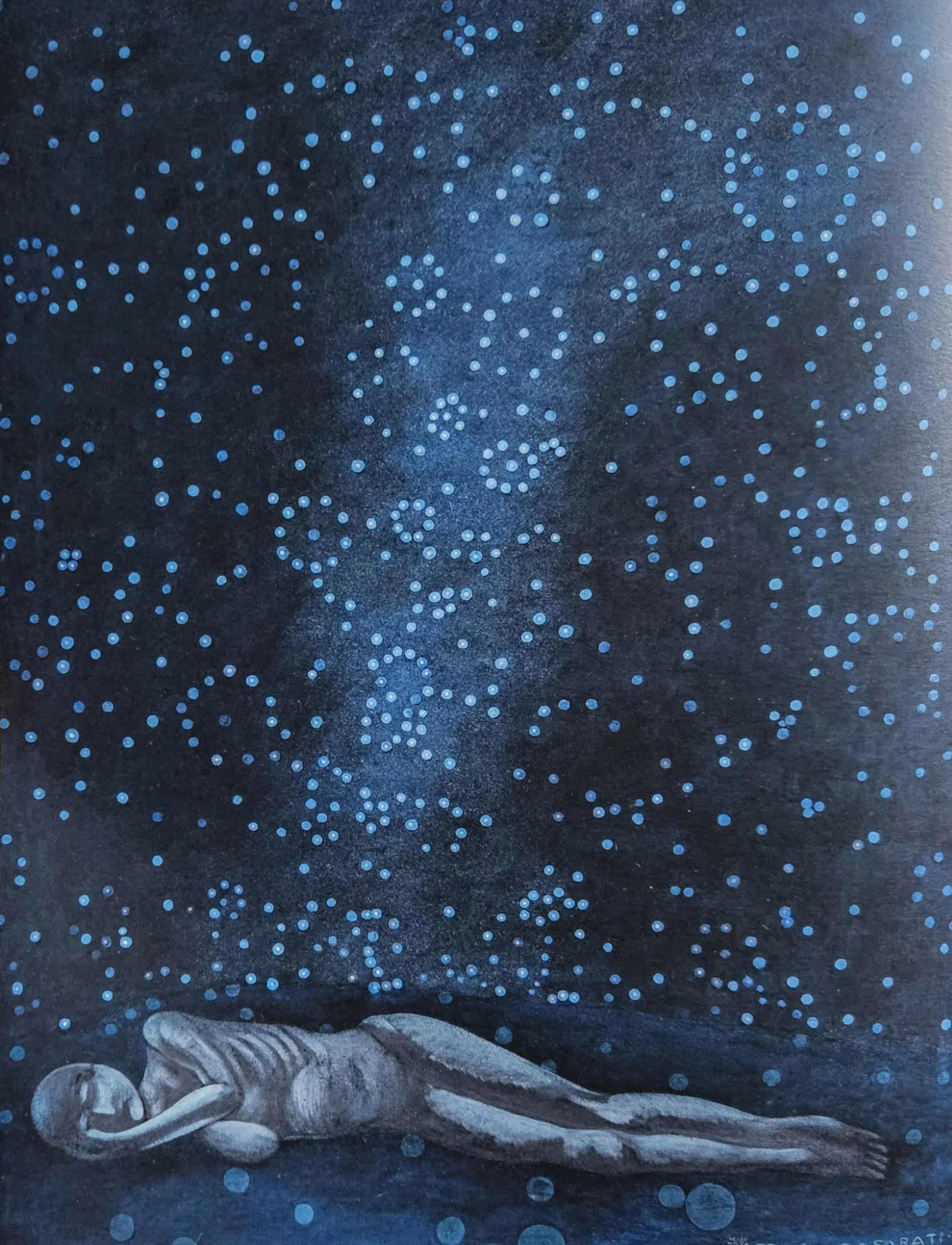
The Milky Way (La via lattea), 1914
Tempera and oil on canvas
174.5 × 138.5 cm
Private collection
Blue rings, scattered lights, and a pale vertical band of stars fill almost the entire canvas. Only at the very bottom does a reclining figure appear. In The Milky Way (La via lattea), painted in Verona in 1914, Felice Casorati transforms the night sky into a vast ornamental universe.
Summer Nights at San Floriano and the Veronese Journal
Casorati developed the imagery for The Milky Way after spending the summer of 1913 at San Floriano, a hillside village in the Valpolicella area outside Verona. Working in a temporary studio inside the villa of his early patrons, the Veronesi family, he began recording the summer night sky in studies such as Nocturne at San Floriano (Notturno a San Floriano, 1913) and Milky Way and Boats (Via lattea e barche, c. 1913).
During this same period in Verona, Casorati joined three young local intellectuals, Augusto Calabi, Pino Tedeschi, and Umberto Zerbinati, to launch La Via Lattea, an avant-garde magazine uniting visual art and literature. Printed in a square format with refined Secessionist typography, the journal issued a promotional prospectus followed by two numbers in August and September 1914 before the outbreak of the First World War halted publication. Alongside the cover design, Casorati contributed independent woodcuts echoing the linear clarity of Gustav Klimt and Aubrey Beardsley. On this large canvas from 1914, he translated that graphic discipline into tempera and oil, turning starlight into an architectural pattern of crisp circular rings.
Monochrome Anatomy Beneath Celestial Ornament
A stark tonal divide separates earth from sky across the composition. Along the dark horizon at the bottom, the reclining figure appears drained of warm flesh color. Casorati modeled her elongated torso and prominent ribs in cool silver-gray shades, giving her body the stillness of carved stone. Larger translucent blue discs drift across the dark ground beside her feet.
The stars do not behave like stars. Many form circles, clusters, and repeating patterns that seem carefully constructed rather than observed. A pale vertical band rises through the center of the composition, suggesting the Milky Way itself, yet Casorati avoids scientific description. The night sky becomes a decorative language of dots, rings, and rhythms.
Even the larger blue discs scattered across the foreground seem suspended between earth and sky. Rather than creating an illusion of depth, Casorati arranges celestial forms almost like motifs on a textile or a printed page, reflecting the graphic discipline visible in his contemporary work for La Via Lattea.
Unlike the lush floral robes in The Prayer, 1914, painted during the same Veronese period, this canvas strips away terrestrial ornament. At the lower right corner, the artist signed the dark ground in pale blue capitals: “F. CASORATI.”
From the 1914 Venice Biennale to Secessione Romana
Casorati debuted The Milky Way in Sala 9 of the eleventh Venice Biennale in 1914 as part of a trio of visionary canvases alongside Transfiguration (Trasfigurazione) and The Rainbow (L’arcobaleno). Contemporary critics immediately recognized how deeply Gustav Klimt’s 1910 Venice solo room had shaped his anti-naturalistic direction.
Across Italy, other artists were also exploring decorative alternatives to naturalism, among them Galileo Chini in The life and animation of the meadows, 1914, Vittorio Zecchin, Gino Rossi, and Luigi Bonazza in Portrait of Italia Bertotti, 1910, but few pushed the night sky as far from observation and as close to ornament as Casorati does here.
At the same time, Casorati exhibited regularly with the Secessione Romana, showing alongside progressive painters such as Camillo Innocenti, author of Morning, 1908, and Plinio Nomellini. By 1915, the Roman Secession awarded Casorati a dedicated solo room before wartime military service interrupted his studio work. Because the 1914 Biennale marked his final Venice appearance for a full decade until his 1924 solo show, The Milky Way remained largely hidden in a private collection. It returned to the Venice Biennale in 1986 for the Arte e scienza exhibition and reappeared in 2026 during shows at the Galleria Civica d’Arte Moderna e Contemporanea in Turin and the Studio Museo Felice Casorati in Pavarolo.
The figure occupies only a narrow strip at the bottom of the canvas. Everything else belongs to the night sky. Faced with that vast field of stars, the human body seems fragile, temporary, almost incidental.
Leave a Reply