The Italian Connection with Klimt: Galileo Chini
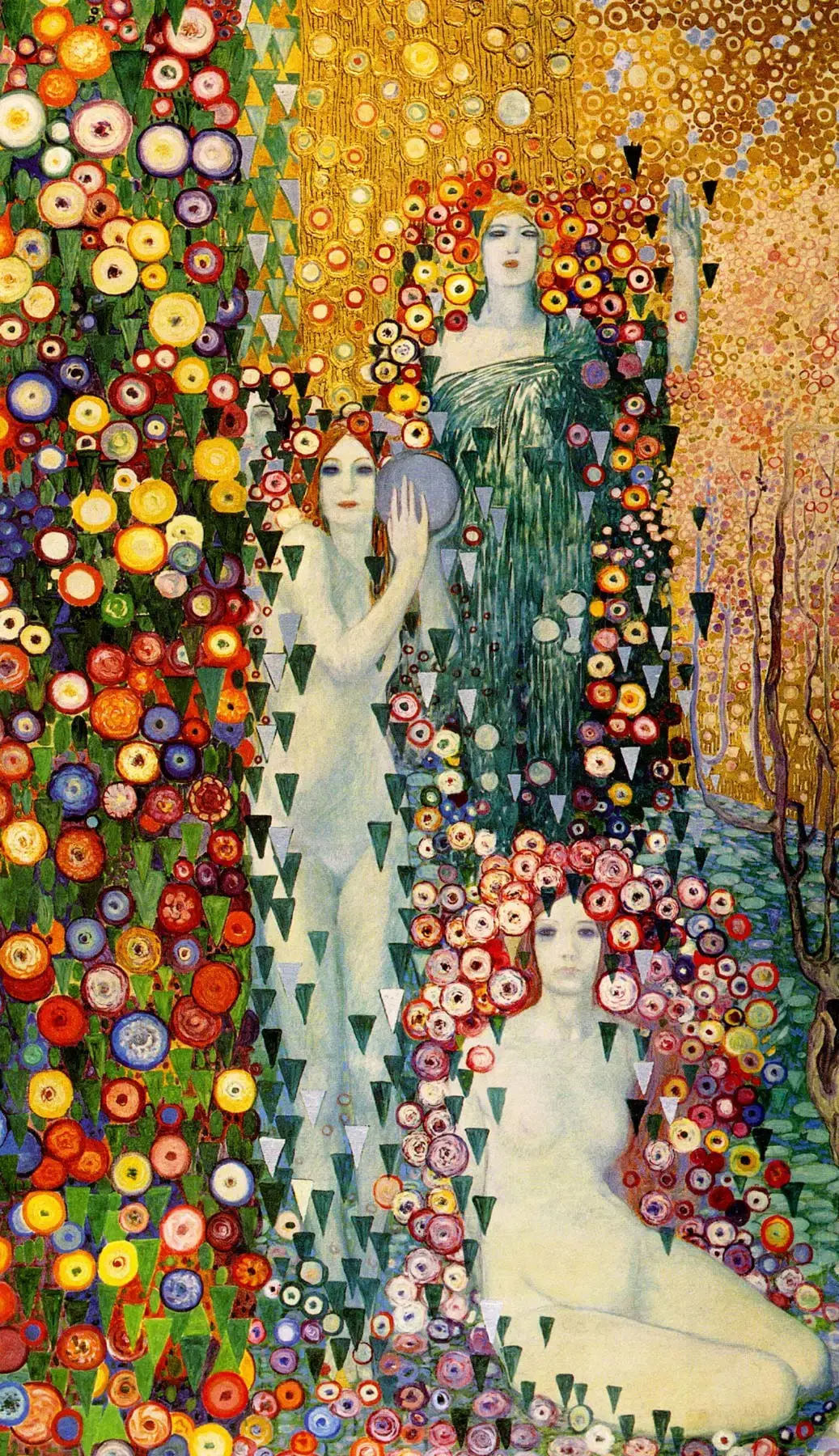
The life and animation of the meadows (from the cycle La Primavera), 1914 (La vita e l’animazione dei prati (dal ciclo La Primavera))
Mixed media
400 x 200 cm
private collection
Galileo Chini’s masterpiece The Life and Animation of the Meadows (La vita e l’animazione dei prati) is a monumental panel measuring four meters high by two meters wide. Created in 1914 as part of the Primavera cycle, it was intended for the central pavilion of the XI Venice Biennale—an essential moment in Italian modernism, when decorative symbolism began to give way to more expressive, international styles.
The panel, with its motif of cascading vegetation enveloping human figures, stands as one of Chini’s most immersive reinterpretations of Secessionist aesthetics. Its portrayal of meadows captures the essence of spring and the energy of nature, while the ornamental dissolution between flora and human form suggests a dreamlike unity—an escape from industrial modernity and a yearning for renewal, especially poignant on the eve of World War I.
Following his return from Thailand, where he had decorated the throne room of King Rama VI, Chini exhibited at the Second Exhibition of the Secessione Romana in 1914. This movement, inspired by the Viennese Secession, provided a platform for his emotionally resonant and decorative style. The Primavera cycle, including La vita e l’animazione dei prati, reflects this ethos—lush, symbolic, and psychologically rich.
The cycle was likely influenced by the sculpture of Arrigo Minerbi, whose stylized, elongated forms may have inspired Chini’s treatment of the human figure and its integration into natural rhythms. While clearly indebted to Gustav Klimt, Chini’s version of Secessionism is more fluid and organic, often blending Eastern decorative motifs with Western symbolism.
Galileo Chini (1873–1956), a leading figure in Italian Art Nouveau, was both a painter and ceramist. He played a significant role in shaping the visual identity of the Venice Biennale and exhibited internationally, including in London and Turin. During a distinct phase of his career, Chini’s work reflected strong Secessionist and Klimtian influences, resulting in ornamental, dreamlike compositions. Notable examples include La Primavera (1914) and L’amore (1919), with Klimt’s impact also evident in several of Chini’s murals and other paintings.


Leave a Reply