German Expressionism/Weimar: Georg Tappert
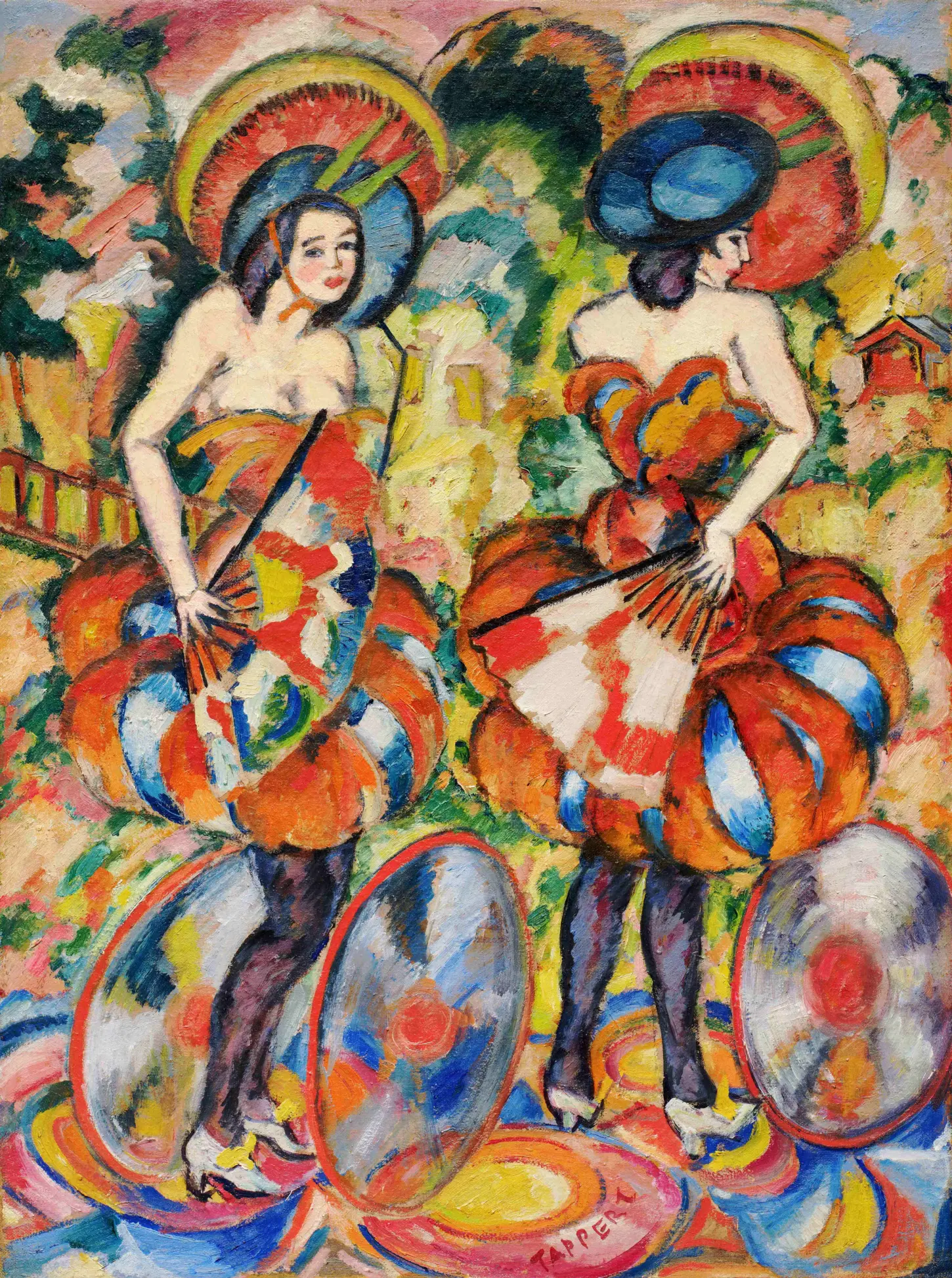
Two Dancers with Fans (Zwei Tänzerinnen mit Fächern), cc. 1913
Oil on canvas
71 x 53.3 cm (28 x 21 in.)
Auctioned at Sotheby’s in 2026 for est. £100,000 – 150,000 GBP
Georg Tappert painted Two Dancers with Fans in his studio in the Berlin district of Friedenau around 1913. Signed on the front and inscribed with his studio address on the reverse, the canvas depicts two stage performers holding decorative fans. During the final years of the German Empire, Tappert frequently visited Berlin’s variety theaters to sketch dancers outside the conventions of academic portraiture.
From Tailoring to the Berlin Avant-Garde
Born in Berlin in 1880, Tappert completed a formal tailoring apprenticeship between 1894 and 1896 before entering art school. That early trade training gave him direct technical familiarity with garment construction, textile patterns, and how heavy fabrics drape across a moving body. Max Liebermann recognized Tappert’s draftsmanship early on and urged him to enroll at the Academy of Fine Arts in Karlsruhe.
Upon returning to Berlin, Tappert established himself as a central organizer within the city’s modernist circle. In 1910, the jury of the Berlin Secession rejected twenty-seven Expressionist submissions from its annual exhibition. Tappert responded alongside Max Pechstein by founding the Neue Secession, serving as its primary exhibition organizer and opening its galleries to members of Die Brücke and Der Blaue Reiter.
Two Women in the Spotlight
At the time, Berlin’s variety theaters were flourishing. Audiences crowded into music halls, cabarets, and revue venues that helped make the city one of Europe’s most dynamic cultural centers on the eve of the First World War.
The two dancers dominate the canvas. Their enormous hats, brightly coloured dresses, and decorative fans immediately draw the eye. Rather than recording a specific performance, Tappert immerses the viewer in a world of colour, movement, and theatrical display.
The painting is filled with repeating circular forms. The hats echo the fans, the fans echo the swirling skirts, and those shapes continue across the stage-like setting. Reds, oranges, blues, yellows, and greens collide across the surface, creating an energy that feels almost musical.
Tappert was not interested in polished society portraiture. Instead, he captured the excitement of Berlin’s entertainment culture, where dancers, performers, and cabaret artists helped define the city’s modern identity. The thick paint and strong outlines heighten that atmosphere rather than describing it realistically.
Although the work is titled Two Dancers with Fans, the figures seem to become part of the spectacle itself. Costume, colour, movement, and performance merge into a single vibrant image that captures the spirit of pre-war Berlin.
This focus on popular entertainment continued throughout the decade, reappearing in later cabaret scenes such as Tingeltangel II from 1917.
Paired female figures remained a recurring motif throughout Tappert’s career. A decade later, in Two Girls on a Blue Sofa, the theatrical setting gives way to a quieter interior, but Tappert’s fascination with the presence of two closely connected figures remains. By 1930, in Lady with Feather Boa, the world of performance is still present, though filtered through the more introspective mood of a single sitter.
Teaching, Suppression, and Archival Recovery
Following the First World War, Tappert became an influential educator in Berlin. He taught at the State Art School and the private Reimann-Schule, where he instructed younger artists in decorative painting and fashion illustration. Among his students was Dodo, who would later become one of the most recognizable chroniclers of Berlin’s modern women during the final years of the Weimar Republic.
Tappert’s institutional career ended abruptly in 1933. National Socialist authorities dismissed him from his teaching post, prohibited him from exhibiting, and later confiscated his works under the Entartete Kunst campaign. Allied bombing raids on Berlin during the Second World War destroyed a substantial portion of the paintings stored in his studio, making surviving pre-1914 canvases relatively scarce.
The women portrayed in the painting remain unidentified, but Tappert was clearly less interested in individual likeness than in the energy of the modern stage. Their oversized hats, dramatic costumes, and brightly coloured fans transform them into symbols of a vibrant entertainment culture that flourished in Berlin before the First World War. More than a record of two performers, Two Dancers with Fans is a celebration of colour, spectacle, and the excitement of a city embracing modern life.
Leave a Reply