German Expressionism/Weimar: Georg Tappert
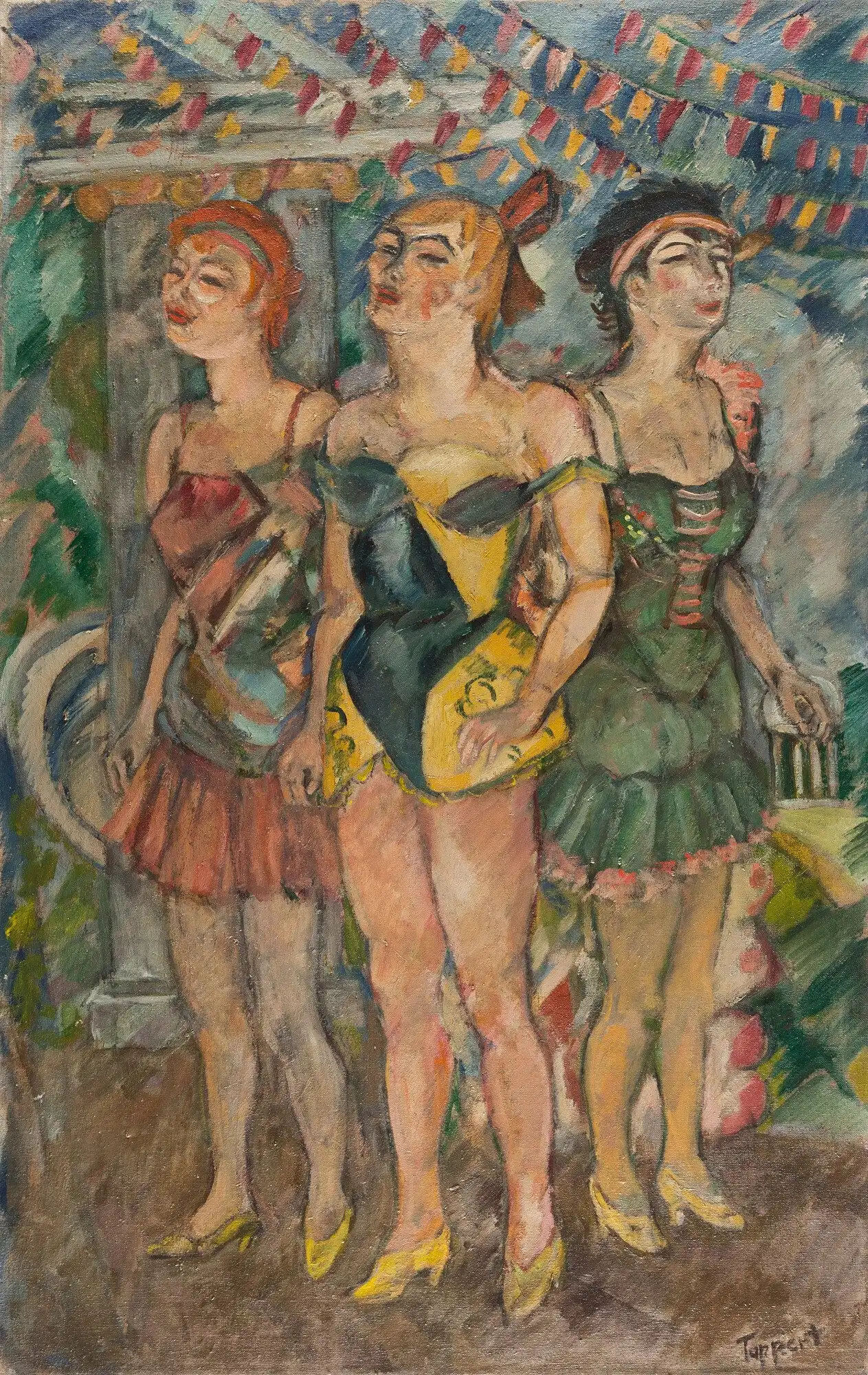
Tingeltangel II, 1917
Oil on canvas
84 × 54 cm
Painted in 1917
Auctioned at Karl & Faber, Munich, in 2017 for €125,000
In Tingeltangel II, painted in 1917, Georg Tappert captures the pulse of Berlin’s entertainment world at a moment when the city was transforming into a modern metropolis. Tappert was among the first German artists to embrace nightlife as a central subject, and here he turns his gaze to the variety stage, portraying three dancers shoulder to shoulder in a striking reinterpretation of the classical motif of the Three Graces. A redhead, a blonde, and a dark-haired woman stand together, their colorful costumes revealing legs in provocative display. With pointed mouths, half-closed eyes, and uplifted heads, they seem caught at the tonal peak of their song. Yet Tappert resists idealization: these are not mythic figures but real performers, each rendered with distinctive features and expressive individuality.
The title Tingeltangel refers to the low-budget variety shows and cabarets that flourished in Berlin’s entertainment districts — risqué, lively, and often considered scandalous. Tappert’s fascination lay not only with the glittering surface of this world but with the human stories beneath. His paintings uncover the loneliness and rootlessness of the city dweller, reflecting the ambivalence of modern freedom. Berlin, with its night cafés and cabarets, was considered a “den of sin” and became a myth of limitless pleasures. Tappert’s canvases reveal both the allure and the fragility of this world, exposing the performers as individuals whose lives were entwined with the rhythms of mass entertainment.
This canvas belongs to a group of cabaret paintings Tappert began in 1917, the first version of which was executed in a more sketch-like manner. The present work, more fully realized, stands as the definitive Tingeltangel II. His engagement with the demimonde stemmed from childhood encounters with Berlin’s underworld, and throughout the 1920s and 1930s he devoted himself to portraying women from exotic milieus — dancers, singers, and performers in cafés, night bars, and circuses.
As a member of the Berlin Secession and later associated with the Expressionist circle around Der Sturm, Tappert was a key figure in German modernism. His focus on nightlife and entertainment culture aligned him with contemporaries such as Ernst Ludwig Kirchner, though his approach was more documentary than stylized, offering a vivid record of Berlin’s restless nights. During the Nazi era, Tappert’s paintings were branded “degenerate art,” a stark reminder of how his depictions of urban modernity and social freedom clashed with the regime’s ideology.
This painting rightly emphasizes his central theme: the human being in transition to modern mass society, caught between anonymity and desire, freedom and isolation. In this painting, that theme finds vivid expression in the three dancers — at once mythic Graces and real women, embodying the ambivalence of Berlin’s modern carnival.
Leave a Reply