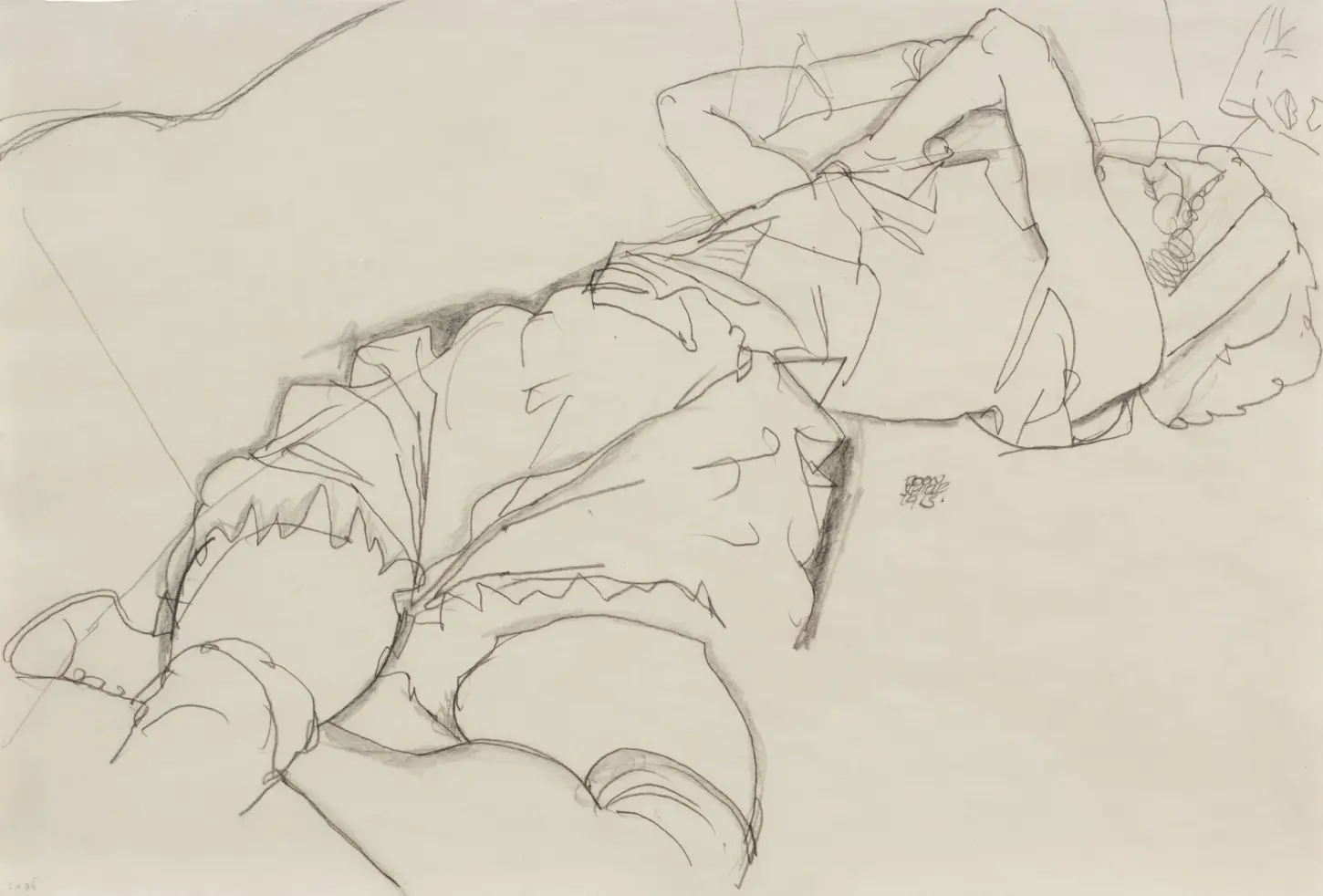
Egon Schiele:
Lovers (Self-Portrait with Model) Liebespaar (Selbstbildnis mit Modell), 1913
Pencil on paper
31.1 × 46.4 cm
To be auctioned at Sotheby’s, New York, November 19, 2026, Estimate: 400,000–600,000 USD
(Kallir d1449a)
Some Schiele drawings announce themselves immediately. Others spend decades quietly hidden away in private collections. Liebespaar (Selbstbildnis mit Modell) belongs to the latter group. Following its acquisition from Richard Nagy in 1996, the drawing disappeared into an American private collection and has rarely been seen since. Its reappearance at Sotheby’s on November 19 offers a welcome opportunity to take a fresh look at a work from one of the artist’s most fascinating years.
Hidden in Plain Sight
The provenance of the drawing links several prominent dealers before its move to the United States. The work passed through Galeria Galatea in Turin and later the collection of Fabio Rossi in London before entering the inventory of Richard Nagy, one of the leading specialists in Viennese Modernism.
The current owner acquired the sheet on May 24, 1996. While the drawing was included in Jane Kallir’s Egon Schiele: The Complete Works, Expanded Edition under number D1449a, it appeared only as a small catalogue illustration. Seeing the work in Sotheby’s recent photographs reveals details that were difficult to appreciate in earlier reproductions.
Lovers Without Embrace
If you only read the title, you might expect an embrace. Instead, Schiele presents something far less straightforward.
Your eye is immediately drawn to the reclining model. Her body stretches across almost the entire sheet, while Schiele places his own figure near the upper right edge. Between them lies a surprisingly large expanse of untouched paper. With only a handful of lines, Schiele creates a composition that feels both intimate and strangely distant.
Although the title identifies the pair as lovers, he never turns them into a conventional couple. The figures share the same sheet of paper, yet each remains distinctly separate. The tension comes not from dramatic gestures but from what is left unresolved.
An Early Echo of Wally
Readers interested in this drawing may also enjoy our earlier article on Lovers (Self-Portrait with Wally), 1915.
Although separated by only two years, the two works share certain themes. In the 1915 drawing, Wally and Schiele stand physically closer together, yet a sense of distance remains. Looking at this 1913 sheet, you can already see Schiele exploring a similar tension.
Leave a Reply