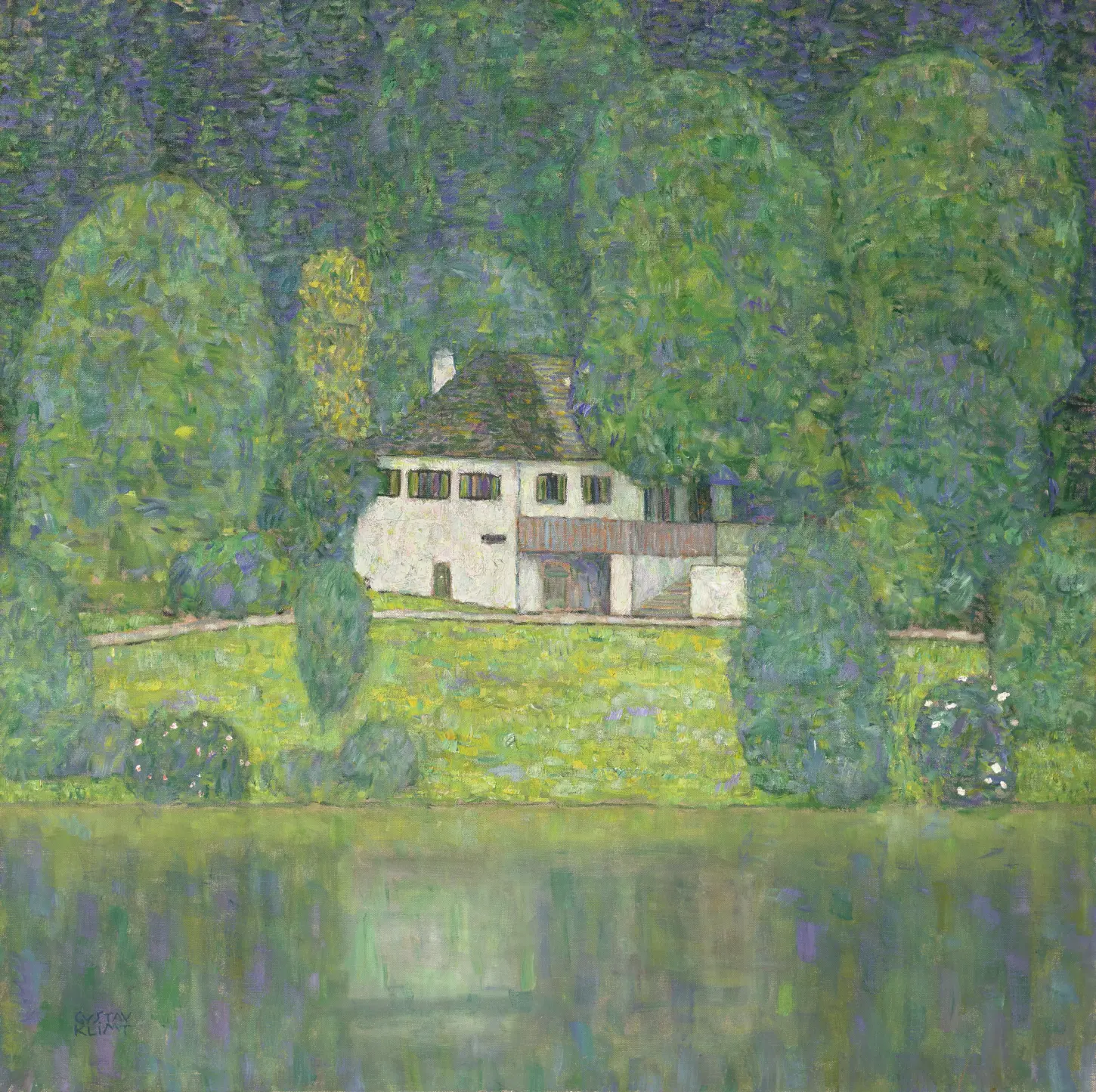
Gustav Klimt:
Litzlbergkeller, 1915-1916
Oil on canvas
110.5 x 110.5 cm (43 ½ x 43 ½ in.)
To be auctioned at Christie’s, New York, estimate USD 60,000,000 – USD 80,000,000
(Natter 213)
Every summer, Gustav Klimt escaped the demands of Vienna and retreated to the shores of the Attersee. There, between 1915 and 1916, he painted Litzlbergkeller, a view of a lakeside inn surrounded by trees and reflected in the still waters of the lake. Executed on his characteristic square canvas, the work belongs to the landscape paintings that occupied him during the final years of his life. On November 17, the painting will return to the auction market when it is offered at Christie’s in New York.
The Primavesi Connection
In May 1916, Klimt sold the painting directly to Otto and Eugenia Primavesi, among his most important patrons. Readers may recognise Eugenia Primavesi from the celebrated portrait Klimt painted a few years earlier, a work that captures one of the central figures in the cultural life of fin-de-siècle Vienna. While that portrait focuses on the patron herself, Litzlbergkeller offers a glimpse into another side of Klimt’s world: the landscapes he returned to year after year during his summers at the Attersee.
The painting later passed through several notable collections before reaching the present owner. Its appearance at Christie’s this November places it back in the spotlight, more than a century after Klimt painted the quiet lakeside scene.
A World Without Horizon
At first glance, the scene appears almost straightforward. A white inn stands on the opposite shore, surrounded by trees and reflected in the calm water below. Yet the longer one looks, the more the painting reveals itself. Small touches of green, blue and violet break up the surface and give the landscape a gentle sense of movement, as if light and foliage are constantly shifting before our eyes.
The building forms the heart of the composition, but it never completely takes over. Klimt gives equal attention to the trees, the gardens and their reflections in the lake. The water occupies the entire foreground, quietly doubling the scene and softening the transition between land and sky. This careful balance creates a sense of calm that feels as fresh today as it must have a century ago.
Klimt’s Late Vision of Nature
By this stage of his career, Klimt was spending much of his summer at the Attersee. Away from the portrait commissions that made him famous, the landscape offered different possibilities. In Litzlbergkeller, an ordinary lakeside building becomes something quietly memorable. The subject is simple, yet the combination of water, trees, colour and reflection gives the painting a lasting sense of harmony.
Painted just two years before Klimt’s death, the work shows how deeply the Attersee continued to inspire him. More than a record of a particular place, Litzlbergkeller captures the pleasure of looking carefully. The longer the eye wanders across the canvas, the more the painting rewards attention, revealing subtle shifts of colour and light within an apparently simple scene.
Leave a Reply