Egon Schiele:
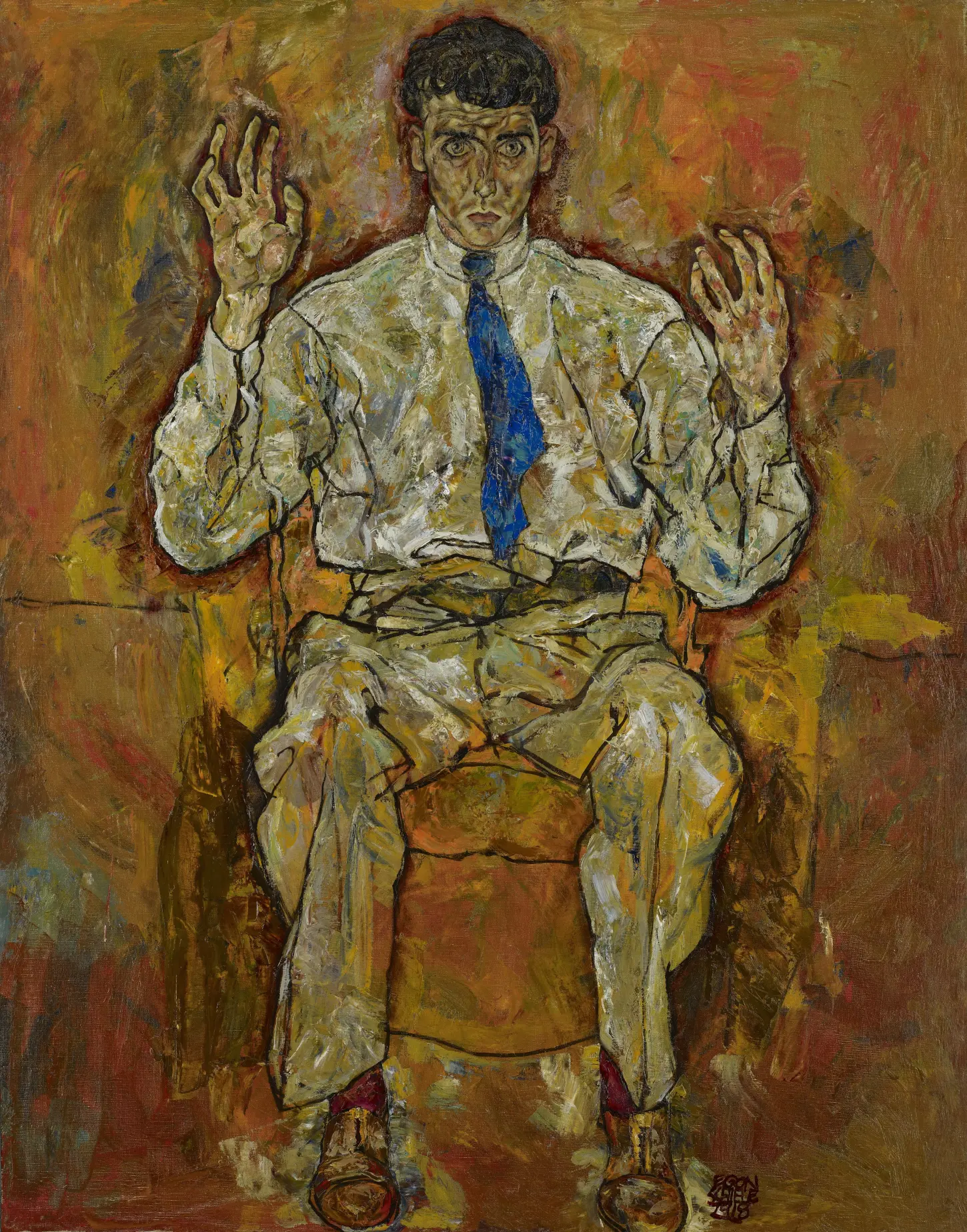
Portrait of the Painter Albert Paris Gütersloh (Bildnis des Malers Albert Paris Gütersloh), 1918
Oil on canvas
140.3 x 109.9 cm
©Minneapolis Institute of Art, Minneapolis, United States
(Kallir P322)
Egon Schiele completed this large portrait of Albert Paris Gütersloh during the same months he worked on the canvas of Robert Müller. The painting shows the same textural paint layers that defined his final year in Vienna. It captures a close artistic ally at the moment of creative inspiration, showing how Schiele handled anatomy and paint just before his death.
The Neukunstgruppe and Critical Alliances
Schiele and Gütersloh shared a long history within the Viennese avant-garde. Gütersloh worked as a painter, writer, actor, producer, and stage designer. In 1909, he joined Schiele as a founding member of the Neukunstgruppe, a group formed to protest the conservative academic art scene in Vienna. Gütersloh became a key defender of Schiele’s work, writing the first study of Schiele’s art in 1911.
Schiele deeply admired his friend’s extraordinary intellectual and artistic talents. In this painting, he sought to portray Gütersloh as a creative genius. With his body tense and eyes transfixed, Gütersloh appears with his hands raised in a gesture that signals both attraction and repulsion. This specific posture captures the sitter at the exact moment of artistic inspiration rather than in a passive studio pose.
The Secession Timeline and Material Textures
The physical layer of the canvas connects directly to the method seen in the portrait of Robert Müller. Schiele built up the background and the clothes of the sitter using thick, multidirectional strokes of ochre, yellow, and brown. He left the nervous outlines of his early career behind, treating the oil paint like a physical mass to create depth.
Archival records from the Vienna Secession reveal an unusual timeline for the creation of this piece. Schiele and Gütersloh met for regular sitting sessions between April and June 1918. However, records show that Schiele had already exhibited a portrait of Gütersloh in March 1918 during the 49th Secession exhibition. This indicates that Schiele continued to work on the canvas after its first public viewing, refining the thick paint layers around the head and hands long after the exhibition closed. This transition from radical formal experiments to a style with physical fullness was recently featured in Vienna at the Changing Times: Egon Schiele’s Last Years exhibition at the Leopold Museum.
A Finished Vision Next to a Fragment
When placed next to the portrait of Müller, the Gütersloh canvas shows what Schiele intended to achieve with his late style. While the portrait of Müller remained a fragment due to the trimming of the fabric, the Gütersloh painting fills the entire space of a large format. The dense network of colorful strokes surrounding the body shows how Schiele used paint to create an atmosphere around his sitters.
The painting entered the collection of the Minneapolis Institute of Art in 1954 as a gift from the P.D. McMillan Land Company. Together with the portrait of Müller, it documents the final direction of the Neukunstgruppe pioneers. The sudden end of Schiele’s life in October 1918 left this painterly style as his final statement in modern portraiture.
Leave a Reply