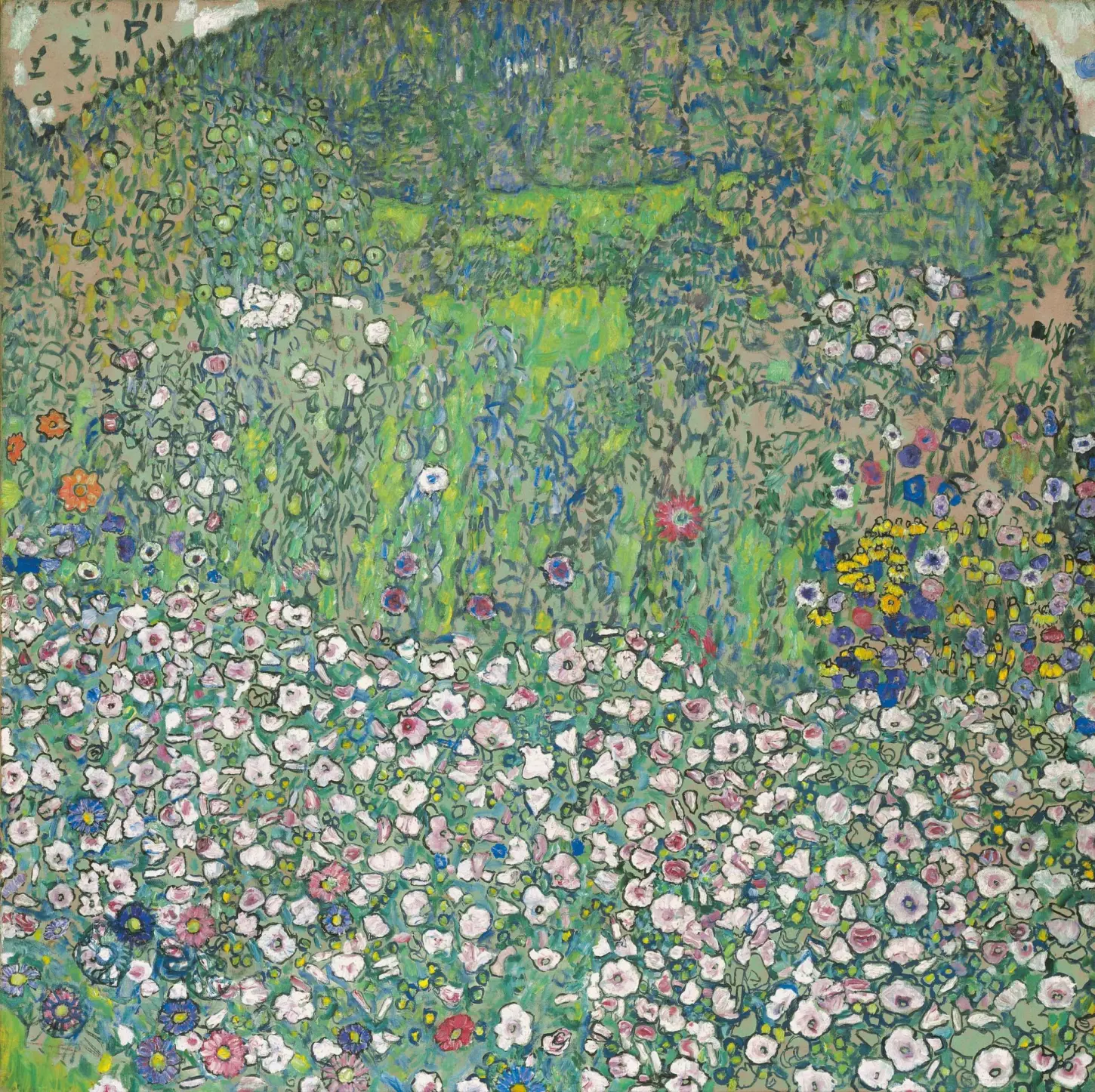
Gustav Klimt:
Garden Landscape with Rounded Mountaintop or Hilltop (Gartenlandschaft mit Bergkuppe (Pfarrgarten)), 1916
Oil on canvas
110 x 110 cm
©Kamm Collection Foundation, Kamm, Switzerland
(Natter no. 221)
Gustav Klimt completely transformed the Austrian countryside into a lush, breathing mosaic of raw paint for this summer landscape. Moving far beyond the ornate decorations of his earlier career, the artist packed every inch of the square canvas with an explosion of green foliage and pale blossoms. It captures Klimt inventing a new visual language just as the world around him began to fracture.
Compressed Perspectives and Schiele’s Postcards
The layout relies on simple geometry. A massive field of white petunias occupies the lower half of the view, creating a heavy pattern of pale shapes. The flowers push directly against thick green bushes and orchard trees. The smooth curve of the hill marks the upper boundary, leaving almost no room for a traditional sky.
Archival records from art historian Daniela Maier show that Klimt built this view during his summer stay in Weissenbach near the Attersee. He used a small cardboard viewfinder alongside a telescope to isolate this specific section of the countryside. This method stripped away the sense of depth. The resulting imagery belongs to a distinct group of late works where nature appears frozen and almost crystalline. By pulling distant trees and nearby flowers onto the exact same visual plane, Klimt introduced the early strands of abstract painting into his art. The dense, colorful mosaic of flowers closely mirrors the stylized floral drawings Egon Schiele created for Wiener Werkstätte postcards that were ultimately rejected by the artistic committee.
The Primavesi Provenance and the Question of Completion
While modern catalog records place this painting around 1916, historical documentation shows some uncertainty about the exact year Klimt finished the canvas. The painting also carries the alternative title Parsonage Garden, or Pfarrgarten in the original German documentation. This alternative title traces back directly to Eugenia Primavesi, an actress and prominent art patron who owned the painting during the early twentieth century.
In his catalog raisonné, Tobias Natter notes a specific detail regarding the physical state of the canvas. In several places, the raw support of the canvas shows through the paint layers to such an extent that some observers might take it as a sign that the picture is unfinished. However, because Klimt placed his formal signature on the work, most art historians generally conclude that the artist viewed the composition as a finished piece.
The sales and ownership records trace the safe preservation of the canvas through the subsequent decades. The painting eventually entered the collection of Fritz Kamm, a Swiss businessman who gathered key examples of Viennese modernism during the mid-century years. The Kamm Collection Foundation later took charge of the estate to keep the inventory together. The foundation placed the painting on a permanent loan to the Kunsthaus Zug in Switzerland, ensuring the late landscape remained accessible for modern archival research.
Habsburg Shadows and Unfulfilled Horizons
The year 1916 marked a dark and exhausting phase for both the Austro-Hungarian Empire and Klimt personally. The escalating destruction of World War I made travel increasingly difficult due to military transport restrictions and severe food shortages. Imperial Vienna was collapsing economically, and the joyful avant-garde culture of the Secession era had vanished.
This geopolitical crisis caused a major shift in Klimt’s artistic production. He abandoned the luxury materials of his iconic early phases, turning instead to heavy oil paint and more somber color values. While the public faced the realities of trench warfare, Klimt spent his isolation painting nature scenes. The choice to paint a quiet parish garden offered a temporary retreat from the collapse of the Habsburg world. This painting leaves us evaluating how his style might have evolved, particularly in his landscape paintings, had he lived beyond 1918. His sudden death from a stroke and the influenza epidemic left this final stylistic shift permanently unresolved.
Leave a Reply