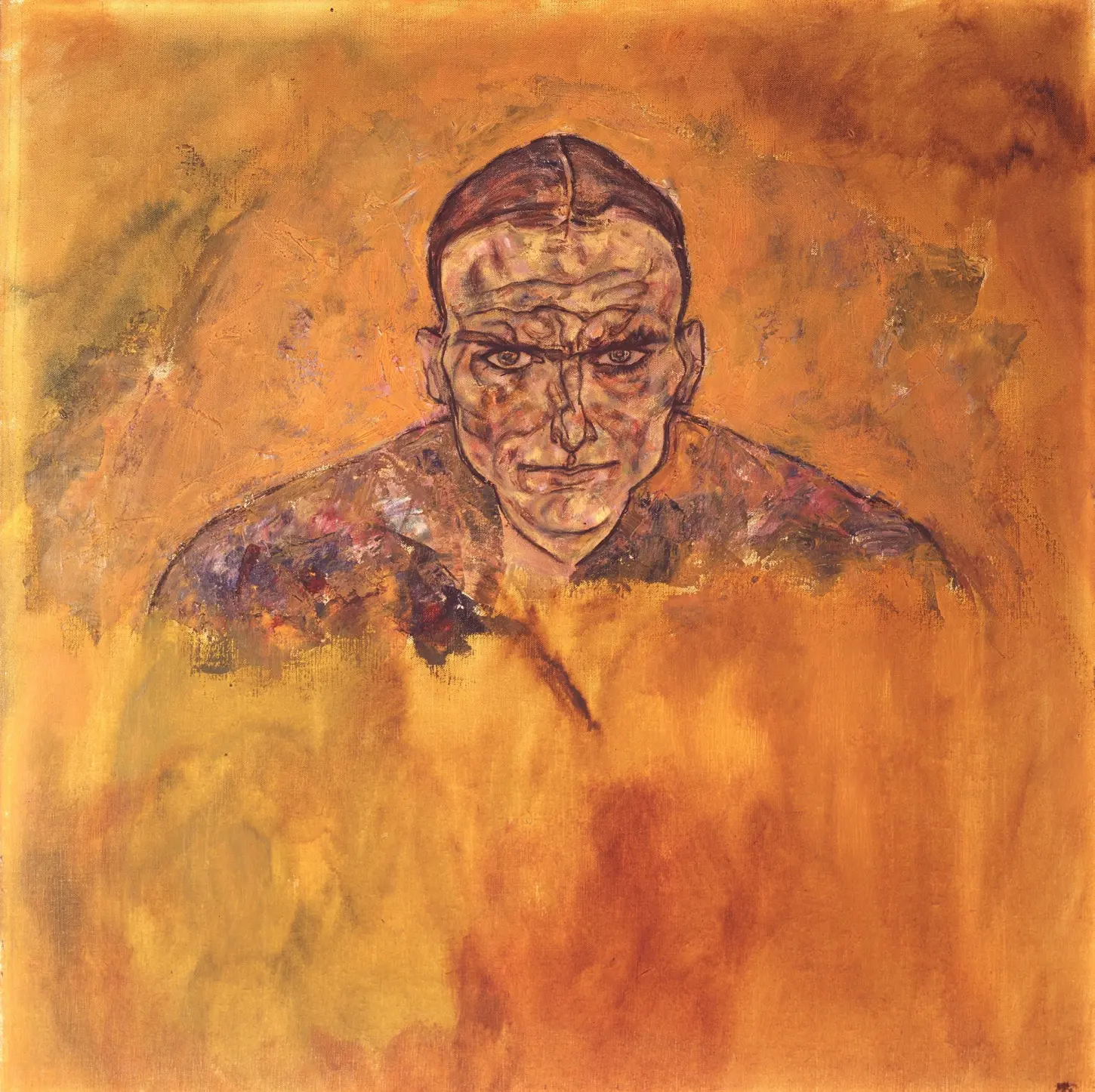
Egon Schiele:
Portrait of the Writer Robert Müller (Bildnis des Schriftstellers Robert Müller), 1918 (Unfinished)
Oil on canvas
71 x 71 cm
Private collection
(Kallir P321)
Egon Schiele painted this portrait of Robert Müller during the final months of his life. The unfinished canvas shows a shift in his style that was cut short at the peak of his career. It stands as a fragment of a new direction in his portraiture just before his studio work ended in October 1918.
The Literary Circle and the Trimmed Canvas
Schiele started working on this portrait of Robert Müller in January 1918. This year brought the artist his greatest professional success, highlighted by his breakthrough exhibition at the Vienna Secession. Archival research by Jane Kallir shows that Müller was a writer and the editor of the Austrian magazine Die Muskete. Schiele met Müller through their work for journals like Der Ruf and Der Anbruch. These magazines served as meeting grounds for the young Viennese avant-garde.
The physical painting itself tells a story of later changes. Schiele originally planned a vertical portrait that showed Müller from the bust up. He left areas of the lower canvas blank while he focused his energy on the face. After Schiele died, handlers cut away the unpainted lower part and the empty sides of the fabric. This left the painting in the square shape we see today. The crop forces our eyes onto the painted head isolated against the ochre background.
A New Way of Painting and the Gütersloh Connection
The paint on Müller’s face shows a change from the thin lines of Schiele’s earlier work. During his final months, he stepped away from the scratching outlines that made him famous before the war. Instead, he started using oil paint like a sculptor, building up layers to give the skin weight and volume.
We can see where this method was going when we compare this piece to his Portrait of Albert Paris Gütersloh. Schiele painted that canvas during the same months of 1918. The finished Gütersloh canvas shows the end result of this experiment, using paint strokes that make the subject seem to vibrate with life. In the portrait of Müller, we catch the beginning of that same transition. The paint marks around the collar show a broader way of painting the human body.
An Evolution Cut Short
The year 1918 was supposed to be Schiele’s breakthrough year. His success at the Secession exhibition finally brought him financial security and praise from critics. He rented extra studio spaces in Vienna to start working on large canvases. He wanted to use these formats to showcase his heavier style of painting. His letters from this time show an artist eager to push the boundaries of oil paint, moving away from drawing toward a deeper expression.
The arrival of the Spanish flu epidemic in the autumn of 1918 brought a halt to this creative journey. The disease swept through Vienna, claiming Schiele’s pregnant wife Edith (and his unborn child) before taking the twenty-eight-year-old artist himself a few days later on October 31, 1918. This unfinished portrait of Müller remains a document of that abrupt ending. It leaves us looking at an unfulfilled trajectory, wondering how Schiele and modern art would have evolved if one of its primary pioneers had been given more time.
Leave a Reply