
The Mysterious Blue Clouds of Emmy Obransky: Schiele’s Final Romance?
When we think of the women in Egon Schiele’s life, names like his sister Gerti, who served as his primary model from his early academic days until around 1910, instantly come to mind. Then there is Wally Neuzil, the devoted partner with whom he shared both love and hardship between 1911 and 1915, and whose presence defines much of his art of these years. And finally, Edith Harms, the middle-class woman he left Wally for and to whom he was married from 1915 until their tragic deaths—with her sister Adele always looming in the background. Yet, in the shadows of his very last weeks—just before the Spanish flu cut his life short on October 31, 1918—another name emerges from the archives: Emmy (Emilie) Obransky.
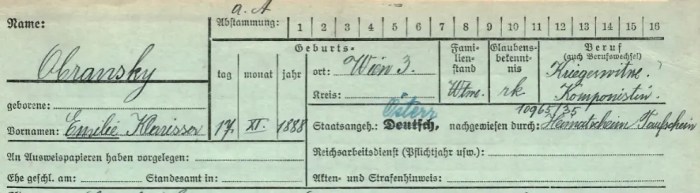
In different documents, her name appears in variations like Emmy, Emma, or Emmi. However, church and civil records reveal her true identity as Emilie (Klarissa) Obransky, born on November 17, 1888. While some may have dismissed her as an intrusive or obsessive admirer, could the digitization of personal documents by the Leopold Museum lead to a completely different view of Emmy? Her letters and postcards seem to tell a far different, deeply intimate story.
“Blue clouds in long strips”
In the autumn of 1918, Emmy, an opera singer, musician, and composer, was living on Vorgartenstraße in Vienna. From there, she was a frequent visitor to Schiele’s studio on Hietzinger Hauptstraße. On a handwritten postcard dated October 15, 1918, preserved in the Leopold Museum Online Collection (for a full transcription go: here), she sent a document that bridges the gap between text and sound. Rather than a standard message, the reverse side of this postcard reveals an original, hand-composed musical autograph. Obransky used purple ink to hand-draw musical staves, treble clefs, and specific note values directly across the card, weaving her poetic German verses into the notation as a sung melody or vocal aria. By a tragic twist of fate, this card was written just over two weeks before the Spanish flu would claim the lives of first Edith and her unborn child, and then Egon himself:


“Blue clouds in long strips
On a yellow background
It is the hour of dusk
The night comes prowling,
Again a day
Without you has fled – and –
Left something in my heart – the wound!
Greatly looking forward to seeing you
again soon! Yours, Emmy Obransky”
These are not the words of a distant fan. This looks more like a distant sound of the Vienna Secession, filled with drama, longing, and heavy melancholy.
Just a day earlier, on October 14, 1918, she had sent another urgent postcard to Schiele (for a ful transcription in German go: here), which provides essential context to their scheduling. In this document, she explicitly pleads with him not to be angry and requests to change their upcoming meeting from Thursday to Wednesday at 4 o’clock, explaining that she is strictly required to attend a performance at the Volksoper on Thursday evening.
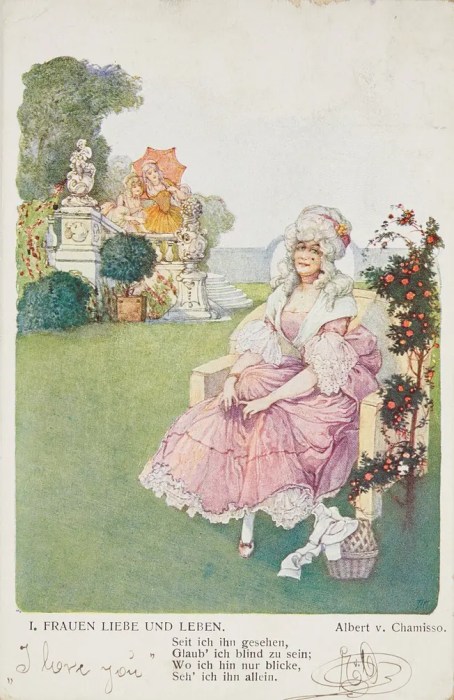
Most striking is the front of this postcard, which features lines from Adelbert von Chamisso’s poetry cycle Frauen-Liebe und Leben. Directly beneath these printed German verses, Obransky penned a remarkably bold and private declaration: “I love you”—written defiantly in English to a married artist.
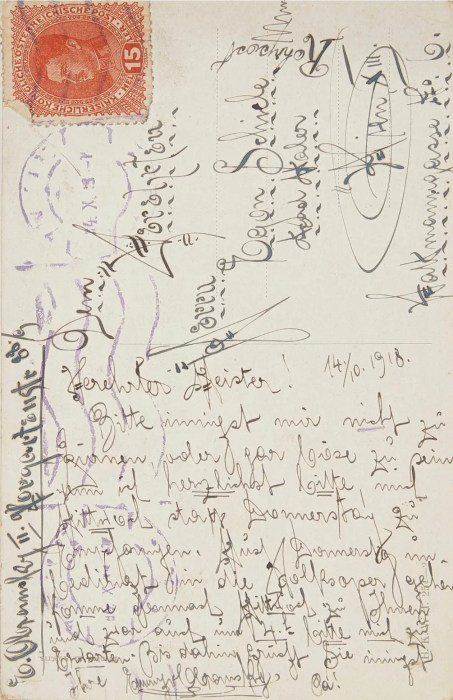
Crucially, this was not a one-sided fixation. Egon Schiele’s personal pocket notebook from October 1918 reveals a series of closely scheduled appointments explicitly marked with the shorthand “Obr.” on October 13, 16, 18, 22, and 24. These archival records prove they maintained regular, extended contact during these final weeks, with their last meeting occurring just four days before Edith’s death! It shows that Schiele was actively sketching Emmy in his studio up until the very end, directly matching her later claims about promised drawings.
Devoted Love or One-Sided Obsession?
The burning question remains: was this love mutual? Schiele was married to Edith, who was heavily pregnant at the time. To understand the sheer gravity of this situation, one must look at the immense drama unfolding behind the scenes. By early November 1918—barely after Emmy’s last appointments with Egon—Schiele’s mother, Marie Schiele, was trapped in an unimaginable nightmare. Within just four devastating days, the pandemic had wiped out first her daughter-in-law, and her unborn grandchild, and then finally her son. Marie was mourning for the loss of her family.
Archival records reveal that Emmy’s presence emerged immediately amidst this wreckage. According to a funeral registry list dated November 3, 1918—the exact day of Schiele’s burial—Emmy had flowers formally delivered to his grave. This material trace shows she was mourning him at the Ober Sankt Veit Friedhof from the very moment he was laid to rest.
Just one week later, on November 10, 1918, she sent her first letter to his grieving mother to declare her own place in Egon’s heart.


Her correspondence reveals (for a full transcription in German go: here) a deeply vulnerable and desperate reality. Facing “abject poverty” and fighting a “tough and bitter” struggle entirely on her own, Emmy reached out to the family Egon had left. In her shared grief, she compared her artistic journey to his, telling Marie: “I will either achieve what your son achieved or end my sad existence.”
She shared how Egon had wanted to support her goals because he loved her just as devoutly, and openly turned to Marie in the hope of receiving the artwork he had intended for her: “I would be very happy to own the drawings that Egon wanted to give me. Only you, Madam, can decide whether my heart’s wish will be granted.” Out of a sense of shame or pain over her current situation, she explained that she could not visit again until she had proven herself as a renowned composer. She signed off respectfully as the “miserable Emmy,” leaving a final word of encouragement for Egon’s sister, Melanie: “Dear Miss Mella, please follow your immortal brother’s example in pursuing the art of painting. Do!”
But Emmy’s plea was met with absolute silence. Marie Schiele never replied. Emmy’s need for connection and acknowledgment was so urgent that she followed up with a second letter seven days later, on November 17, 1918—the exact day of her own 30th birthday.

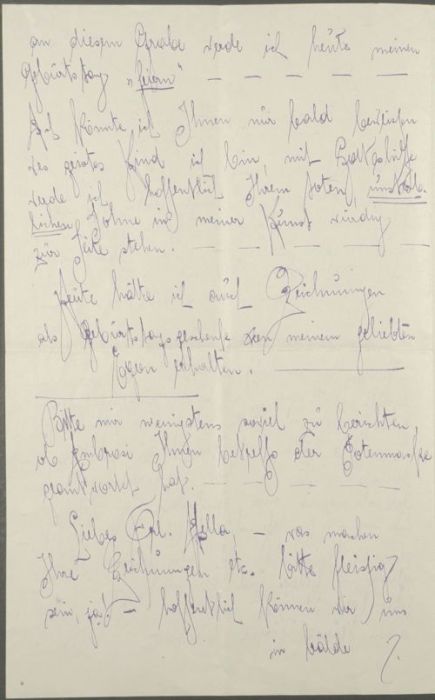
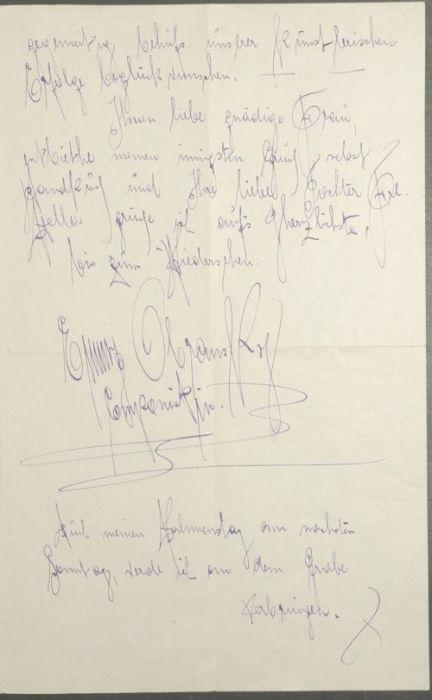
In this deeply painful second letter (for a full transcription in German go: here), a heartbroken Emmy expressed her immense sorrow that Marie did not even have a single word of comfort for her, before revealing just how close she and Schiele had been just a month prior:
“How differently did I imagine my birthday today four weeks ago—at that time your poor, unfortunate son was still alive and I had the inner happiness of possessing his love completely… back then I had to promise him to celebrate my birthday in his company… today I only have his grave… and at this grave I will ‘celebrate’ my birthday today.”
Emmy then dropped a vital clue: “Today I would also have received drawings as a birthday present from my beloved Egon.” This confirms that a specific portfolio of drawings had been set aside by Schiele specifically for her birthday. Desperate for any connection, she also asked Marie if the sculptor Gustinus Ambrosi had responded yet regarding Egon’s death mask, proving she was intimately informed about the immediate arrangements surrounding the artist’s passing. She signed this second letter proudly with her professional title: “Emmy Obransky, Componistin.”
Whether this was a genuine, hidden romance or a desperate, one-sided obsession, Emmy’s decision to approach a mother at this exact, devastating time gives us much to contemplate. Her focus was absolute, born out of a profound sense of loss by Egon’s death, but written to a mother who mourned the deaths of Egon, Edith and their unborn child.
The Mystery Endures… Or Does It?
Whether Schiele ever actually sketched Emmy is no longer the question—her letters confirm that these drawings existed and were intended for her birthday. The real mystery lies in their fate. Did Marie Schiele ever answer her pleas and hand them over? Or did Emmy’s desperate letters receive only silence? It raises the possibility that some of Schiele’s known, unidentified drawings from October 1918 might actually depict Emmy Obransky, sitting unrecognized in collections today. To this day, however, no verified portrait bearing her name appears in Jane Kallir’s official catalogue raisonné. After her final note stating she would also spend her upcoming name-day at the cemetery, Emmy Obransky seems to disappear from the documented Viennese art records of late 1918.
But is history that simple?
What if her path didn’t end in the ashes of 1918 Vienna? Of a Vienna slowly but not quickly recovering from an all-devastating war and a pandemic that raged even after World War I?
What if she was a widowed mother at the time, raising her two sons who grew up in the shadow of a changing Europe. But once she modelled for Schiele and Klimt… until her own life many decades later was abruptly cut short in the 1960s. What remains of her final resting place today?
Stay tuned for Part 2, where I hope to trace Emmy’s footsteps after 1918, untangle more of her life as a mother, and look into the whispers of a collection that might still be waiting to be found…


Leave a Reply