Die Brücke: Ernst Ludwig Kirchner
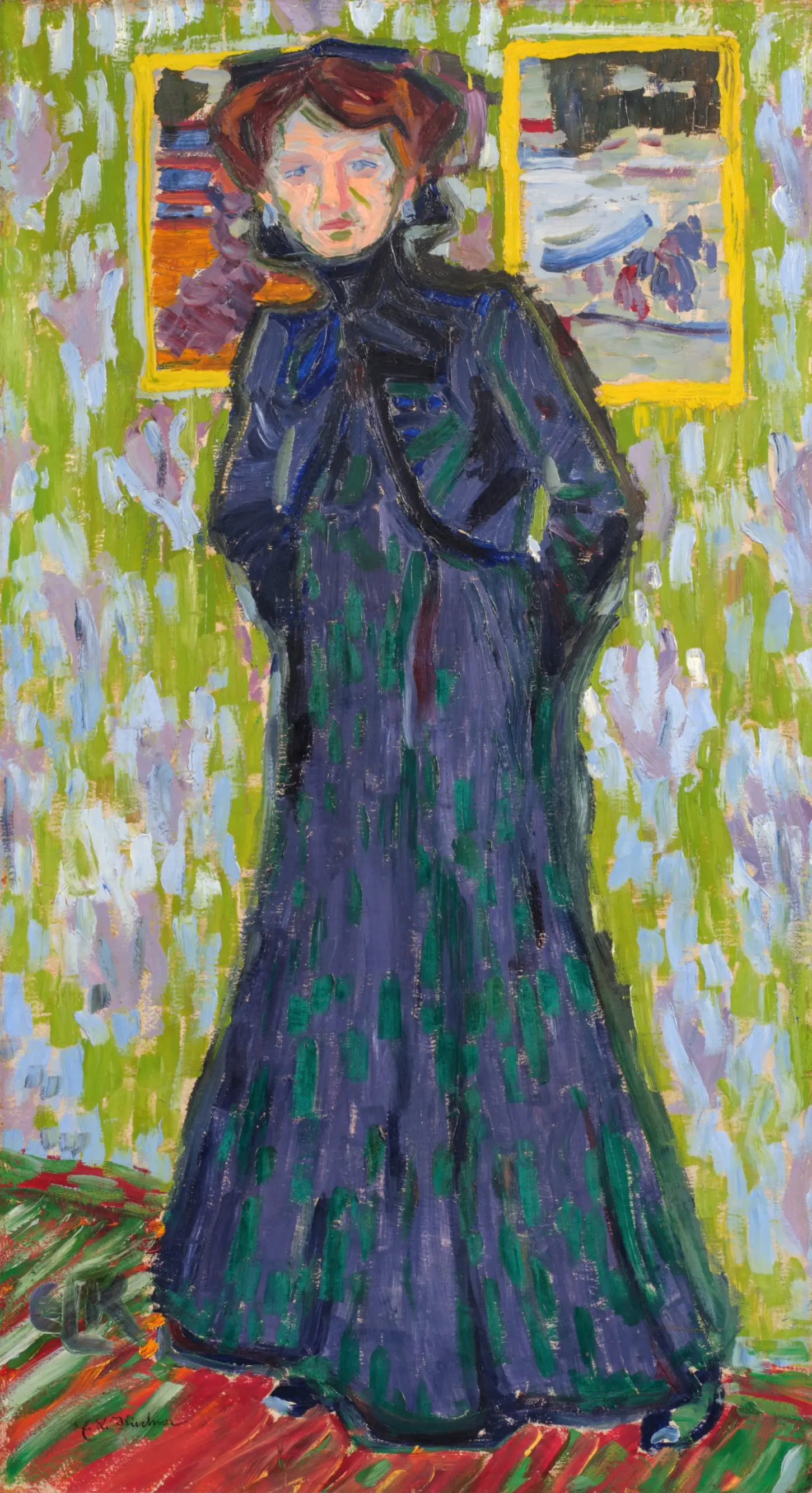
Doris Standing (Standing Lady in a Black Dress, Doris with a Ruff) (Doris Stehend. Stehende Dame in schwarzem Kleid, Doris mit Halskrause), 1906
Oil on board laid down on canvas
96.5 x 52.4 cm
Auctioned at Sotheby’s in 2026 for 845,400 USD
Ernst Ludwig Kirchner painted this full-length portrait of Doris Große, known as Dodo, in 1906, right during the energetic first months of the Die Brücke group in Dresden. The canvas captures a short, critical transition phase where Kirchner broke away from rigid academic studio rules to focus completely on raw human presence and emotional intensity. This rebellion mirrors the exact path his contemporaries Gustav Klimt and Egon Schiele took in Vienna, where walking away from traditional art schools became necessary to build a new visual language.
The Bohemian Muse and the Vienna Line
Dodo was working as a milliner and shop assistant when she met Kirchner, quickly becoming his lover, his live-in companion, and the core muse of his Dresden years. She actively chose a bohemian lifestyle, posing freely and helping the Die Brücke artists establish an unguarded way of living and looking at the human form.
While Kirchner later painted Dodo in heavily patterned studio spaces—often nude or wearing exotic accessories—this early portrait stands out for its quiet restraint and psychological focus. Her background as a hatmaker directly shapes the fashion choices in the painting. The high ruff collar and the tailored black dress create a sharp, vertical line. This framing closely links to how Klimt used high-society fashion in Vienna to isolate his models and transform the human figure into an elegant pillar.
The Van Gogh Encounter and Schiele’s Contour
The thick, heavy application of paint on this board is a direct result of Kirchner encountering the work of Vincent van Gogh in Dresden in late 1905. Van Gogh’s art proved to the young German painters that heightened colors and visible, assertive brushwork could communicate a model’s inner emotional state.
Kirchner dropped all conventional academic shading, leaving the background as a flat field of contrasting blue and yellow tones. He locked Dodo’s figure in place with a heavy, visible contour line. This technique of relying on a sharp, nervous outline to bring out the psychological weight of a subject is the exact same method Egon Schiele developed in his early drawings, using the pencil line as an emotional tool.
Studio History and the Thyssen Version
The painting stayed inside Kirchner’s studio collection for decades, eventually passing to Erna Kirchner in Davos. The Kunstmuseum Basel held the board on deposit until 1954, and the Latner family kept it privately from 1968 until its 2026 auction.
A closely related version of this specific composition, titled Doris with Ruff Collar, belongs to the permanent collection of the Museo Nacional Thyssen-Bornemisza in Madrid.
Leave a Reply