Egon Schiele:
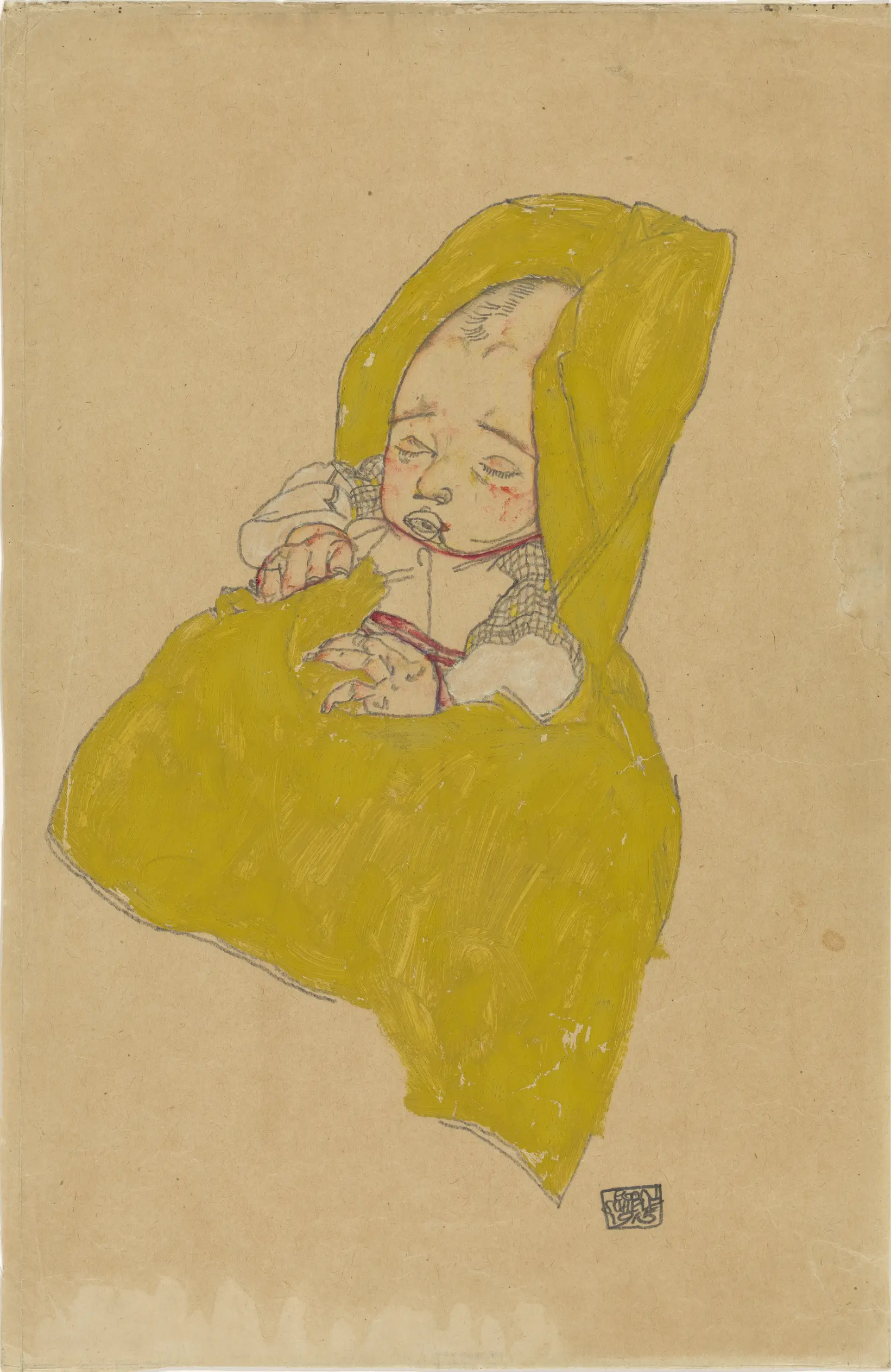
Infant in a Swaddling Blanket (Säugling im Wickelpolster), 1915
Gouache and pencil on packing paper
48.3 × 31.3 cm
©Wien Museum, Vienna
(Kallir d1702)
Egon Schiele created this mixed-media drawing in 1915 during the first year of the First World War. The composition shows an infant wrapped in a thick, vibrant yellow cushion. Schiele utilized loose sheets of coarse packaging paper for this work instead of traditional artist board. The rough texture and uneven edges of the brown paper remain visible beneath the opaque layers of gouache.
A Visual Record of Family History
The provenance of the artwork links directly to Schiele’s immediate family circle. The piece originally formed part of the Sammlung Peschka, a private collection held by the artist’s younger sister, Gertrude Peschka, and her husband, the painter Anton Peschka. Gertrude gave birth to their son, Anton Peschka Jr., on December 27, 1914. This exact birthdate establishes that Schiele executed the drawing shortly after the child’s birth. The newborn nephew became a central subject for the artist, who produced a sequence of intimate studies tracking the infant’s early development during the first months of 1915.
Material Choices in Wartime Vienna
Schiele relied on a stark visual contrast to isolate the figure on the page. He applied the yellow gouache paint thickly to block out the mass of the swaddling blanket. This bright color contrasts with the neutral tone of the surrounding packaging sheet. For the infant’s face and hands, Schiele shifted to fine pencil lines. He added small touches of red gouache to highlight the cheeks, lips, and closed eyelids of the sleeping child. The detailed rendering of the small fingers grasping the edge of the fabric demonstrates his linear precision.
The Evolution of the Baby Portrait
The work represents a shift in how Schiele approached depictions of early childhood. His infant drawings from around 1910 often presented newborns with emaciated, distorted limbs floating isolated within abstract pictorial voids. Those earlier expressionist studies emphasized physiological strain and existential isolation. In contrast, this 1915 portrait abandons that harshness for a sense of protective shelter. The infant rests securely within the heavy contours of the blanket, reflecting a more tender and intimate domestic focus.
The everyday reality of wartime shortages also shaped the production of this later piece. The reliance on common wrapping paper underlines the material constraints of the period. This specific drawing remained in the possession of the Peschka family for decades. Following the death of Anton Peschka Jr. in 1997, the entire family estate entered the permanent collection of the Wien Museum as a landmark historic bequest.
Leave a Reply