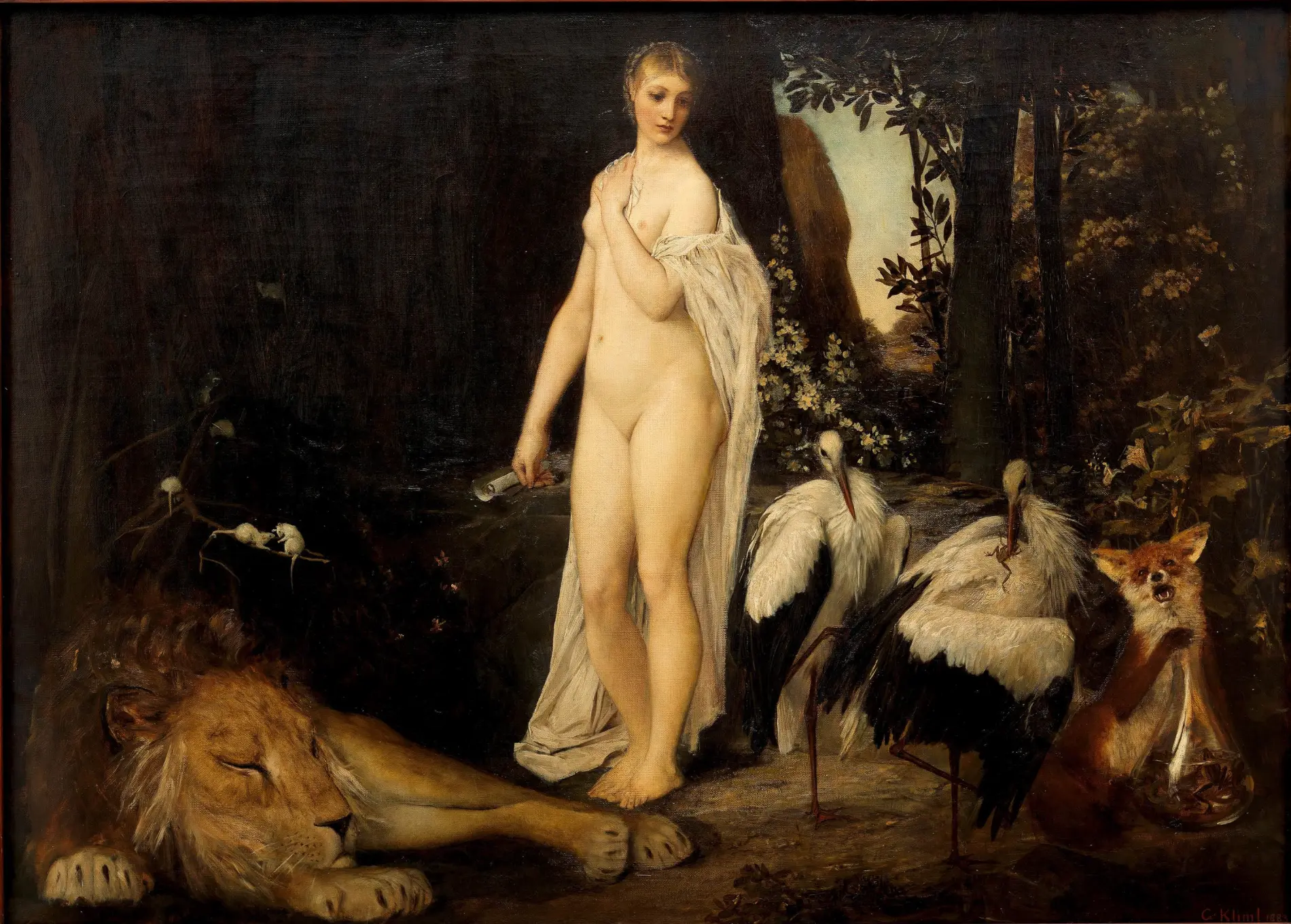
Gustav Klimt:
Allegory of Fable (Allegorie der Fabel), 1883
Oil on canvas
83.5 × 116 cm
©Wien Museum, Vienna
(Natter 26)
Gustav Klimt painted Allegory of Fable(Allegorie der Fabel) in 1883 during his final year at the Vienna Kunstgewerbeschule. He used a traditional perspective to build the scene with strict academic realism. The canvas documents his early student training before he changed his style.
A Commission for the Vienna Art Market
At this early point in his career, Klimt operated as a highly disciplined, academically trained painter reliant on commercial commissions. To establish a foothold in the competitive Viennese art market, he formed a joint studio named the Künstlercompagnie with his brother Ernst Klimt and their classmate Franz Matsch. The trio focused on building a collective reputation for high-quality decorative and historicist projects. The publishing house Gerlach & Schenk hired the young studio to supply material for a new design project titled Allegorien und Embleme. Curated by art historian Albert Ilg, this luxury print compendium provided classical templates for modern craftsmen. The publisher gathered prominent artistic talent from across Austria-Hungary and Germany for the project. The famous symbolist Max Klinger contributed work. Later editions included designs by Franz von Stuck, Koloman Moser, and Carl Otto Czeschka.
Tobias G. Natter’s catalogue raisonné notes that Klimt produced various mixed-media and pencil drawings for the publication. He also delivered three finished oil paintings as design mockups for the series. The other two paintings in the group were Allegory of Idyll and Love.
The Rare Inclusion of Animals
The composition functions as a direct illustration of traditional animal fables. A nude female figure stands inside a dark forest. She holds a rolled parchment to represent written wisdom and moral education. Klimt surrounded her with specific creatures from the historic texts of Aesop and Jean de La Fontaine. Two storks stand on the left. A single fox looks out from the undergrowth on the right. A large lion rests in the lower left corner, and three small rodents gather on a branch above his head.
While museum archives explicitly classify these three creatures as mice—pointing directly to Aesop’s famous moral tale of The Lion and the Mouse—their long tails and pointed snouts give them a distinctly rat-like appearance on the canvas.
This focus on animals is an exceptional choice in Klimt’s career. He loved animals in his private life and famously filled his studio with cats. However, he rarely included creatures in his paintings. His professional work remained dedicated to the human form and natural landscapes. Aside from later decorative or highly stylized symbolic elements—such as the black bird in The Tree of Life or the monster Typhon in the Beethoven Frieze—the only exceptions are his satirical painting Goldfish and two highly unusual, realistic depictions of cows inside a barn from around 1900. Seeing Klimt dedicate so much space to realistic animals remains a rare exception in his oeuvre.
Funding Artistic Independence
The print project paid the young members of the Künstlercompagnie very well. The publication successfully established the studio’s reputation among wealthy Viennese patrons. These professional connections quickly resulted in major municipal interior commissions for theaters and museums throughout the empire. This early commercial success gave Klimt the financial stability he needed to develop his own vision.
Leave a Reply