Women of Secession: Clara Siewert
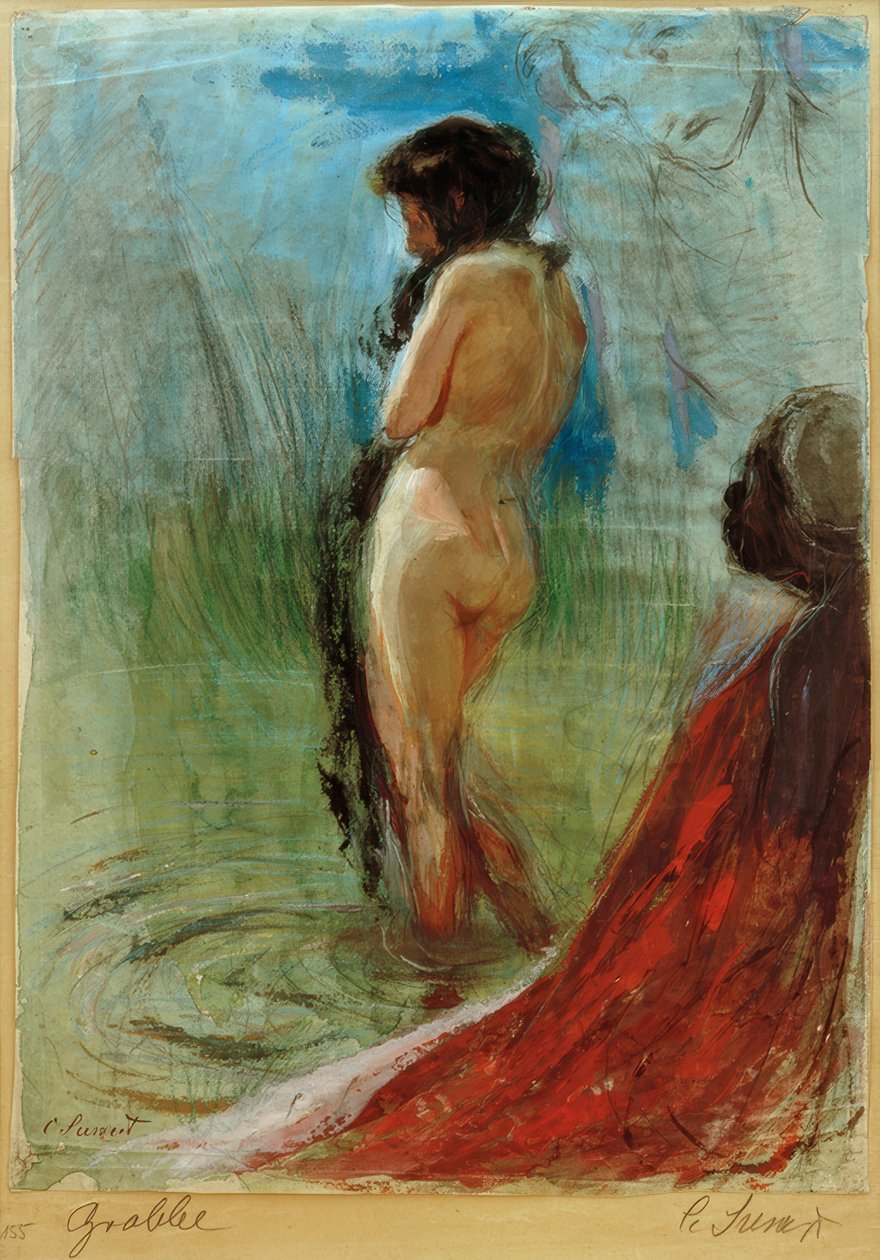
Donna Anna by the Water (Donna Anna am Wasser), 1925
Pencil, gouache, and colored chalk on paper
47 × 34 cm
©Kunstforum Ostdeutsche Galerie, Regensburg
Clara Siewert’s Donna Anna am Wasser stands as a significant yet historically marginalized example of early 20th-century German Symbolism. Produced during a period of deep professional isolation, this mixed-media work subverts traditional literary narratives by redirecting the visual focus toward psychological vulnerability. Through its distinct technical composition and complex archival history, the sheet offers a crucial window into the fragmented legacy of an artist working on the periphery of the Berlin avant-garde.
A Closer Look at the Materials
Donna Anna am Wasser shows how Clara Siewert built her artwork step by step. Instead of using just one material, she combined a pencil sketch with layers of fluid gouache paint and dry colored chalk. This mix of media was popular among artists in the Berlin Secession, who loved treating paper as a space for experiment. One might wonder how the compact scale of these mixed-media works alters our engagement with Symbolist themes, especially when compared to the massive oil canvases made by her contemporaries. Because chalk and paper fade quickly when exposed to daylight, the artwork requires strict care today. It is safely kept in the dark storage rooms of the Grafische Sammlung in Regensburg and is only brought out for short, special exhibitions.
Inside the 1925 Don Juan Series
This piece is part of a larger series of drawings from 1925. In this collection, Siewert looked at the famous story of Don Juan from a completely different angle. Instead of showing the dramatic adventures of the seducer, she focused entirely on the inner world of his victims. By placing Donna Anna as a bathing nude all alone in the shallow water, Siewert demonstrates her distinct skill in rendering the human body. Her approach to the female nude skips traditional academic idealization; instead, she uses the exposed, vulnerable form to build raw psychological tension against the heavy red cloak of the watching figure on the shore. On the lower edge of the sheet, raw workshop notes are visible, featuring the name “Grabbe” and “Le Tremplin”—archival clues that show how closely connected her work was to the theatrical and literary tragedies of her time. It makes us ask how a simple change in perspective can completely turn a traditional, centuries-old narrative upside down.
Lost Records and Broken History
Reconstructing Clara Siewert’s life story remains a difficult task for modern historians, often obscured by persistent biographical errors. Her early career was deeply connected to her close friend Käthe Kollwitz, with whom she had previously studied under Karl Stauffer-Bern. Although they both exhibited with the Berlin Secession, Siewert’s formal departure from the group in 1912 marked the beginning of an increasing professional and financial isolation. This separation proved difficult to reverse; even when Kollwitz used her position on the Secession jury in 1916 to champion Siewert’s submissions, her efforts were unsuccessful.
Decades later, a wartime bomb hit Siewert’s Berlin studio in 1943, destroying her letters, administration, and a massive part of her art collection. For decades, major reference texts—and even the title of the comprehensive 2008 collection monograph Clara Siewert: Zwischen Traum und Wirklichkeit 1862–1944—mistakenly claimed that Siewert had perished during the war in 1944. In reality, recent archival research has established that she survived the bombings and the war itself, dying in deep poverty in October 1945. This leaves us with an intriguing question: in what ways does the combination of mistaken biographical data and the severe loss of an artist’s studio archives distort our current understanding of her position in the early modern art market? Because of this fragmented history, the artwork does not have an official catalogue number today, forcing scholars to rely on surviving museum logs and the physical handwritten notes on the paper itself to piece her intellectual universe back together.
Leave a Reply