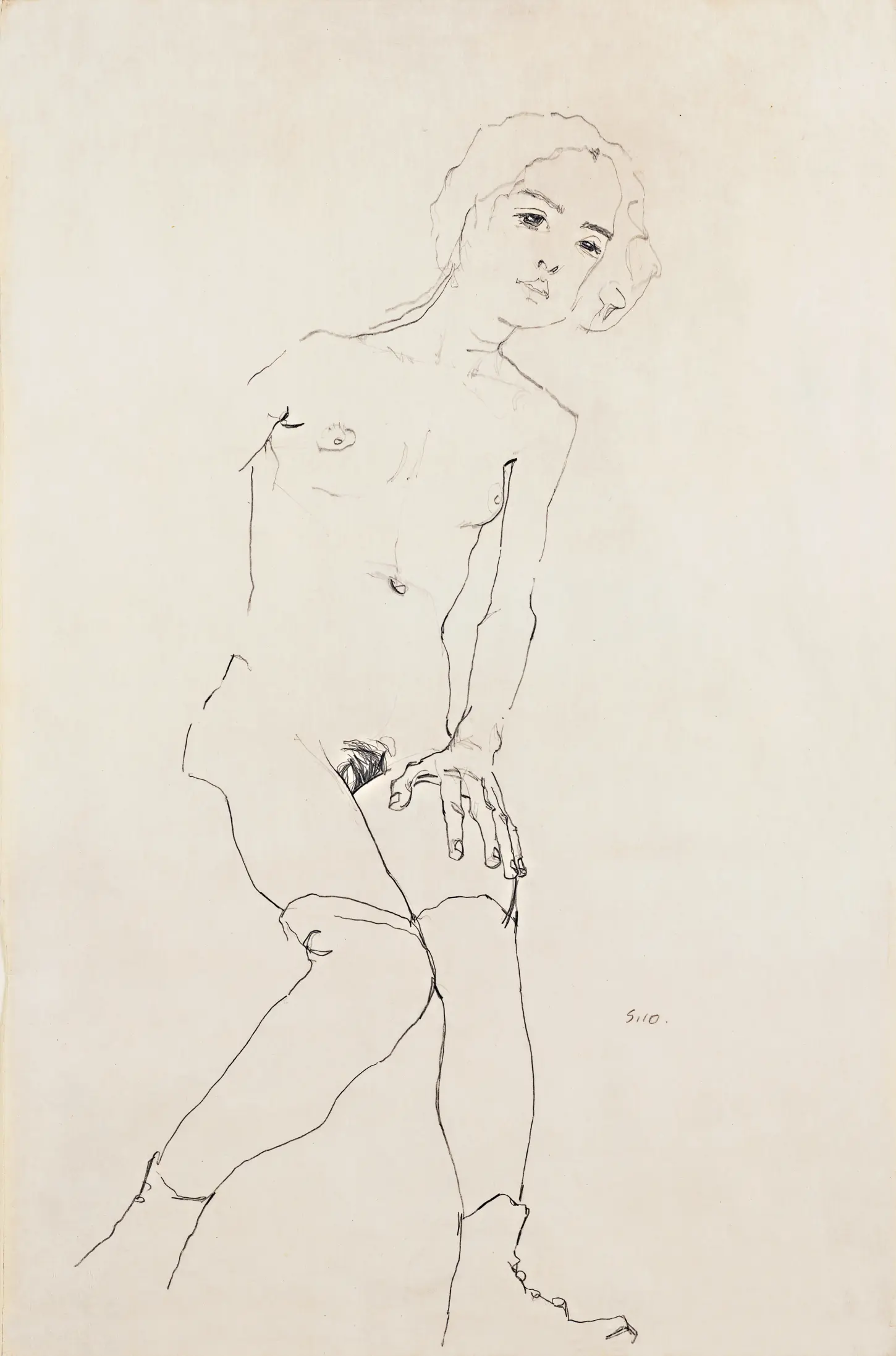
Egon Schiele:
Sitting Nude Girl with Stockings and Shoes (Sitzendes nacktes Mädchen mit Strümpfen und Schuhen), 1910
Pencil on paper
55 × 35.7 cm
©Leopold Museum, Vienna, Inv. 1390
(Kallir d576)
Egon Schiele’s early modern career is heavily anchored in the graphic documentation of the human form, utilizing strict linework to navigate the human anatomy. This specific 1910 sheet highlights how the artist transitioned away from early academic conventions into institutional expressionism. Through its clear provenance and formal isolation, the work provides a documented case study into early twentieth-century Viennese collecting habits.
A New Style and Focus
The year 1910 marked a definitive shift in Egon Schiele’s artistic trajectory, characterized by a departure from the ornamental constraints of the Vienna Secession toward a distinct expressionist linear style. This graphic work isolates the human figure against an unrendered background. The compositional focus rests entirely on the contours of the seated female subject, whose position is defined by the placement of her hands on her upper thighs. The structural geometry of the limbs is emphasized by the inclusion of footwear and stockings, which provide a material contrast to the exposed skin.
Confronting the Taboo: The Intended Shock of 1910
Looking at this drawing today triggers an immediate, visceral discomfort that cannot—and should not—be smoothed over. The subject is a young, underdeveloped girl, and her exposure under the intense gaze of the artist feels deeply unsettling to a modern audience. Yet, rather than avoiding this friction, analyzing the artwork requires understanding what Schiele was attempting to achieve in 1910 Vienna. He was deliberately dismantling the traditional, hypocritical “pretty” nudes taught at the Academy. Schiele did not seek to paint an idealized, safe classical muse; he wanted to capture the raw, psychological, and often uncomfortable material reality of the human body.
By stripping away the background and leaving nothing but the girl, her shoes, and her stockings, Schiele isolates the figure to force a direct, unfiltered confrontation. In 1910, this was a radical attempt to expose the tension between societal taboos and the absolute, raw truth of human existence. Vienna at the time was a pressure cooker of sexual repression and psychological awakening—heavily influenced by the emerging theories of Sigmund Freud. Schiele’s goal was to push the boundaries of what art was allowed to see and document, using the vulnerable and unpolished form to shock his contemporary viewers out of their bourgeois complacency.
Historical context, however, does not erase or invalidate contemporary repulsion. Even when providing the archival framework of 1910 Vienna, the friction between the image and the viewer remains fully intact. A deeper knowledge of Schiele’s artistic rebellion does not require the audience to abandon their current ethical boundaries or feel at peace with the depiction. The value of analyzing this work lies precisely in accepting that this lingering sense of unease cannot be resolved or explained away by history.
The Story of Who Owned It
Archival documentation provides a traceable ownership lineage for this specific sheet, illuminating the mid-twentieth-century market for Viennese modernist works. Prior to 1919, the drawing entered the private collection of Dr. Erwin von Graff in Vienna, where it remained until 1952. Ownership then transferred to Adele Licka in Feldkirch before being acquired by a public institution, the Neue Galerie am Landesmuseum Joanneum in Graz, in 1956. The work remained in the museum’s inventory for over two decades until 1979, when it was purchased by Dr. Rudolf Leopold. In 1994, the drawing was formally integrated into the permanent collection of the Leopold Museum-Privatstiftung.
The Unresolved Horizon
The ultimate test of Schiele’s work lies in its refusal to offer closure. By isolating the figure from any historical background, the artist stripped the image of any comforting context, leaving behind a raw study of exposure that refuses to settle neatly into history books. The historical record traces the ownership of this paper through doctors and public galleries, yet the physical tension on the sheet remains raw and unbothered by time. In the end, the drawing forces us to acknowledge that some historical artifacts cannot be entirely neutralized by explanation, leaving the modern viewer to carry the weight of an unresolved and permanent friction.
Leave a Reply